

‘A long journey’: Reconciliation happening day by day, one year after Pope’s apology
Advertisement
Read this article for free:
or
Already have an account? Log in here »
To continue reading, please subscribe:

Digital Subscription
One year of digital access for only $205*
- Enjoy unlimited reading on winnipegfreepress.com
- Read the E-Edition, our digital replica newspaper
- Access News Break, our award-winning app
- Play interactive puzzles
*First annual payment billed as $205.00 + GST for one year. This annual subscription will automatically renew at $233.00 + GST every 52 weeks (10% off the regular annual price of $259.35). Offer available to new and qualified returning subscribers only. Cancel any time.
To continue reading, please subscribe:
Add Free Press access to your Brandon Sun subscription for only an additional
$1 for the first 4 weeks*
- Enjoy unlimited reading on winnipegfreepress.com
- Read the E-Edition, our digital replica newspaper
- Access News Break, our award-winning app
- Play interactive puzzles
*Your next Brandon Sun subscription payment will increase by $1.00 and you will be charged $17.95 plus GST for four weeks. After four weeks, your payment will increase to $24.95 plus GST every four weeks.
Read unlimited articles for free today:
or
Already have an account? Log in here »
Hey there, time traveller!
This article was published 23/07/2023 (1180 days ago), so information in it may no longer be current.
Phil Fontaine has had a year to reflect since he heard an apology from the head of the Roman Catholic Church, something the former Assembly of First Nations national chief fought much of his life to have delivered on Canadian soil.
“Without an apology, it would be impossible to forgive,” Fontaine says after taking a few moments to contemplate the historic moment.
“And without forgiveness, there can’t be any true healing.”
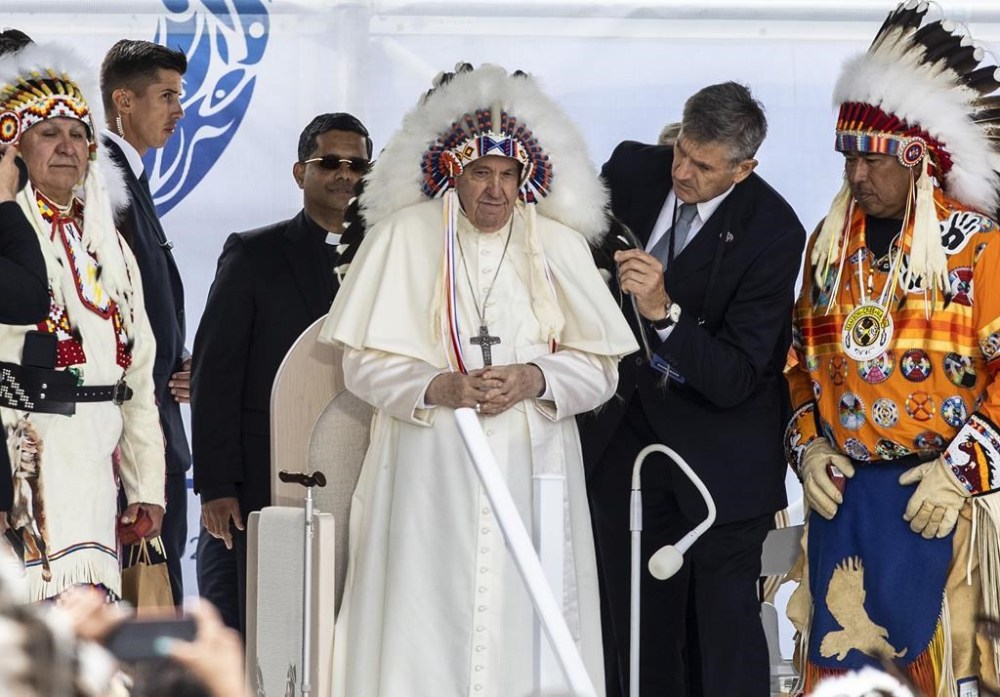
This week marks a year since Pope Francis arrived in Canada. He delivered his first apology in Maskwacis, a Cree community south of Edmonton, in front of thousands of survivors, leaders and community members.
Pope Francis said he was sorry for the Roman Catholic Church’s role in the cultural destruction and forced assimilation of Indigenous people, which culminated in residential schools.
The pontiff would deliver further apologies as he made stops in Alberta, Quebec and Nunavut during the six-day tour. On his flight back to Rome, in response to a journalist’s question, Francis said the abuses Indigenous Peoples faced amounted to genocide.
The apologies met a mixed response. Many Indigenous people said it was necessary, especially for residential school survivors, because it meant the head of the Catholic Church was finally recognizing harms were committed.
Some criticized Francis for not going far enough. Others thought Indigenous Peoples and organizations should disengage with the church altogether because they’d expended enough energy on it. Many called for actions, not words.
For Fontaine, the apology was extremely important.
The abuse inside the schools was long kept quiet nationally, but Fontaine broke the silence in 1990 when he spoke about his own experiences at the Fort Alexander Residential School in Manitoba.
An estimated 150,000 Indigenous children were forced to attend residential schools. More than 60 per cent of the schools were run by the Catholic Church.
Fontaine went to the Vatican in 2009 to meet Benedict, who was then the pontiff, and requested an apology. Benedict didn’t oblige.
Fontaine once again travelled to the Vatican with an Indigenous delegation last year. This time, Pope Francis delivered his first apology and committed to bring his atonement to Canada.
The apology may not have been accepted by everyone, but Francis’s plea for forgiveness is just part of the journey the church must take, Fontaine says.
“We received the apology each in our own way as individuals,” Fontaine says. “And we decide as individuals whether we want to forgive.”
Donald Bolen, the Archbishop of Regina, described the papal visit and apology as “life giving.” But when Pope Francis left, Bolen says, it became even more important for the church to take action.
“The real work of reconciliation happens day by day on the ground,” he says. “We are on a long journey of reconciliation.”
Pope Francis asked Canadian Catholics to commit to four things: to ensure history is told in a truthful way; to support Indigenous language, culture and traditions; to be an ally in the pursuit of justice; and to appreciate Indigenous wisdom to care for the land and environment.
“It’s easier to say it than to do it,” Bolen says.
Bolen reflected on what the church accomplished in the last 12 months. Many dioceses, including his own, have been working on providing access to archives. There has been financial support for culture camps and a national fundraising campaign by the Canadian Conference of Catholic Bishops.
Earlier this year, the Vatican formally denounced the 15th-century papal bulls used as the basis for the Doctrine of Discovery, which legitimized the seizure of Indigenous land.
Bolen says the hard daily task for churches on a local level will be building relationships with Indigenous people, listening deeply and learning to walk together to improve society.
But Bolen recognizes not every non-Indigenous Catholic has committed to reconciliation in the same way. Shifts in society happen over a long time, he says.
“People are at various places on the journey.”
Paul Gareau, an associate dean in Native Studies at the University of Alberta, says he feels “slightly confused and maybe a little hopeful” a year after the apology.
Gareau, who is Métis and from the Batoche Homeland in Saskatchewan, says he felt “gobsmacked” watching Francis participating in the Lac Ste. Anne pilgrimage wearing a red Métis sash around his neck.
In the historic relationship between Catholics and Indigenous people, Gareau says the church has acted “like bad relatives,” making betrayals even more devastating.
“The church has to take a reflection on how to be a good relative,” he says.
Francis said in his apology that the largest evil is indifference, so now it is up to the Catholic institution to work on dismantling 400 years of a colonial mindset toward Indigenous Peoples, Gareau says.
Gareau pointed to Vatican II, which significantly modernized church practices to meet cultural shifts in the early 1960s. Not everyone immediately embraced the structural changes, but it eventually revolutionized the church.

Francis has steered the ship in a direction toward reconciliation, Gareau says. But the church must now recognize Indigenous sovereignty, and that means engaging in diplomatic relations and returning land.
It also means changing the hearts and mind of Catholics and dismantling anti-Indigenous structural racism — work that cannot and should not rely on Indigenous people.
“There’s so much at stake.”
The Indian Residential Schools Resolution Health Support Program has a hotline to help residential school survivors and their relatives suffering from trauma invoked by the recall of past abuse. The number is 1-866-925-4419.
This report by The Canadian Press was first published July 23, 2023.
Related Articles
Pope voices willingness to return Indigenous loot, artifacts

Advertisement Advertise With Us
Advertisement Advertise With Us
The Free Press acknowledges the financial support it receives from members of the city’s faith community, which makes our coverage of religion possible.



