Moving memories Cross-country train journey retraces trek of 21,000 Mennonites who came to Canada a century ago, fleeing persecution in the Soviet Union
Read this article for free:
or
Already have an account? Log in here »
To continue reading, please subscribe:

Digital Subscription
One year of digital access for only $205*
- Enjoy unlimited reading on winnipegfreepress.com
- Read the E-Edition, our digital replica newspaper
- Access News Break, our award-winning app
- Play interactive puzzles
*First annual payment billed as $205.00 + GST for one year. This annual subscription will automatically renew at $233.00 + GST every 52 weeks (10% off the regular annual price of $259.35). Offer available to new and qualified returning subscribers only. Cancel any time.
To continue reading, please subscribe:
Add Free Press access to your Brandon Sun subscription for only an additional
$1 for the first 4 weeks*
- Enjoy unlimited reading on winnipegfreepress.com
- Read the E-Edition, our digital replica newspaper
- Access News Break, our award-winning app
- Play interactive puzzles
*Your next Brandon Sun subscription payment will increase by $1.00 and you will be charged $17.95 plus GST for four weeks. After four weeks, your payment will increase to $24.95 plus GST every four weeks.
Read unlimited articles for free today:
or
Already have an account? Log in here »
Hey there, time traveller!
This article was published 03/08/2023 (1163 days ago), so information in it may no longer be current.
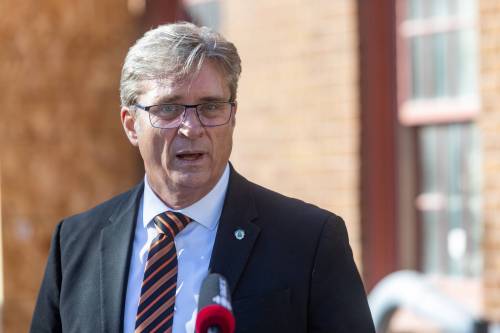
For Henry Schroeder, a retired teacher from Winnipeg, participating in Memories of Migration: Russlaender 100, a cross-country train tour from Quebec to B.C., was a way to remember his mother.
Schroeder’s mother, who was a child when her family made the journey to Canada from the Soviet Union, was one of 21,000 Mennonites to come to this country between 1923 and 1930.
“She was reluctant to talk about those times,” said Schroeder, speaking in the dome car of Via Rail’s passenger train, The Canadian.
JOHN LONGHURST / WINNIPEG FREE PRESS Henry Schroeder sits in the dome car of Via Rail’s train, The Canadian, as it rolls through the Rocky Mountains.
His mother and others fled the Soviet Union because of the persecution, violence, murder and rape they suffered at the hands of anarchists and bandits after the Bolshevik Revolution in the country.
One of the few memories his mother did share with him was about the time bandits came to her home village and massacred all the men — except her father. He was spared due to the fact he and the family were out of town at the time.
She also told him about a month spent hiding with her family to avoid being killed because they were Mennonites. They had to be absolutely quiet so as not to be discovered, Schroeder remembers her saying.
One time, she crept to the window to peek outside and saw a wagon loaded with dead bodies rolling down the street, perhaps to a mass grave.
“It was a time of starvation,” Schroeder said quietly.
“It was a time of starvation.”–Henry Schroeder
Schroeder was among the 126 people from Canada, the U.S., Japan and Ukraine who participated in the tour, which travelled by train from Quebec City to Vancouver from July 6-24 to replicate the journey of the Mennonites who came to this country from the Soviet Union a century ago.
The tour, which was divided into three legs — Quebec City to Kitchener, Toronto to Winnipeg and Winnipeg to Vancouver — was organized by the Mennonite Historical Society of Canada.
The project was the brainchild of Winnipegger Ingrid Riesen Moehlmann. She came up with the idea for recreating the railway journey after her dying father asked her to find a way to commemorate the anniversary.
“That story was an all-consuming passion for him,” she said. “He was afraid it was being lost and forgotten.”
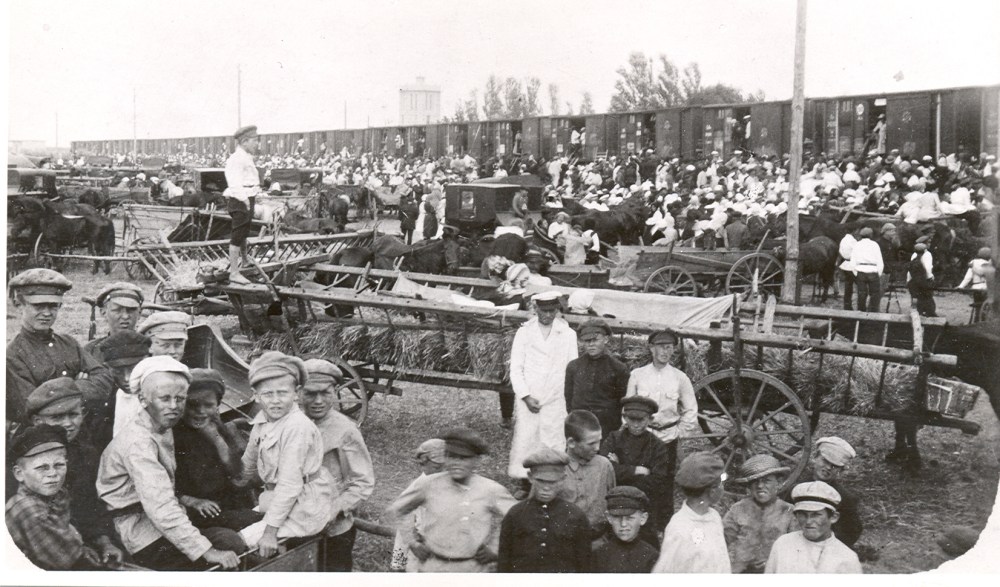
The tour made stops of historical interest in Grosse Île, Que., where the immigrants were checked for disease, Quebec City, where they boarded trains for the west, as well as in Montreal, Kitchener-Waterloo, Winnipeg, Saskatoon, Edmonton and Abbotsford, B.C.
In Montreal, tour members held an event to acknowledge the role of the Canadian Pacific Railway, which loaned the immigrants $1.7 million to come to Canada.
It was a win-win for both; the CPR wanted immigrants to settle in Western Canada while the Mennonites wanted to escape the Soviet Union for a new life.
Each Mennonite family who travelled to Canada on credit promised to pay back the debt, called a “Reiseschuld” in German. When the Great Depression hit, repayment was difficult for many, especially those who took up farming. But by 1946, the debt was entirely paid off.
“This is a tribute to the lives saved through this loan, the second chance given, the generations created, the contributions to Canadian society made,” said Aileen Friesen, co-director and associate professor with the Centre for Transnational Mennonite Studies at the University of Winnipeg.
“This is a tribute to the lives saved through this loan, the second chance given, the generations created, the contributions to Canadian society made.”–Aileen Friesen
In Waterloo, Winnipeg, Saskatoon and Abbotsford, the tour involved concerts that raised more than $90,000 for Mennonite Central Committee’s work in Ukraine, with refugees and with Indigenous people in Canada.
The Winnipeg concert, called a “sängerfest” in German, drew 2,300 to the Centennial Concert Hall to hear and join in with a choir of more than 200 singers.
Throughout the tour, participants were reminded that what was good news for the Mennonite immigrants — new homes in Canada — was often bad news for Indigenous people.
“That this was Indigenous land, that there were wrongs done to Indigenous people as well, is a part of this story that can’t be ignored,” Friesen said.
“We can tell our story about what took place in Ukraine and there is a lot of heartbreak and tears associated with that, but … we need to understand that we came to this land as settlers and therefore we are incorporated into this fabric of settler colonialism that is part of Canadian history. And we cannot get away from that. That is also part of our story and we need to acknowledge it.”
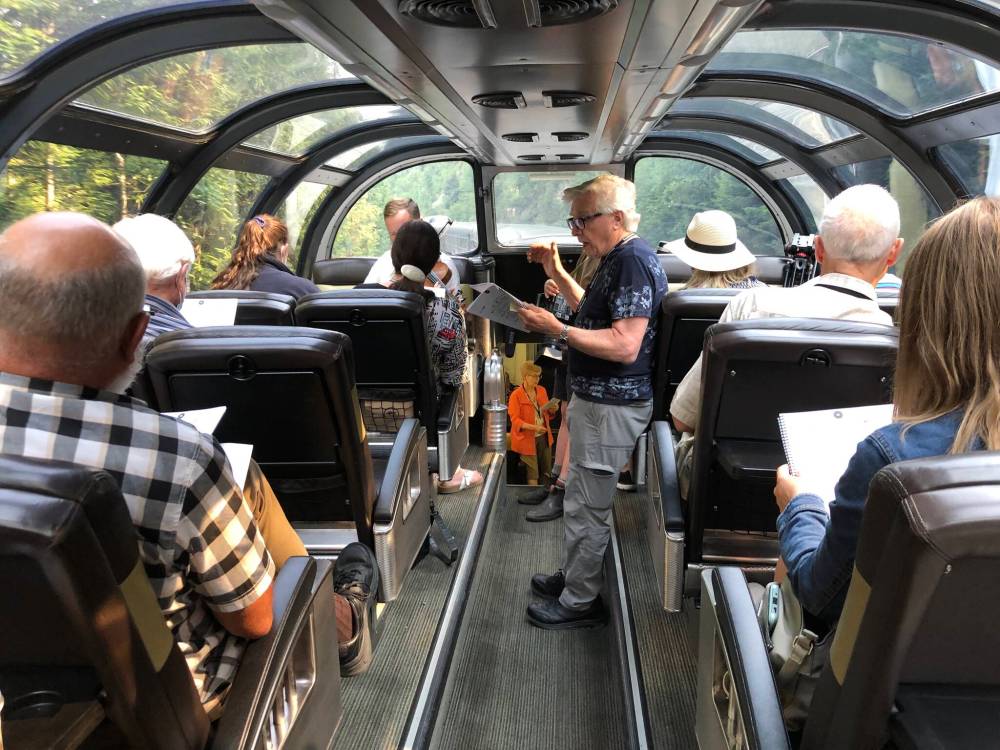
All along the way the group sang — in a chapel at Grosse Île, at a ceremony with Indigenous people in Abbotsford, B.C., and in impromptu gatherings on the train.
Rebekah Smoot-Enns was five months pregnant while taking part in the third leg of the tour, from Saskatoon to B.C. It helped her gain a new appreciation for her great-grandmother, who came to Canada in the 1920s.
“She was pregnant, too, during her journey,” said Smoot-Enns, originally from Winnipeg but now living in Waterloo, Ont.
“I thought of her when I was feeling tired and uncomfortable,” she said, adding that unlike her great-grandmother she was travelling by choice and with modern comforts.
The tour was also a way for Smoot-Enns to honour the women who made the trip.
“There’s not a lot written about the women who made that journey,” she said. “I don’t know enough about what it was like for them. I’m sure they were busy looking after children and thinking about the homes they had left behind.”

It also sparked a new interest in her family history, and the need to pass it on to her own child.
“Now that I am expecting, the next thing for me to think about is what to tell my child about their past, what stories I can share, what this experience was like when I was pregnant,” she said.
Also on the tour was Ruth Dyck, a teacher at Westgate Mennonite Collegiate in Winnipeg.
For her, it was a way to honour her parents and grandparents, who arrived in Canada in 1924.
“They were well-to-do in Ukraine, living on an estate,” she said, noting they arrived in Canada with little and made a new life here as farmers.
Those were hard times for her parents, Ruth remembers, but they made sure to pay their travel debt to the CPR — her father farmed and her mother worked as a maid and cook.
JOHN LONGHURST / WINNIPEG FREE PRESS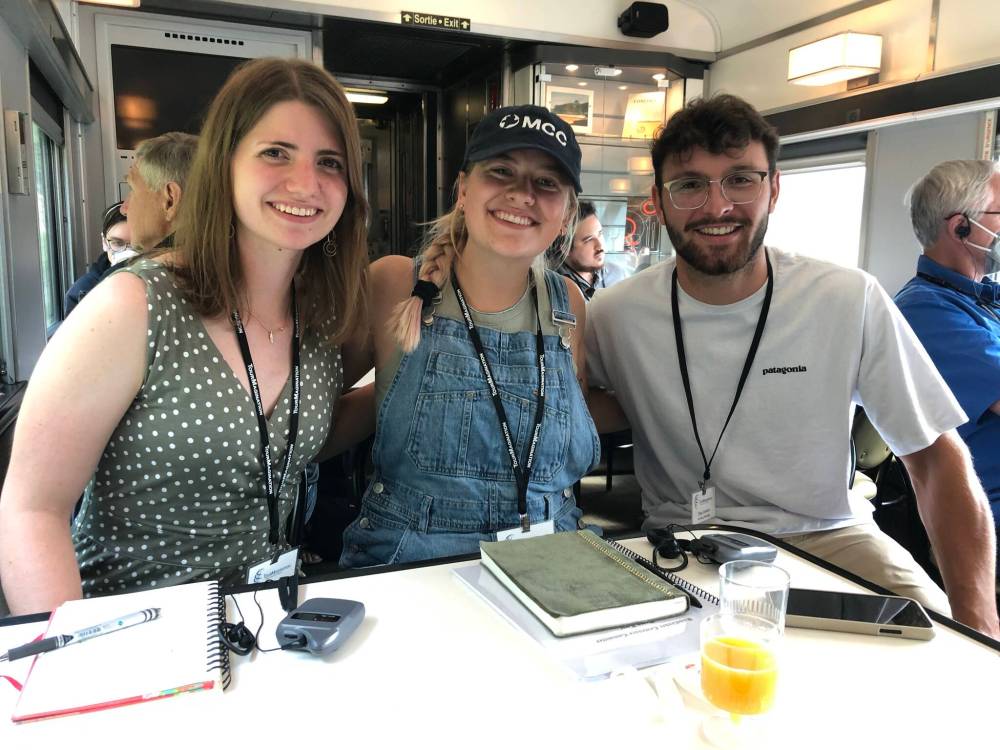
Kailey Schroeder, 22, of Steinbach, has no family connections to the 1923-30 migration; her Mennonite ancestors came to Canada in the 1870s. But she does have an interest in Mennonite history.
“I find it intriguing,” she said, noting that on the tour she has enjoyed hearing stories, often emotional, from participants.
“It’s a privilege to be able to hear those stories,” she said.
Theo Loewen of Winnipeg “really likes history,” so a tour like this was something he was eager to take part in.
Like Schroeder, he doesn’t have ties to the Russlaender migration; his grandparents came to Canada after the Second World War.
The tour gave him a sense of “how big Mennonite history is,” he said.
“It’s a privilege to be able to hear those stories.”–Kailey Schroeder
Alexander Funk of Winnipeg was on the tour with his grandfather.
The 15-year-old went along with Henry Funk, 77, of Hague, Sask., on the third leg of the tour.
Funk brought Alexander along to pass along the story of how his father came to Canada with his family in 1923.
Due to an eye condition, his father, then just 11 years old, was left behind in quarantine when his parents and siblings sailed away.
“He was left with a distant relative,” Funk said, adding his father thought he’d never see his family again.
Four months later he made the trip himself, being reunited with them in Saskatchewan. “He arrived in Rosthern on his 12th birthday,” Funk said.
His memories of the time before leaving the Soviet Union include feelings of fear as the family repeatedly had to flee for their safety. That included when bandits showed up at their house and demanded food and shelter. “They had no choice but to offer it,” Funk said.
His father also remembered playing on a haystack one day when a bandit came by and ordered him to get off it. “He pointed his gun at my father, saying he would shoot him if he didn’t obey,” he said.
“It was awesome spending time with him (grandfather) and learning my family’s story… It is making that history more real to me.”–Alexander Funk
His father always considered himself fortunate he escaped unharmed. But physical injury wasn’t the only kind of trauma they were exposed to, Funk said. “They were harmed in other ways. It’s naïve to say they weren’t when they were facing men with guns.”
For Alexander, hearing those stories is a reminder of the blessings he has received from growing up in Canada. “Those were horrible times,” he said of what his ancestors went through. “I’m glad Canada was willing to help them.”
Being on the tour has given him a chance to get closer to his grandfather. “It was awesome spending time with him and learning my family’s story,” he said. “It is making that history more real to me.”
As for Riesen Moehlmann, “the trip exceeded my expectations in every way,” she said, bringing together faith, community and reconciliation.
“The tour brought all three things to the forefront,” she said. “We had many religious experiences on our journey as we sang our hymns and participated in services across the country. We formed a very close community on each leg of our train trip across the country. Collectively we reached out to every Mennonite community in which we spent time, as we sought to understand our story through the prisms of theology, music, literature, art, culture and history.”
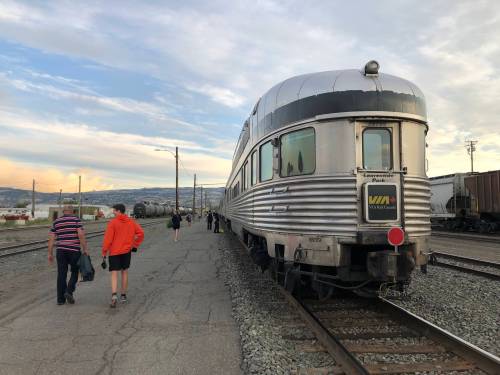
JOHN LONGHURST / WINNIPEG FREE PRESS The train pulls into Kamloops, B.C.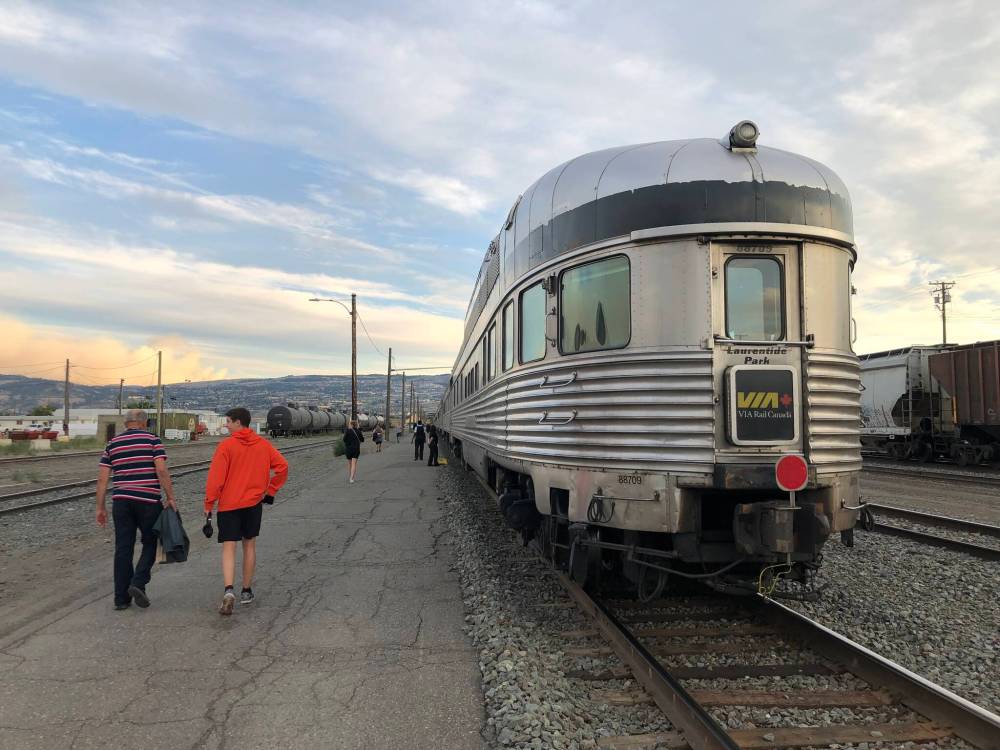
As the tour moved west, “we were ever more aware that the great exodus of Russian Mennonites to Canada in the 1920s had unwittingly displaced many of our Indigenous neighbours,” Moehlmann said. Taking time to acknowledge this, including the apology in Abbotsford, “was a fitting end to this magnificent and moving centennial celebration.”
“I am not sure I have ever felt so connected to Mennonites in my life as I did on this trip, which brought co-religionists of every stripe together in such a meaningful and positive way,” she said.
“My father would have been a witness to these events. I know he would have been delighted to have set in motion the wheels of a celebration that would bring a continent together in joyous and thoughtful remembrance. I have fulfilled a promise.”
faith@freepress.mb.ca
The Free Press is committed to covering faith in Manitoba through our Religion in the News project. This reporting continues because readers like you step forward to fund it.
Donate now to support our reporting on religion.
Your donation is eligible for a charitable tax receipt.
BECOME A FAITH JOURNALISM SUPPORTER

Our newsroom depends on a growing audience of readers to power our journalism. If you are not a paid reader, please consider becoming a subscriber.
Our newsroom depends on its audience of readers to power our journalism. Thank you for your support.
The Free Press acknowledges the financial support it receives from members of the city’s faith community, which makes our coverage of religion possible.