AP visual analysis: Rocket from Gaza appeared to go astray, likely caused deadly hospital explosion
Advertisement
Read this article for free:
or
Already have an account? Log in here »
To continue reading, please subscribe:

Digital Subscription
One year of digital access for only $205*
- Enjoy unlimited reading on winnipegfreepress.com
- Read the E-Edition, our digital replica newspaper
- Access News Break, our award-winning app
- Play interactive puzzles
*First annual payment billed as $205.00 + GST for one year. This annual subscription will automatically renew at $233.00 + GST every 52 weeks (10% off the regular annual price of $259.35). Offer available to new and qualified returning subscribers only. Cancel any time.
To continue reading, please subscribe:
Add Free Press access to your Brandon Sun subscription for only an additional
$1 for the first 4 weeks*
- Enjoy unlimited reading on winnipegfreepress.com
- Read the E-Edition, our digital replica newspaper
- Access News Break, our award-winning app
- Play interactive puzzles
*Your next Brandon Sun subscription payment will increase by $1.00 and you will be charged $17.95 plus GST for four weeks. After four weeks, your payment will increase to $24.95 plus GST every four weeks.
Read unlimited articles for free today:
or
Already have an account? Log in here »
Hey there, time traveller!
This article was published 20/10/2023 (1085 days ago), so information in it may no longer be current.
Shortly before 7 p.m. Tuesday, a volley of rockets lit up the darkened sky over Gaza. Videos analyzed by The Associated Press show one veering off course, breaking up in the air before crashing to the ground.
Seconds later, the videos show a large explosion in the same area – the site of Gaza’s al-Ahli Arab Hospital.
Who is to blame for the fiery explosion has set off intense debate and finger pointing between the Israeli government and Palestinian militants, further escalating tensions in their two week-long war.
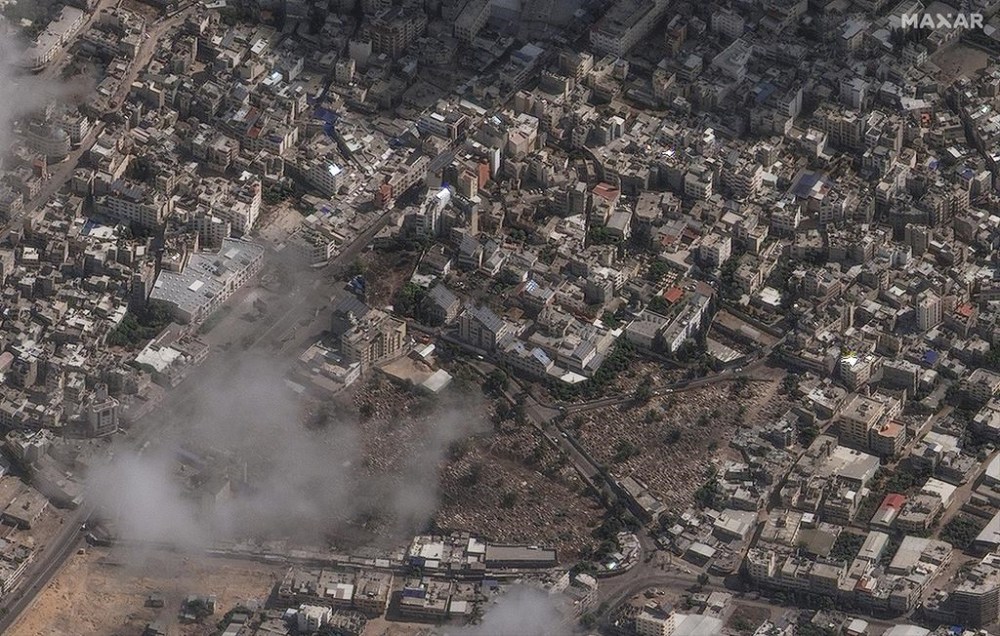
The AP analyzed more than a dozen videos from the moments before, during and after the hospital explosion, as well as satellite imagery and photos. AP’s analysis shows that the rocket that broke up in the air was fired from within Palestinian territory, and that the hospital explosion was most likely caused when part of that rocket crashed to the ground.
A lack of forensic evidence and the difficulty of gathering that material on the ground in the middle of a war means there is no definitive proof the break-up of the rocket and the explosion at the hospital are linked. However, AP’s assessment is supported by a range of experts with specialties in open-source intelligence, geolocation and rocketry.
“In the absence of additional evidence, the most likely scenario would be that it was a rocket launched from Gaza that failed mid-flight and that it mistakenly hit the hospital,” said Henry Schlottman, a former U.S. Army intelligence analyst and open-source intelligence expert.
WHAT AP FOUND
The AP reached its conclusion by reviewing more than a dozen videos from news broadcasts, security cameras and social media posts, and matching the locations to satellite imagery and photos from before the explosion.
A key video in the analysis came shortly before 7 p.m. local time, when the Arabic-language news channel Al Jazeera was airing live coverage of the Gaza City skyline. As a correspondent speaks, the camera pans to zoom in on a volley of rockets being fired from the ground nearby.
One of the rockets appears to veer from the others, away from the distant lights of Israel and back toward a darkened Gaza City, where electricity has largely been cut. The camera follows the light from the rocket’s tail as it arches in the sky upwards and toward the left. Suddenly, the rocket seems to fragment, and a piece appears to break off and fall. Another fragment shoots sharply up and to the right, blazing before it explodes in a fireworks-like flash, leaving a brief trail of sparks.
A small explosion is then seen on the ground in the distance, followed two seconds later by a much larger blast closer to the camera. The corner of the scroll at the bottom of the live broadcast reads 6:59 p.m. Gaza time.
Using maps and satellite imagery, the AP was able to match the view of the explosion from Al Jazeera’s live camera feed to an upper floor of the building that houses Al Jazeera’s Gaza bureau, which is less than a mile (1.5 kilometers) from the al-Ahli Arab Hospital. Using other buildings visible in the frame, the AP was able to confirm that the larger explosion seen at 6:59 p.m. was in the precise direction of the hospital.
A second video, taken from a camera inside Israel at the exact time as the Al Jazeera footage and obtained by the AP, shows a barrage of at least 17 rockets being launched from inside Gaza before a large explosion lights up the horizon on the Palestinian side of the border. The camera is on a building in Netiv Ha’asara, an Israeli community footsteps from the border wall, and faces southwest, confirming that the rocket launches and explosion were in the direction of Gaza City.
A third video by Israeli news station Channel 12 — taken from a camera on the upper floor of its building in Netivot, a town about 10 miles (16 kilometers) southeast of the hospital in Gaza City — also captured the barrage of rockets fired at 6:59 p.m.
Seen together, the three videos show multiple rockets were launched from inside Gaza before one appears to have come apart in midair about three seconds before the explosion at the al-Ahli Arab Hospital.
At 7 p.m., one minute after the explosion, Hamas’ military wing al-Qassam Brigades said in a post to its Telegram channel that it “fired at occupied Ashdod with a barrage of rockets.” Ashdod is an Israeli coastal city about 30 miles (50 kilometers) north of Gaza.
Minutes later, Islamic Jihad, a militant group that works with Hamas, also posted on Telegram that it had launched a rocket strike on Tel Aviv in response “to massacre against civilians.” Over the next hour, there were five more posts from the militant groups announcing rocket attacks against Israel.
Israel’s military has repeatedly said it did not strike the hospital and blamed an errant rocket fired from within Gaza by the Islamic Jihad. Israel’s assessment, backed by U.S. intelligence and President Joe Biden, also cited the lack of both a large crater and extensive structural damage that would be consistent with a bomb dropped by Israeli aircraft.
Hamas calls Israel’s narrative “fabricated” and accuses it of punishing the hospital for ignoring a warning to evacuate two days earlier, though it has not released any evidence to support its claims.
Hamas spokesperson Ghazi Hamad told the AP the group would welcome a United Nations investigation into the cause of the blast.
“Look at the stupid position that was taken by the President of the United States of America who said, ‘I agree with Israel’s version’ without any investigation,” Hamad said. “Unfortunately, the Western world is full of hypocrisy.”
WHAT THE EXPERTS SAY
AP ran its visual analysis by a half-dozen experts who all agreed the most likely scenario was a rocket from within Gaza that veered off and came apart seconds before the explosion.
Andrea Richardson, an expert in analyzing open-source intelligence who is a consultant with the Human Rights Center at the University of California, Berkeley, School of Law, said specific landmarks visible in the videos show where the rockets were launched.
“From the video evidence that I have seen, it’s very clear that the rockets came from within Gaza,” said Richardson, a human rights lawyer and experienced war crimes investigator who has worked in the Middle East. She added that the timing of the rocket launches, the explosion and the first reports that the hospital had been hit also seemed to confirm the sequence of events.
While still potentially lethal, the explosive warheads carried by the homemade rockets used by militants in Gaza can be relatively small when compared with the munitions used by large militaries like those of the U.S. and Russia. With Gaza’s borders and ports blockaded for the past decade, militants often build rockets and launch tubes inside Gaza using whatever parts and materials they can scavenge, including underground water pipes.
Justin Crump, a former British Army officer and intelligence consultant, said the failure rate of such homemade rockets is high.
“You can see obviously it fails in flight, it spins out and disintegrates, and the impacts on the ground follow that,” said Crump, CEO of Sibylline, a London-based strategic advisory firm. “The most likely explanation is this was a tragic accident.”
Such a scenario unfolded last year, when Islamic Jihad-fired rockets malfunctioned and killed at least a dozen Gaza residents. The AP reported at the time that live TV footage showed the militant rockets falling short in densely packed residential neighborhoods.
THREE-SECOND GAP
Some of the questions about who is to blame focus on the three-second gap between the rocket’s explosive breakup in the sky and the explosion on the ground at the al-Ahli Arab Hospital, and whether those two events are linked, especially because the videos analyzed by AP don’t appear to show a trace of light that follows the rocket to the ground.
Outside experts said it’s not possible to rule out with absolute certainty that the rocket launches occurring near the hospital and the timing of the explosion seconds later are just a coincidence. However, they also noted there is no evidence to support that scenario.
Richardson said the timestamps on videos showing the rocket launches from within Gaza, the midair malfunction and the large explosion striking the hospital below within seconds of each other provided a logical chain of events.
“An incredibly small timeframe,” she said.
Intelligence analyst Schlottman said the most likely scenario remains that it was a militant rocket that somehow had some kind of malfunction mid-flight and then landed on the hospital.
“We have video of when the explosion happened and the only rocket visible in that video was the one that kind of had that diverging trajectory,” he said. “We cannot possibly exclude other scenarios. … Just what we have right now points to that.”
EVIDENCE ON THE GROUND
About 10 minutes after the multiple rocket launches from Gaza were captured on video Tuesday night, posts began to appear on social media. The AP verified a video taken from a balcony near the hospital that shows the moment of impact, with the loud whizzing sound followed by a huge fireball and the clap of a massive explosion. AP could find no visual evidence to support speculation that the blast was triggered by a car bomb or other such device.
“Oh God! Oh God!” a man’s voice exclaims in Arabic. “The hospital!” says a second male voice.
Other videos and photos reviewed by AP appear to show the explosion in the hospital’s central parking lot and courtyard, where civilians had taken refuge after orders to evacuate the city. Some footage shows burning cars and more than a dozen dead bodies, including those of children.
AP photos taken the morning after Tuesday’s explosion showed no evidence of a large crater at the impact site that would be consistent with a bomb like those dropped by Israeli aircraft in other recent strikes. The hospital buildings surrounding the outdoor area at the center of the explosion were still standing and did not appear to suffer significant structural damage.
A small crater photographed in the hospital’s parking lot appeared to be about a meter across, suggesting a device with a much smaller explosive payload than a bomb. While Israel’s extensive arsenal includes smaller missiles that can be fired from helicopters and drones, there has been no public evidence of such missile strikes in the area around the al-Ahli Arab Hospital on Tuesday night.
David Shank, a retired U.S. Army colonel and expert on military rockets and missiles, said the large fireball captured on video at the hospital could potentially be explained by the fact the malfunctioning militant rocket impacted prematurely and was still full of propellant. That highly volatile fuel then ignited when it hit the ground, setting off a large explosion but leaving a relatively small crater.
After Hamas’ Oct. 7 surprise attack on southern Israel that killed 1,400, with another 200 people taken hostage, Israel’s military said it dropped more than 6,000 bombs on Gaza in the first week of the war alone, and Gaza officials say that campaign has so far resulted in more than 4,100 deaths.
Hamas spokesman Hamad said that Israeli officials had threatened al-Ahli Arab hospital and other medical facilities, and ordered their evacuation before the deadly blast. He argued that the missiles belonging to Hamas and the Islamic Jihad would not have been capable of inflicting such damage.
Al-Ahli Arab Hospital’s operators posted on its website that the facility’s cancer center was struck by Israel three days before the deadly blast, leaving a hole in an exterior wall and an unexploded artillery shell next to an ultrasound machine.
IRON DOME THEORY
Speculation has circulated on social media in the days since the explosion that the breakup of the rocket and the explosion on the ground was caused by Israel’s Iron Dome defense system, which is designed to shoot such rockets out of the sky.
Israel has said it does not use its Iron Dome system within Gaza, but to intercept and destroy rockets coming into Israeli airspace.
Experts also noted multiple videos from around the time of the hospital explosion showed no visible evidence of Iron Dome missiles being fired from Israel into the airspace over Gaza.
John Erath, the senior policy director at the Center for Arms Control and an expert on missile defense, said that while it might be technically possible for Iron Dome to intercept a missile over Gaza, it would be unlikely in this case because the projectile was very early in its flight path – still on the way up – and the system is designed to only intercept projectiles it determines are on a flight path to a populated part of Israel.
“I’m not saying that it’s impossible,” Erath said. “But based on my understanding of how the system works, it is unlikely.”
Added missile expert Shank: “They don’t engage a target unless it’s going to impact a critical asset such as a population area, maybe a power grid, maybe a military base.”

“It’s technically designed to take the best shot that gives it the highest probability of kill,” he said. “And for Iron Dome … that is not over Gaza.”
___
AP Global Investigative Reporter Michael Biesecker reported from Washington. Reporter Danica Kirka in London contributed.
__
Contact AP’s global investigative team at Investigative@ap.org.
The Free Press acknowledges the financial support it receives from members of the city’s faith community, which makes our coverage of religion possible.