The Vatican’s top expert on AI ethics is a friar from a medieval Franciscan order

Advertisement

Advertise with us

ROME (AP) — Friar Paolo Benanti wears the plain brown robes of his medieval Franciscan order as he pursues one of the most pressing issues in contemporary times: how to govern artificial intelligence so that it enriches — and doesn’t exploit — people’s lives.

Read this article for free:


or

Already have an account? Log in here »

To continue reading, please subscribe:

Subscribe and receive a limited-edition Free Press branded hat or tote.

Digital Subscription

One year of digital access for only $205*

  • Enjoy unlimited reading on winnipegfreepress.com
  • Read the E-Edition, our digital replica newspaper
  • Access News Break, our award-winning app
  • Play interactive puzzles

*First annual payment billed as $205.00 + GST for one year. This annual subscription will automatically renew at $233.00 + GST every 52 weeks (10% off the regular annual price of $259.35). Offer available to new and qualified returning subscribers only. Cancel any time.

To continue reading, please subscribe:

Add Free Press access to your Brandon Sun subscription for only an additional

$1 for the first 4 weeks*

  • Enjoy unlimited reading on winnipegfreepress.com
  • Read the E-Edition, our digital replica newspaper
  • Access News Break, our award-winning app
  • Play interactive puzzles
Start now

*Your next Brandon Sun subscription payment will increase by $1.00 and you will be charged $17.95 plus GST for four weeks. After four weeks, your payment will increase to $24.95 plus GST every four weeks.

Hey there, time traveller!
This article was published 17/01/2024 (990 days ago), so information in it may no longer be current.

ROME (AP) — Friar Paolo Benanti wears the plain brown robes of his medieval Franciscan order as he pursues one of the most pressing issues in contemporary times: how to govern artificial intelligence so that it enriches — and doesn’t exploit — people’s lives.

Benanti is the Vatican’s go-to person on the technology and he has the ear of Pope Francis as well as some of Silicon Valley’s top engineers and executives.

With a background in engineering, a doctorate in moral theology and a passion for what he calls the “ethics of technology,” the 50-year-old Italian priest is on an urgent mission that he shares with Francis, who, in his annual peace message for 2024, pushed for an international treaty to ensure the ethical use of AI technology.
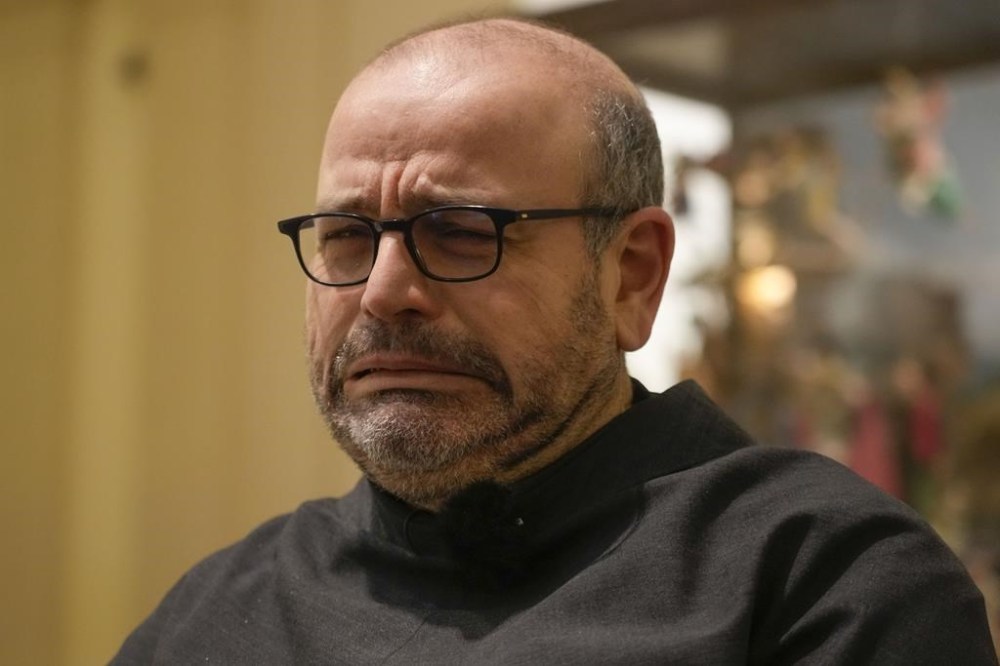
Head of the Italian committee on Artificial Intelligence (AI), Franciscan Friar Paolo Benanti who is also a consultant for The Vatican and discusses AI with Pope Francis is interviewed by the Associated Press in Rome, Monday, Jan. 15, 2024. (AP Photo/Gregorio Borgia)

“What is the difference between a man who exists and a machine that functions?” said Benanti in an interview this week with The Associated Press during a break at the Pontifical Gregorian University, where he teaches courses such as moral theology and bioethics to students preparing for the priesthood. “This is perhaps the greatest question of these times, because we are witnessing a challenge that every day grows more profound with a machine that is humanizing.”

Benanti is a member of the United Nations’ Advisory Body on Artificial Intelligence as well as head of an Italian government commission tasked with providing recommendations on how to safeguard journalism from fake news and other disinformation. He is also a consultant to the Vatican’s Pontifical Academy for Life.

Benanti says he helps “better clarify the more technical terms for the Holy Father” during their encounters. His knowledge came in handy for a 2023 meeting at the Vatican between Francis and Microsoft President Brad Smith that focused on how AI could help or hurt humanity.

Francis and Smith had also discussed artificial intelligence “at the service of the common good” during a meeting a few years earlier, according to the Vatican. With a papacy heavily attentive to those who live on society’s margins, Francis has made clear his concern that AI technology could limit human rights by, say, negatively impacting a homebuyer’s mortgage application, a migrant’s asylum bid or an evaluation of an offender’s likelihood to repeat a crime.

“It’s clear that if we choose some data that aren’t sufficiently inclusive, we will have some choices that aren’t inclusive,″ said Benanti, whose religious order was founded in the early 13th century by St. Francis of Assisi, who renounced earthly riches and promoted charitable works.

Microsoft first reached out to Benanti several years ago for his thoughts on technology, the friar said. In 2023, Smith did a podcast with Benanti in Rome, describing the friar as bringing “one of the most fascinating combinations in the world” in terms of his background in engineering, ethics and technology, to the AI debate.

Benanti, who was one year shy of obtaining his engineering degree at Rome’s Sapienza University when he forsook the degree — and also his girlfriend — to join the Franciscans in his 20s, described how AI could be a “really powerful tool” in bringing down the cost of medicine and empowering doctors to help more people.

But he also described the ethical implications of a technology that could have the same capabilities as a human — or perhaps even more.

“It is a problem not of using (AI) but it is a problem of governance,” the friar said. ”And here is where ethics come in — finding the right level of use inside a social context.”
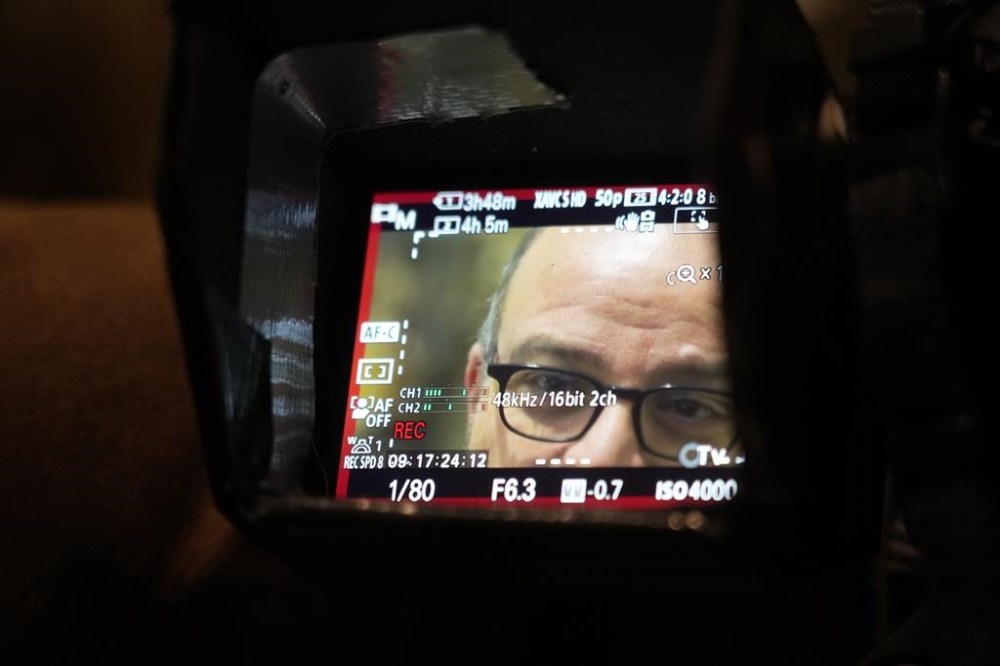
Head of the Italian committee on Artificial Intelligence (AI), Franciscan Friar Paolo Benanti who is also a consultant for The Vatican and discusses AI with Pope Francis is seen through a camera monitor during an interview with the Associated Press in Rome, Monday, Jan. 15, 2024. (AP Photo/Gregorio Borgia)

Benanti noted that much of the data that informs AI is fed by low-wage workers, many in developing countries entrenched in a history of colonialism and an exploited workforce.

“I don’t want this to be remembered as the season in which we extract from the global South cognitive resources,” he said. If one examines “the best tools that we are producing in AI” in the West, one sees that AI is “trained with underpaid workers from English-speaking former colonies.″

How to govern AI is an issue that countries all over the globe are trying to resolve. The European Union became a trailblazer late last year when negotiators secured a deal that paves the way for legal oversight of AI technology.

In Italy, Premier Giorgia Meloni, who worries that AI could lead to job losses, will make the technology a focus of this year’s G-7 summit being hosted by Italy. As part of those efforts, Meloni on Thursday met with visiting Microsoft founder Bill Gates in Rome, an encounter that was attended by Benanti.

For his part, the friar told AP that regulating artificial intelligence shouldn’t mean limiting its development.

“It means keeping them compatible with that fragile system that is democracy, that today seems to be the best system,” Benanti said.

Report Error Submit a Tip

The Free Press acknowledges the financial support it receives from members of the city’s faith community, which makes our coverage of religion possible.

More Stories

A day on the campaign trail: Winnipeg's mayor, seeking a second term, does double duty

Malak Abas 12 minute read Preview

A day on the campaign trail: Winnipeg's mayor, seeking a second term, does double duty

Malak Abas 12 minute read Updated: Yesterday at 5:56 PM CDT

In the weeks leading up to the civic election, Scott Gillingham has been performing a juggling act: he’s running to be Winnipeg’s 45th mayor, while still serving as its 44th.

“If someone asks me about the campaign, I’m going to answer them. But I think for most people, I’m the mayor of Winnipeg, even if I’m showing up as a candidate,” Gillingham, 58, says. “I try to do all I can to maintain that distinction.”

The Free Press joined Gillingham on a recent rainy September Saturday on the campaign trail, where he served in both roles during an event-laden day. City council’s final meeting before the Oct. 28 election was days earlier.

In Winnipeg, it’s rare for an incumbent to be defeated. But Gillingham knows his win in 2022 wasn’t exactly a landslide — he won with 27.5 per cent of the vote — and he’s been thinking about his second term ever since.

Read
Updated: Yesterday at 5:56 PM CDT

Clock ticks down on destruction of records documenting residential school abuses

Marsha McLeod 13 minute read Preview

Clock ticks down on destruction of records documenting residential school abuses

Marsha McLeod 13 minute read Yesterday at 12:49 PM CDT

In less than a year, a private company is set to destroy the largest cache of records detailing the widespread abuse of Indigenous children at residential schools in Canada.

The destruction, which was ordered by an Ontario court in 2014 and later upheld by the Supreme Court, is set to take place on Sept. 19, 2027.

This countdown is igniting emotional conversations that seek to balance the immense historical value of the records alongside the confidentiality survivors were promised as part of the process of providing detailed testimony about abuses they’d suffered.

The records were created as part of the Indian Residential Schools Settlement Agreement, a class-action settlement stemming from survivors who began suing the federal government in the late 1990s over the harm they’d been subjected to at residential schools.

Read
Yesterday at 12:49 PM CDT

A 22-year-old man is dead and an 18-year-old is in hospital in critical condition after a two-vehicle crash on Highway 8 on Thursday evening.

A Gimli RCMP officer was driving north on the highway, near Riverton, when he witnessed the collision at about 6:45 p.m.

A vehicle headed north had passed the Mountie at a high speed before colliding with an SUV that was turning west onto Provincial Road 329 from Highway 8.

The driver of the first vehicle, an 18-year-old man from Arborg, was rushed to hospital by a helicopter ambulance with injuries RCMP describe as serious and life-threatening.

Six high school hockey programs ceased operations following new Hockey Manitoba policy

Joshua Frey-Sam 7 minute read Preview

Six high school hockey programs ceased operations following new Hockey Manitoba policy

Joshua Frey-Sam 7 minute read Updated: Yesterday at 8:19 PM CDT

She lived the best of both worlds.

For the last three years, the 17-year-old wore a sweater for two different hockey programs — her high school team and AAA club in the Manitoba Female Hockey League — and was preparing to flourish in both colours again this winter.

Recently, however, the blue-liner was disappointed to learn she is no longer eligible to play her Grade 12 season with her school owing to a new policy imposed by Hockey Manitoba that bans players from participating in the Manitoba Women’s High School Hockey League if they are rostered on a U18 AAA team.

The rule applies to all athletes who play for both Winnipeg-based and rural AAA teams.

Read
Updated: Yesterday at 8:19 PM CDT

Jets bench boss Arniel talks rebuilding from last season’s struggles

Mike McIntyre and Ken Wiebe 12 minute read Preview

Jets bench boss Arniel talks rebuilding from last season’s struggles

Mike McIntyre and Ken Wiebe 12 minute read Thursday, Oct. 1, 2026

Scott Arniel has a lot on his plate these days.

But the head coach of the Winnipeg Jets took some time Thursday to sit down with Free Press hockey writers Mike McIntyre and Ken Wiebe to discuss a number of topics on the eve of a new hockey season. This interview has been condensed and edited for clarity.

Wiebe: What was the evaluation of last season like? What did you personally do in an attempt to improve after going from first-overall to 26th-overall?

I just went back and looked at things and made sure my communication was where it needed to be with my players. Was my communication where it needed to be with my boss, with my general manager (Kevin Cheveldayoff)? How our coaching staff worked. How we handled highs and lows. Things I felt I could have done better.

Read
Thursday, Oct. 1, 2026

You’re a solid, loyal sister, so worry not

Maureen Scurfield 5 minute read Yesterday at 2:00 AM CDT

DEAR MISS LONELYHEARTS: I ran into my sister’s husband at the bar recently. He was drinking with a bunch of people from his work. I noticed he was sitting close to a young woman, with his arm around her.

I just nodded without a smile as I slowly passed them. I kept on going, but he knew I saw them together. A few minutes later he came over — obviously drunk — and said, “You’re a good girl! You won’t say anything to your sister, will you?” Ha! I looked at him and said, “Of course I’m going to say something!”

My loyalty will always be to my sister. I phoned my sis in my car and blabbed. She tried to laugh it off, but she’s gone silent since — not answering my calls or messages. So apparently now I’m the troublemaker? That’d be just her style! What should I do?

— Worried About Us, North Kildonan