Long after pope’s abuse summit, victims still traumatized by the system meant to address their cases
Advertisement
Read this article for free:
or
Already have an account? Log in here »
To continue reading, please subscribe:

Digital Subscription
One year of digital access for only $205*
- Enjoy unlimited reading on winnipegfreepress.com
- Read the E-Edition, our digital replica newspaper
- Access News Break, our award-winning app
- Play interactive puzzles
*First annual payment billed as $205.00 + GST for one year. This annual subscription will automatically renew at $233.00 + GST every 52 weeks (10% off the regular annual price of $259.35). Offer available to new and qualified returning subscribers only. Cancel any time.
To continue reading, please subscribe:
Add Free Press access to your Brandon Sun subscription for only an additional
$1 for the first 4 weeks*
- Enjoy unlimited reading on winnipegfreepress.com
- Read the E-Edition, our digital replica newspaper
- Access News Break, our award-winning app
- Play interactive puzzles
*Your next Brandon Sun subscription payment will increase by $1.00 and you will be charged $17.95 plus GST for four weeks. After four weeks, your payment will increase to $24.95 plus GST every four weeks.
Read unlimited articles for free today:
or
Already have an account? Log in here »
Hey there, time traveller!
This article was published 19/02/2024 (961 days ago), so information in it may no longer be current.
VATICAN CITY (AP) — One afternoon in mid-December, Pope Francis had a meeting that wasn’t on his official agenda or otherwise recorded, that underscored the utter dysfunction of the Catholic Church’s response to the global clergy sex abuse scandal.
In the main reception room of the Vatican hotel where he lives, Francis met for more than an hour with a Spaniard who as a young seminarian was molested by his spiritual director. The former seminarian was desperate.
He had lodged a complaint with the Toledo, Spain Archdiocese in 2009, and visited Vatican offices multiple times to deposit damning documents and demand action be taken against his abuser and the bishops who allegedly covered for him. But for 15 years, he had received no justice from the church.
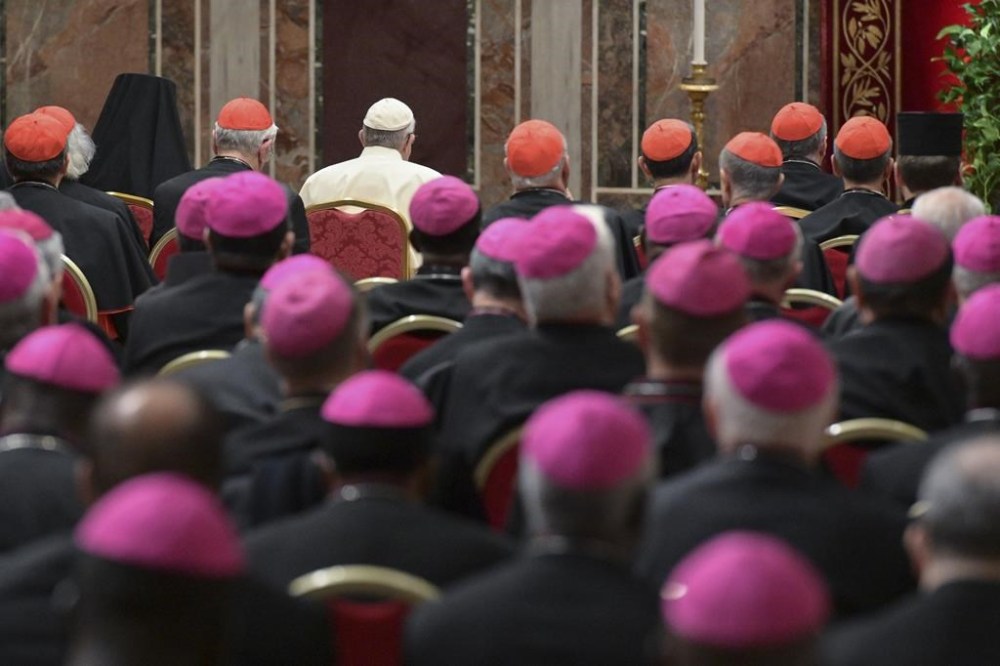
While Francis’ decision to hear his story was laudable and pastorally sensitive, it was also evidence that the church’s in-house system to deal with abuse isn’t working — from the laws available to punish abusers to its policies for helping survivors. For every victim who has enough well-connected friends at the Vatican who can arrange a papal audience, countless others will never feel that the church cares for them or will provide them justice.
Five years ago this week, Francis convened an unprecedented summit of bishops from around the world to impress on them that clergy abuse was a global problem and they needed to address it. Over four days, these bishops heard harrowing tales of trauma from victims, learned how to investigate and sanction pedophile priests, and were warned that they too would face punishment if they continued to cover for abusers.
Yet five years later, despite new church laws to hold bishops accountable and promises to do better, the Catholic Church’s in-house legal system and pastoral response to victims has proven still incapable of dealing with the problem.
STAKEHOLDERS WARN CHURCH’S EVOLVING RESPONSE STILL HARMS VICTIMS
In fact, victims, outside investigators and even in-house canon lawyers increasingly say the church’s response, crafted and amended over two decades of unrelenting scandal around the world, is damaging to the very people already harmed — the victims. They are often retraumatized when they summon the courage to report abuse in the face of the church’s silence, stonewalling and inaction.
“It’s a horrific experience. And it’s not something that I would advise anyone to do unless they are prepared to have not just their world, but their sense of being turned upside down,” said Brian Devlin, a former Scottish priest whose internal, and then public accusations of sexual misconduct against the late Scottish Cardinal Keith O’Brien marked O’Brien’s downfall.
“You become the troublemaker. You become the whistleblower. And I can well understand that people who go through that process end up with bigger problems than they had before they started it. It’s a hugely, hugely, destructive process.”
Then-Cardinal Joseph Ratzinger revolutionized the way the Catholic Church dealt with abusive clergy in 2001, when he persuaded St. John Paul II to order all abuse cases be sent to his office for review.
Ratzinger acted because, after nearly a quarter century at the Congregation for the Doctrine of the Faith, he had seen that bishops weren’t following the church’s own laws and were moving predators around from parish to parish rather than sanctioning them.
At the end of his 2019 summit, Francis vowed to confront abusive clergy with “the wrath of God.” Within months, he passed a new law requiring all abuse to be reported in-house to church authorities (but not to police) and mapped out procedures to investigate bishops who abused or protected predator priests.
But five years later, the Vatican has offered no statistics on the number of bishops investigated or sanctioned. Even the pope’s own child protection advisory commission says structural problems built into the system are harming victims and preventing basic justice.
“Recent publicly reported cases point to tragically harmful deficiencies in the norms intended to punish abusers and hold accountable those whose duty is to address wrongdoing,” the Pontifical Commission for the Protection of Minors said after its last assembly. “We are long overdue in fixing the flaws in procedures that leave victims wounded and in the dark both during and after cases have been decided.”
At the 2019 summit, the norms enacted by the U.S. Catholic Church for sanctioning priests and protecting minors were touted as the gold standard. The U.S. bishops adopted a get-tough policy after the U.S. abuse scandal exploded with the 2002 Boston Globe “Spotlight” series.
SOME SAY VICTIMS SHOULD SKIP PURSUING JUSTICE FROM THE CHURCH
But even in the U.S., victims and canon lawyers say the system isn’t working, and that’s not even taking into consideration the new frontier of abuse cases involving adult victims. Some call it “charter fatigue,” that the hierarchy simply wants to move on beyond the scandal that spawned the 2002 Charter for the Protection of Children and Young People.
The Rev. Tom Doyle, a U.S. canon lawyer who worked for the Vatican embassy in Washington and now provides consulting for victims, says he no longer advises they pursue church justice.
Why? Because “the church will screw them every which way from Sunday,” he said.
“Don’t waste your time,” Doyle says he tells victims. “The only justice, or semblance of justice that has been meted out is in civilian courts because the church can’t screw them up.”
Nearly every investigation into abuse in the Catholic Church that has been published in recent years has identified the church’s in-house legal system as a big part of the problem, from church-commissioned reports in France and Germany to government inquests in Australia, parliamentary-mandated studies in Spain and law enforcement investigations in the U.S.
While some reforms have occurred, including Francis’ lifting of the official secrecy covering abuse cases in 2019, core issues remain.
Part of the problem is that canon law was never meant to address the needs of abuse survivors or to help them heal: As stated the penal code, the goal of the system is entirely institution-centric: to “restore justice, reform the offender and repair scandal.”
REPORTS IDENTIFY SPECIFIC ISSUES WITH CHURCH’S LATEST POLICIES
Even after the Vatican announced a revised penal code, more than a decade in the making, the outside reports were remarkably uniform in identifying:
—The structural conflict of interest built into the system. According to church procedures, a bishop or religious superior investigates an allegation that one of his priests raped a child and then renders judgement. And yet the bishop or superior has a vested interest, since the priest is considered to be a spiritual son in whom the bishop has invested time, money and love.
It is difficult to think of any other legal system in the world where someone with such a personal, paternal relationship with one party in a dispute could be expected to objectively and fairly render judgment in it.
The independent commission that investigated the French church’s abuse scandal said such a structural conflict of interest “appears, humanly speaking, untenable.”
Even the pope’s own Synod of Bishops came to a similar conclusion. In their November synthesis document after a monthlong meeting, the world’s bishops identified conflict of interest as an ongoing problem.
“The sensitive issue of handling abuse places many bishops in the difficult situation of having to reconcile the role of father with that of judge,” said the synod report, suggesting that the task of judgment be assigned to “other structures.”
—The lack of fundamental rights for victims. In canonical abuse investigations, victims are mere third-party witnesses to their cases. They cannot participate in any of the secret proceedings, they have no access to case files and no right to even know if a canonical investigation has been started, much less its status.
Only due to a Francis reform in 2019 are victims allowed to know the ultimate outcome of their case, but nothing else.
The Spanish ombudsman, tasked by the country’s congress of deputies to investigate abuse in the Spanish Catholic Church, said victims are often retraumatized by such a process.
“Despite the regulations enforced over the last few years, if we take into account international and national standards on the minimum rights of victims in criminal proceedings, the rights and needs of victims in canon law proceedings continue to be neglected,” the report found.
The French experts went further, arguing that the Vatican is essentially in breach of its obligations as a U.N. observer state and member of the Council of Europe, which requires upholding the basic human rights of victims.
Citing the European Convention for the Protection of Human Rights, the French report noted that a fundamental right includes access to a fair trial “which guarantees, in particular, the right of access to independent justice and an adversarial procedure, and, for the victim, the right to an effective remedy.”
“Canon law will only be able to provide a genuine response to the sexual abuse of children and vulnerable persons in the Catholic Church if it meets the universally recognized requirements of justice and if it is implemented more effectively,” the French commission concluded.
—No published case law. Unlike the Vatican tribunal known as the Roman Rota, which publishes redacted marriage annulment cases, the Vatican’s sex abuse office doesn’t publish any of its decisions about how clergy sexual abuse cases have been adjudicated.
That means that a bishop investigating an accusation against one of his priests has no way of knowing how the law has been applied in a similar case. It means canon law students have no case law to study or cite. It means academics, journalists and even victims have no way of knowing what types of behavior gets sanctioned and whether penalties are being imposed arbitrarily or not.
Independent legal experts who investigated clergy abuse in Munich, Germany, said the publication of canonical decisions would help eliminate uncertainties for victims in how church law was being applied. Australia’s Royal Commission, the highest form of inquest in the country, similarly called for the publication of abuse decisions, in redacted form, and to provide written reasons for their decisions “in a timely manner.”
In-house, canon lawyers for years have complained that the lack of published cases was deepening doubts about the credibility and effectiveness of the churches’ response to the church scandal.
“This lack of systematic publication of the jurisprudence of the highest courts in the church is unworthy of a true legal system,” Kurt Martens, a professor at Catholic University of America told a canon law conference in Rome late last year.
Monsignor John Kennedy, who heads the Vatican office investigating abuse cases, said his staff was working diligently to process cases and had received praise from individual bishops, entire conferences who visit and religious superiors.
“We don’t talk about what we do in public but the feedback we receive and the comments from our members who recently met for the Plenaria are very encouraging,” he wrote to The Associated Press. “The pope also expressed his gratitude for the great work that is done in silence.”
But such praise appears to come mostly from the hierarchy, not those who have been harmed: the victims.
They are left to languish, even if — as now advised by the church — they report their abuse. The Spanish seminarian who met with the pope first filed his complaint against his abuser with the Toledo Archdiocese in 2009. But the Toledo archbishop only launched an internal investigation in 2021 and informed the Vatican, after Spain’s El Pais newspaper reported on the case.
The AP does not identify sexual abuse victims unless they choose to go public.

In October, a Spanish criminal court convicted the priest and sentenced him to seven years. An appeals court recently voided the sentence on a technicality.
The seminarian has remained in touch with Francis and recently wrote him saying he was “exhausted” with the process but had nevertheless appealed to Spain’s Supreme Court.
Francis called him right back and encouraged him to keep fighting, he said.
___
Associated Press religion coverage receives support through the AP’s collaboration with The Conversation US, with funding from Lilly Endowment Inc. The AP is solely responsible for this content.
The Free Press acknowledges the financial support it receives from members of the city’s faith community, which makes our coverage of religion possible.