Passover Seders focus on human rights
Advertisement
Read this article for free:
or
Already have an account? Log in here »
To continue reading, please subscribe:

Digital Subscription
One year of digital access for only $205*
- Enjoy unlimited reading on winnipegfreepress.com
- Read the E-Edition, our digital replica newspaper
- Access News Break, our award-winning app
- Play interactive puzzles
*First annual payment billed as $205.00 + GST for one year. This annual subscription will automatically renew at $233.00 + GST every 52 weeks (10% off the regular annual price of $259.35). Offer available to new and qualified returning subscribers only. Cancel any time.
To continue reading, please subscribe:
Add Free Press access to your Brandon Sun subscription for only an additional
$1 for the first 4 weeks*
- Enjoy unlimited reading on winnipegfreepress.com
- Read the E-Edition, our digital replica newspaper
- Access News Break, our award-winning app
- Play interactive puzzles
*Your next Brandon Sun subscription payment will increase by $1.00 and you will be charged $17.95 plus GST for four weeks. After four weeks, your payment will increase to $24.95 plus GST every four weeks.
Read unlimited articles for free today:
or
Already have an account? Log in here »
Hey there, time traveller!
This article was published 20/04/2024 (884 days ago), so information in it may no longer be current.
Passover celebrations are likely to look and sound a little different than usual in 2024 as Jewish families gather around their Seder tables this spring. The Seder is the ritual meal that heralds the start of the eight-day festival which begins, this year, on April 22.
Many Seders in the diaspora are expected to be more solemn and reflective in nature than in past years out of respect for the Israeli victims of Oct. 7 and the 133 hostages still being held in Gaza. Other Seders are expected to be louder and more boisterous than usual, as those gathered for the holiday seek to demonstrate that in spite of Oct. 7, and the global rising tide of antisemitism, Jewish people remain strong and confident in their faith and expressions of their identity.
The events of the last six months in Israel and in Gaza will not just affect the mood around individual tables, but also the discussions, debates, commentary, and questions that, together with a variety of symbolic foods, make up the Seder.
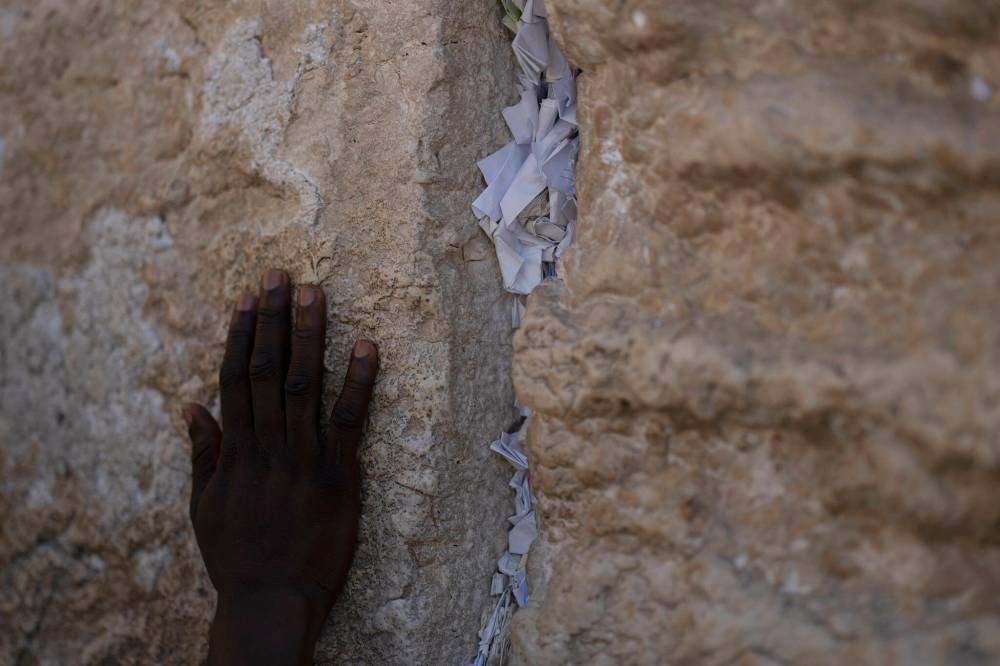
Leo Correa / The Associated Press
A man places his hand next to prayer notes left by visitors at the Western Wall ahead of Passover in Jerusalem’s Old City, on April 16.
The traditional Haggadah — the Passover guide book that maps out 15 steps to be followed at the Seder — recounts the Jewish people’s liberation from slavery in Egypt and their subsequent wandering in the desert for 40 years en route to Israel. While every Haggadah follows the same basic steps, there exist hundreds of varieties of Haggadot (the plural of Haggadah) with new versions and supplements being created every year.
Many newer Haggadot connect the Exodus narrative to contemporary issues. This year, that narrative — a story about persecution, punishment, captivity, liberation, land, hunger, refugees, redemption, and faith — will undoubtedly spur impassioned conversation about the hostages, Hamas’ unprovoked and horrific terror attack in Israel, and the Israeli government’s expansive response to that attack.
The human rights group T’ruah recognizes that not all Jews share the same opinion about the nature and necessity of that Israeli response, especially considering the toll it has taken on Palestinian lives in Gaza. Anticipating the potential for those opposing opinions to disrupt the rhythm and serenity of too many Seders, Truah proactively addressed the issue a week before the start of the holiday in a webinar entitled Talking Israel/Palestine at your Seder.
At the webinar, presenter Rabbi Amy Eilberg, the first woman ordained as a Conservative rabbi by the Jewish Theological Seminary of America and a peace and justice educator, offered several suggestions about how to address the ‘elephant in the room,’ as well how to manage inevitable and emotionally charged disagreements at the table in a manner that does not damage family bonds.
There are two statements in the Haggadah that are at the core of the Seder, Eilberg explains. One statement directs Jews to remember that “in every generation there are those who try to destroy us, and God saved us from their hands.” The other statement emphasizes that “In every generation, each of us must see ourselves as if we ourselves were liberated from Egypt.”
For Eilberg, the second statement is more critical. Jews are reminded to recall their own slavery and subsequent liberation from it precisely so that they will recognize when others are being oppressed and act against that oppression when it occurs.
Speaking out about Palestinian suffering in Gaza, then, would seem to be an obligatory step.
“We know what it is to be oppressed, and of course much more we know what it is to be the object of hatred,” Eilberg said. “We know that and so the moral of the story is we must stand up for every oppressed person in our time and place. We are supposed to be the people who always stand up for people with less power.”
Rabbi Shlomo Levin, author of the Human Rights Haggadah, contends that it is inevitable and important that the topic of the war in Gaza and the plight of the Palestinian people will come up at the Seder this year.

“For the holiday to be relevant we have to allow it to include what is most important to us today,” he elaborates. “One thing that makes the Passover story particularly useful for discussing human rights is that it includes both the oppression of the Israelites, which can be broken down into what we would call human rights violations, and also the Israelites’ fight for freedom. This gives us the opportunity to ask whether the way the fight for freedom was conducted was right. Were the 10 plagues the right way? Are there limits on what we can or should do even when fighting for a just cause?”
Asking questions is an essential part of the Seder. But the questions, responses, and discussions they elicit, Eilberg emphasized, must come from a place of deference, kindness, and empathy, even when opinions and ideas diverge, as they inevitably will. Discussion and debate should support relationships, not endanger them, and keep in mind the heartache that many Jews are experiencing.
“It is probably fair to say that everyone at the table has been in a lot of pain the last six months,” Eilberg concluded. “So everyone is in need of care. Everyone is in need of a glorious loving Seder.”
Passover is generally the most widely celebrated Jewish festival in the year, and is traditionally a time for extended family and friends to come together to sit, sing, remember, rejoice, and dine. That should still be possible. Whether those sitting at the table identify politically as left or right, whether they are Orthodox or Conservative, young or old, strong Zionists or wavering Zionists, their pain, their fears, their grief, and their guilt should all be acknowledged and respected.
swchisvin@gmail.com
The Free Press is committed to covering faith in Manitoba through our Religion in the News project. This reporting continues because readers like you step forward to fund it.
Donate now to support our reporting on religion.
Your donation is eligible for a charitable tax receipt.
BECOME A FAITH JOURNALISM SUPPORTER
The Free Press is committed to covering faith in Manitoba through our Religion in the News project. This reporting continues because readers like you step forward to fund it.
Donate now to support our reporting on religion.
Your donation is eligible for a charitable tax receipt.
BECOME A FAITH JOURNALISM SUPPORTER
Related Articles
City’s Jewish community marks extra-meaningful Passover this year
Advertisement Advertise With Us
Advertisement Advertise With Us
The Free Press acknowledges the financial support it receives from members of the city’s faith community, which makes our coverage of religion possible.