Jewish students grapple with how to respond to pro-Palestinian campus protests
Advertisement
Read this article for free:
or
Already have an account? Log in here »
To continue reading, please subscribe:

Digital Subscription
One year of digital access for only $205*
- Enjoy unlimited reading on winnipegfreepress.com
- Read the E-Edition, our digital replica newspaper
- Access News Break, our award-winning app
- Play interactive puzzles
*First annual payment billed as $205.00 + GST for one year. This annual subscription will automatically renew at $233.00 + GST every 52 weeks (10% off the regular annual price of $259.35). Offer available to new and qualified returning subscribers only. Cancel any time.
To continue reading, please subscribe:
Add Free Press access to your Brandon Sun subscription for only an additional
$1 for the first 4 weeks*
- Enjoy unlimited reading on winnipegfreepress.com
- Read the E-Edition, our digital replica newspaper
- Access News Break, our award-winning app
- Play interactive puzzles
*Your next Brandon Sun subscription payment will increase by $1.00 and you will be charged $17.95 plus GST for four weeks. After four weeks, your payment will increase to $24.95 plus GST every four weeks.
Read unlimited articles for free today:
or
Already have an account? Log in here »
Hey there, time traveller!
This article was published 03/05/2024 (891 days ago), so information in it may no longer be current.
Some Jewish students have taken part in strident pro-Palestinian protests dominating U.S. colleges in recent weeks, but few have led rallies in support of Israel or against perceived displays of antisemitism.
That may be starting to change.
Like many Americans, Jewish students’ views on the Israeli-Palestinian conflict are wide-ranging and often nuanced. It wasn’t for a lack of concern about the war in Gaza or the backlash it has aroused on their campuses that some shied away from demonstrating.
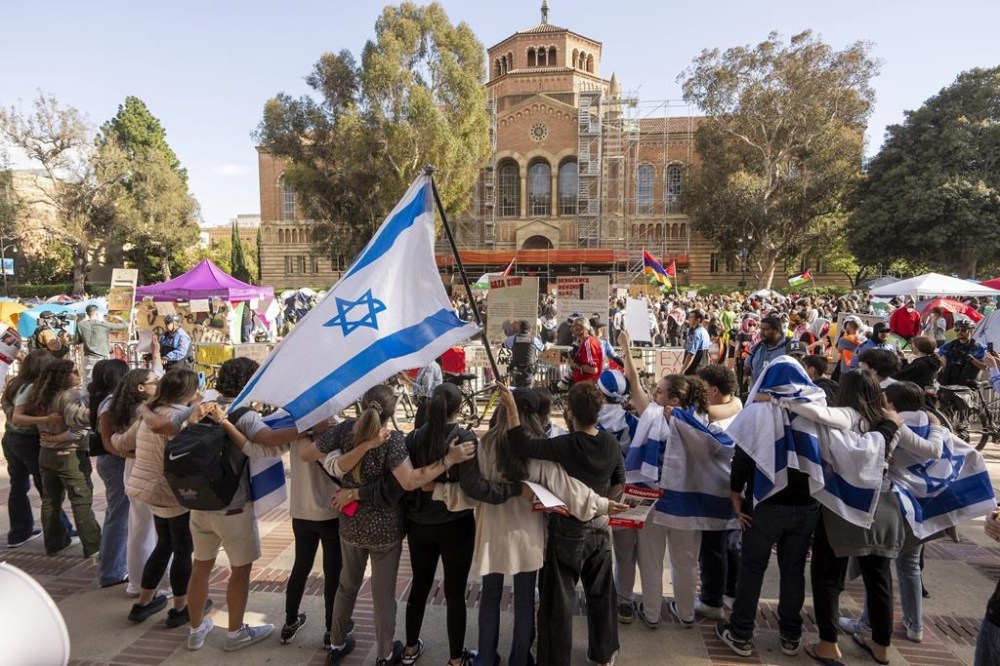
They have had fervent debates with each other over whether and how to respond as pro-Palestinian encampments spread from one university to the next.
Some joined the encampments, celebrating Passover among the tents with fellow protesters. Many felt unnerved by what they considered to be anti-Israel rhetoric and said they feared rallying.
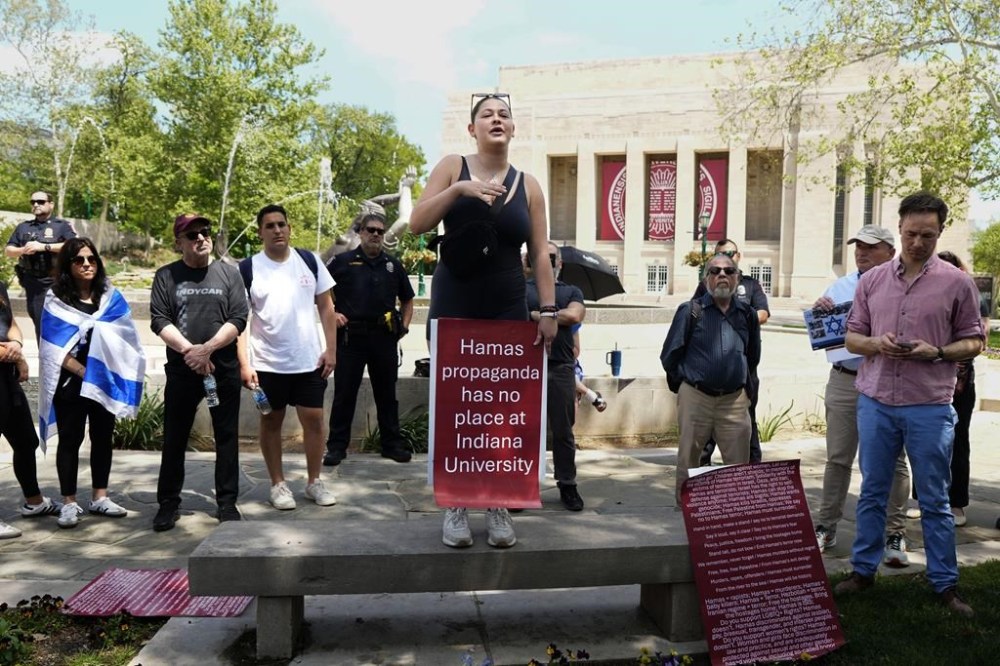
Now, groups in solidarity with Jewish students plan dozens of rallies in the coming days. Protesters hoisted Israeli flags at Indiana University Bloomington and near George Washington University on Thursday, and more flew outside MIT on Friday.
Their goals include standing in solidarity with Jewish students and showing there’s room for empathy for both Palestinians and Israelis affected by the war.
At George Washington University in Washington, D.C., about 150 people — including many Jewish students — gathered Thursday in a grassy courtyard. The goal, said organizer Gabrielle Guigui, “was to show Jewish pride and Jewish unity … and to get Jewish students together, because a lot of them are scared.”
Senior Brina Cartagenova clutched a necklace with her Hebrew name on it, the same necklace she’d previously taken off over fear of retaliation on campus.
“I was scared to put this back on for, like, at least three weeks, and then I finally did the other day,” she said. “This type of event definitely helps me feel more comfortable.”
The pro-Palestinian encampments around the country have been largely peaceful, though there have been some clashes. Administrators and campus police at UCLA faced intense criticism Wednesday for failing to act quickly to stop an attack on a pro-Palestinian encampment on campus by counter demonstrators who threw traffic cones and chairs, released pepper spray and tore down barriers.
Some pro-Palestinian demonstrators fought back, and skirmishes continued for hours before outside law enforcement agencies were called to intervene.
The campus tensions are complicated by the deep history and emotions wrapped up in the Israel-Hamas war. It began on Oct. 7 when Hamas militants attacked Israel and killed roughly 1,200 people, mostly civilians, and took another 250 hostage — the deadliest attack against Jews since the Holocaust.
Vowing to stamp out Hamas, Israel has waged a brutal campaign against the militant group that rules Gaza in a conflict that has killed more than 34,000 Palestinians along the way, according to the Health Ministry there.
Protests in support of Israel or the Palestinians have bubbled up across the U.S. ever since Oct. 7. But the major wave of pro-Palestinian rallies on campuses kicked off two weeks ago, after more than 100 protesters were arrested at Columbia University in New York. They have demanded that colleges stop doing business with Israel and with companies tied to it.
Jewish Americans between the ages of 18 and 34 are closely divided on whether Israel’s post-Oct. 7 military campaign has been acceptable, according to a Pew Research Center poll conducted in February.
But instances of hatred among the antiwar protests have rattled many Jewish students, regardless of how they feel about Israel’s government or its treatment of Palestinians.
Some examples from campus protests that stung: A poster depicting the Star of David crossed out in red. “Death to Israel” scrawled in spray paint. Chants of “We are Hamas.”
“Not everyone is actively endorsing these antisemitic posters and chants and signs and graffiti, but it feels like a large majority is at least OK with it — OK enough to to ignore it and to let Jewish students continue feeling unwelcome,” said Lily Cohen, 21, a Jewish student at Northwestern University.
“It felt very daunting to counterprotest,” she said.
Inside the Northwestern encampment was another Jewish student, junior Paz Baum.
Baum, who held a Passover seder among the tents with the other pro-Palestinian protesters, said her religious values compelled her to protest over the war in Gaza.
“I see a direct parallel between the experiences of my Jewish ancestors and the experience of the tens of thousands of Palestinians being slaughtered,” said Baum, whose great-grandparents fled pogroms in eastern Europe.
Baum insisted that hateful posters were taken down as they were spotted, and said the only antisemitism she had witnessed was from several Jewish protesters, mostly older adults, who confronted the encampment on Sunday.
As Baum held a sign reading “Jews for a cease-fire,” she said they lobbed antisemitic slurs at her. Other pro-Palestinian protesters have said accusations of antisemitism are bandied about merely to discredit their movement.
The encampment at Northwestern reached an agreement with the university on Monday and cleared out.
At Columbia, some pro-Palestinian protesters have condemned hateful rhetoric coming from their ranks, including remarks from a student who said “Zionists don’t deserve to live” in a recently surfaced video. That student, who acted as a spokesperson for the encampment and has since walked back his statements, has been banned from campus. But the incident, along with others, struck a nerve.
“It is completely OK to protest the war in Gaza or be horrified by various actions of the Israeli government,” said Jacob Schmeltz, a student at Columbia, but “Jewish students at Columbia right now do not feel physically or emotionally safe to be on campus.”
Schmeltz, who is one of the leaders of the national Jewish on Campus Student Union, said the group has strategized on how to respond as protests multiplied.
They used social media to highlight what they saw as antisemitism on campus, but a protest wasn’t really on the table.
“How is it possible to organize a counter protest when many of us are at home or just trying to stay in their dorm rooms because they’re afraid of what will happen if they go onto campus?” said Schmeltz.
Organizations including Hillel and the Israeli-American Council have planned more rallies in the coming days to show Jewish and pro-Israel students and faculty “that they are not alone,” said Elan Carr, CEO of the organization.
Adam Lehman, president of Hillel International, said the rallies will affirm that Jewish students are resilient, deserve respect and can “show empathy to the plight of Palestinians while also simultaneously showing empathy for Israelis.”
At the University of North Carolina Chapel Hill, pro-Israel Jewish students have for weeks tossed around different ideas. A few argued to ignore the pro-Palestinian encampment on campus, to show that “you can do that, but you’re not affecting us,” said Jewish student Eliana Halivni. A few waved Israeli flags.

Some scrawled the Star of David in chalk, said Halivni, “so that they know that we’re here, even if they can’t physically see us.”
___
This article has been updated to correct the name of the Israeli-American Council.
___
Associated Press reporters Darren Sands in Washington, Isabella Volmert in Bloomington, Indiana, and Kavish Harjai in Los Angeles, contributed to this report.
The Free Press acknowledges the financial support it receives from members of the city’s faith community, which makes our coverage of religion possible.