Worship in a post-pandemic world
Canada’s overall religious health picture is unclear

Advertisement
Read this article for free:
or
Already have an account? Log in here »
To continue reading, please subscribe:

Digital Subscription
One year of digital access for only $205*
- Enjoy unlimited reading on winnipegfreepress.com
- Read the E-Edition, our digital replica newspaper
- Access News Break, our award-winning app
- Play interactive puzzles
*First annual payment billed as $205.00 + GST for one year. This annual subscription will automatically renew at $233.00 + GST every 52 weeks (10% off the regular annual price of $259.35). Offer available to new and qualified returning subscribers only. Cancel any time.
To continue reading, please subscribe:
Add Free Press access to your Brandon Sun subscription for only an additional
$1 for the first 4 weeks*
- Enjoy unlimited reading on winnipegfreepress.com
- Read the E-Edition, our digital replica newspaper
- Access News Break, our award-winning app
- Play interactive puzzles
*Your next Brandon Sun subscription payment will increase by $1.00 and you will be charged $17.95 plus GST for four weeks. After four weeks, your payment will increase to $24.95 plus GST every four weeks.
Read unlimited articles for free today:
or
Already have an account? Log in here »
Hey there, time traveller!
This article was published 01/03/2025 (587 days ago), so information in it may no longer be current.
Five years ago, about this time, I wrote in this newspaper about a mysterious new virus that was ravaging China.
“God full of compassion and mercy, we lay prostrate before you,” I quoted a pastor in that country as saying. “Wuhan and the surrounding cities have now been closed, and the spread of the virus has exceeded our capacity. The city is surrounded by the shadow of death. We, the covenant people who have received great grace, cry out to You.”
The new virus was also affecting churches in nearby Hong Kong, I also wrote, with some starting to cancel services — something unusual and unheard of at that time.
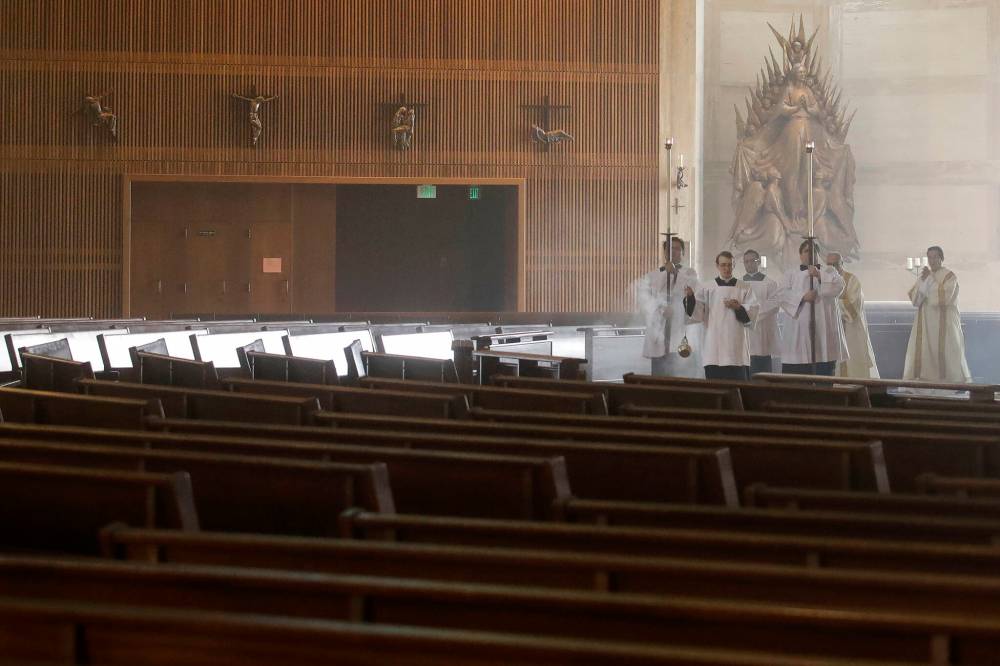
It all felt so far away and remote back then, a problem for people in another country. But before long we were all living in that reality as Canada, along with most of the rest of the world, shut down due to the Corona- virus pandemic.
Over the next almost three years, this newspaper chronicled the impact of the pandemic on religion in the province and across Canada — one of the few to do so in such an intentional way.
In spring 2021, at the height of the pandemic, I reached out to scholars of religion asking them what they thought religion might look like in Canada when the emergency was over.
Everyone who responded made their best guess as to what would happen. All were fairly sure there would be a decline in attendance at religious services when the pandemic abated — a continuation of the trend that had started before COVID-19.
“The pandemic has not changed things as much as it has amplified realities which already existed,” said Stuart Macdonald of the University of Toronto at the time, noting many churches had already been seeing declines in attendance before the pandemic.
Said Sam Reimer of Crandall University: “The pandemic, coupled with congregational closures, likely will create new habits, and returning to regular attendance is less likely. I think this will be particularly true of young families and emerging adults, who are less likely to attend already.”
Kevin Flatt of Redeemer University noted that many people were getting used to staying home on weekends. “Inertia is now on the side of not coming to church,” he said.
They also noted that online services would be here to stay. “When places of worship do reopen, their members will expect their congregation to continue to have an active and interactive online presence,” said Brian Clarke of the University of Toronto.
Joel Thiessen of Ambrose University noted that older people and other shut-ins would especially want online services to continue. “Issues of inaccessibility, such as health and mobility, are top of mind, and congregations should heed this point carefully,” he said.
Last month, I asked them to review their comments from 2021 and see how they stood up. None indicated they were off the mark.
“I stand by what I suggested,” said Macdonald. “The pandemic was an accelerant. Many congregations that were hanging on [before it] have ended up closing.”
While some congregations found new energy through online services, the next big challenge will be finding enough volunteers in the future to keep programs going, he said. This is an area that requires more study, he said, along with the impact of the pandemic on children and churchgoing.
“Minister colleagues who reported having some children present each Sunday before March 2020 now note that on most Sundays, it is simply adults,” MacDonald said. “Clearly, the pandemic had an impact.”
Added Thiessen: “Overall, I’d say we were all pretty much on the mark in our assessments.” The main drawback, he said, is the lack of Canadian data to check those assumptions.
Ah, yes — a lack of Canadian data. There is lots of U.S. data showing a decline in attendance in that country following the pandemic. For example, a report by Gallup found that fewer Americans are likely to be found in places of worship after the pandemic than before it. “It does not appear that church attendance will revert to pre-pandemic levels,” the pollster said.
A report from the Cultural Research Center at Arizona Christian University found that church attendance dropped significantly after the pandemic, adding a majority of Americans (56 per cent) now attend church infrequently or not at all. Prior to the pandemic, that number was 41 per cent.
A report by Pew found the share of U.S. adults typically attending religious services at least once a month dropped from 33 per cent in 2019 to 30 per cent in 2022. It added that about 20 per cent of Americans said they now attend in person less often than they did before the pandemic.

Another study by Grey Matter Research and Infinity Concepts revealed a significant decline in traditional in-person attendance after the pandemic, alongside an increase in virtual attendance.
While those studies are helpful, they don’t tell the Canadian story. Is it different? The same or worse? Or maybe all you have to do is look around on a weekend morning when you are at a place of worship — if you are still going, that is.
Of course, some places of worship are doing fine; their numbers are up and things are back to normal. And religion is not in danger of disappearing from Canada, although some groups are more at risk than others.
While it would be nice to have a clearer picture of what is happening to religion in Canada post-pandemic, one thing we do know is that things are different today for religion than they were five years ago.
faith@freepress.mb.ca
The Free Press is committed to covering faith in Manitoba through our Religion in the News project. This reporting continues because readers like you step forward to fund it.
Donate now to support our reporting on religion.
Your donation is eligible for a charitable tax receipt.
BECOME A FAITH JOURNALISM SUPPORTER
Our newsroom depends on a growing audience of readers to power our journalism. If you are not a paid reader, please consider becoming a subscriber.
Our newsroom depends on its audience of readers to power our journalism. Thank you for your support.
The Free Press is committed to covering faith in Manitoba through our Religion in the News project. This reporting continues because readers like you step forward to fund it.
Donate now to support our reporting on religion.
Your donation is eligible for a charitable tax receipt.
BECOME A FAITH JOURNALISM SUPPORTER
Our newsroom depends on a growing audience of readers to power our journalism. If you are not a paid reader, please consider becoming a subscriber.
Our newsroom depends on its audience of readers to power our journalism. Thank you for your support.
Advertisement Advertise With Us
Advertisement Advertise With Us
The Free Press acknowledges the financial support it receives from members of the city’s faith community, which makes our coverage of religion possible.