The Scopes monkey trial took place 100 years ago, but the fight isn’t over
Advertisement
Read this article for free:
or
Already have an account? Log in here »
To continue reading, please subscribe:

Digital Subscription
One year of digital access for only $205*
- Enjoy unlimited reading on winnipegfreepress.com
- Read the E-Edition, our digital replica newspaper
- Access News Break, our award-winning app
- Play interactive puzzles
*First annual payment billed as $205.00 + GST for one year. This annual subscription will automatically renew at $233.00 + GST every 52 weeks (10% off the regular annual price of $259.35). Offer available to new and qualified returning subscribers only. Cancel any time.
To continue reading, please subscribe:
Add Free Press access to your Brandon Sun subscription for only an additional
$1 for the first 4 weeks*
- Enjoy unlimited reading on winnipegfreepress.com
- Read the E-Edition, our digital replica newspaper
- Access News Break, our award-winning app
- Play interactive puzzles
*Your next Brandon Sun subscription payment will increase by $1.00 and you will be charged $17.95 plus GST for four weeks. After four weeks, your payment will increase to $24.95 plus GST every four weeks.
Read unlimited articles for free today:
or
Already have an account? Log in here »
Hey there, time traveller!
This article was published 13/03/2025 (572 days ago), so information in it may no longer be current.
NASHVILLE, Tenn. (AP) — They called it the “monkey trial.” It was supposed to be a publicity stunt.
A hundred years later, it is remembered as far more.
In March 1925, Tennessee became the first state in the country to ban the teaching of evolution in public school classrooms. Strong reactions rippled across the United States. The eventual upshot: a legal battle that became one of the most renowned in the nation’s history.
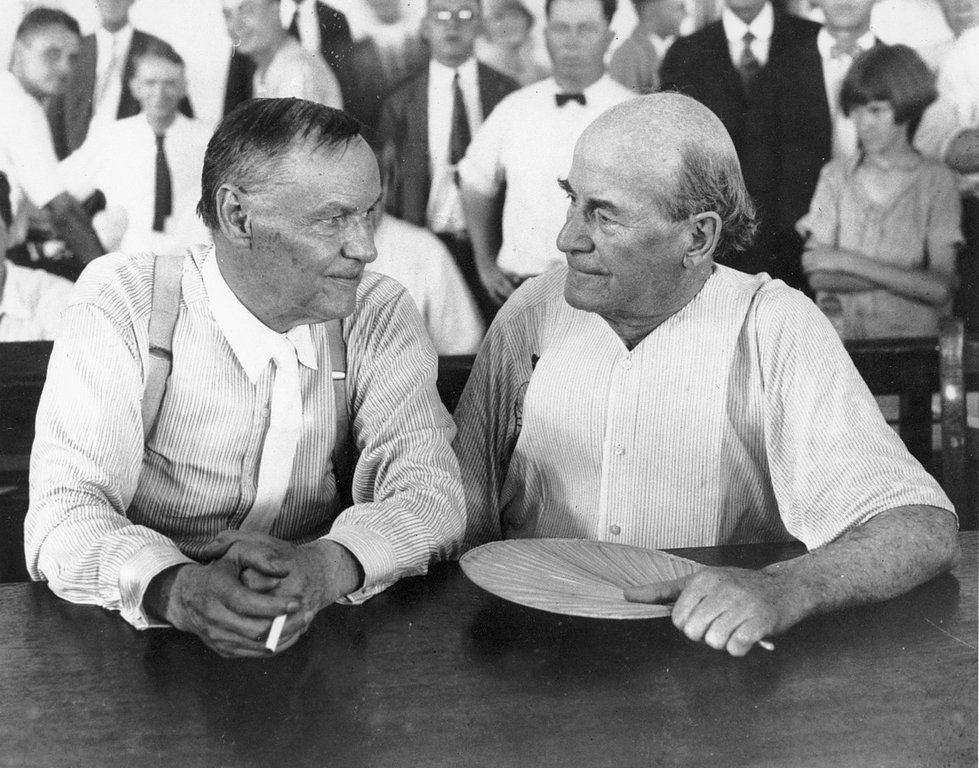
Historians say the trial started as a tourism gambit on behalf of the small town of Dayton, Tennessee — where the landmark case unfolded. The town’s leaders were eager for an economic boost and encouraged a local teacher to challenge the law. They wanted the debate over the controversial anti-evolution mandate to take place in their own backyard while the rest of the country eagerly followed along.
But amid the spectacle, the arguments and tensions raised during the eight-day trial persist. The rift over evolution and creationism — particularly in classrooms — has never fully been put to rest, and questions over how students should be taught about life’s origins still spark debate among educators, lawmakers, and the public.
Here’s a look at what you need to know about the Scopes trial:
Wait, so this was a trial about monkeys?
No.
In 1859, British naturalist Charles Darwin published “On the Origin of Species,” which explained his theory of evolution by means of natural selection. Darwin’s theory was seen as a direct challenge to the biblical story of creation by many fundamentalist Christians at the time. That contention came to a head in the 1920s when state lawmakers began considering outlawing the teaching of evolution in public schools.
Tennessee lawmakers were the first to take the step, passing the Butler Act on March 13, 1925, banning the teaching of any theory saying humanity descended from a “lower order of animal” in contradiction to the biblical teaching of divine creation.
In response, the American Civil Liberties Union put out an ad offering to defend and finance the legal bills for any teacher willing to be a defendant in a test case challenging the evolution ban. According to the Tennessee State Library, Dayton community leaders found 24-year-old John T. Scopes, who had just finished his first year of teaching, willing to take up the test case.
Scopes was arrested on May 9 and the trial started July 10.
A blockbuster case
The Scopes trial became sensational largely because it brought together two long-time adversaries and powerful speakers William Jennings Bryan and Clarence Darrow.
Bryan, a former secretary of state who ran for president three times and served in Congress, lent star power to the prosecution. Meanwhile, Darrow — one of the foremost defense attorneys of his time — agreed to represent Scopes after concluding a separate high-profile case where he saved child-killers Nathan Leopold and Richard Loeb from the death penalty.
Together, the two faced off in a contest not only between creationism and evolution, but also religion and science. Bryan, a fundamentalist Christian, was a leading champion of the anti-evolution movement in the early 1900s. Darrow was an agnostic.
According to the ACLU, roughly 1,000 people and reporters from more than 100 newspapers attended each day of the trial.
Many tried to capitalize off the case by playing off the popular misconception that Darwin’s theory says man descended from apes. The actual theory says man and apes have a common ancestor, but local businesses nevertheless began selling primate-themed souvenirs and novelty dollars. The Dayton Hotel installed a gorilla display in its lobby and a trained chimpanzee named Joe Mendi was brought in to entertain spectators.
Bryan himself took the stand to defend the biblical account of creation. Under withering questioning from Darrow, he conceded some biblical passages should be understood “illustratively” rather than literally.
With as much ink and attention given to the Scopes trial, the case itself only lasted eight days and the jury returned a guilty verdict after deliberating for less than 10 minutes.
Scopes was fined $100 for violating the Butler Act, a punishment that was eventually overturned on a technicality by the Tennessee Supreme Court.
Who won? Depends who you ask, but the impact remains
While the jury sided with the prosecution, the case generated more attention and interest in the theory of evolution. More than 20 anti-evolution theory bills were defeated in statehouses across the U.S. shortly after the Scopes trial. But the debate didn’t end there.
It would take another four decades before Tennessee lawmakers agreed to repeal the Butler Act, nearly around the same time the ACLU found another case to challenge anti-evolution laws.
In the 1960s, the ACLU filed an amicus brief on behalf of a zoology teacher in Arkansas, challenging a state law that banned teaching “that mankind ascended or descended from a lower order of animals.” Unlike the Tennessee case, the Arkansas legal battle went all the way to the U.S. Supreme Court where justices declared the anti-evolution law a violation of the Establishment Clause of the First Amendment.
A federal judge ruled in 2005 that a Pennsylvania public school district could not teach “intelligent design” — the idea life is too complex to have arisen by natural causes — because it is “a religious view, a mere re-labeling of creationism, and not a scientific theory.”
Today, the central themes surrounding the trial continue to pop up. Currently, conservative lawmakers across the country are pushing to introduce more Christianity in public school classrooms.
Last year, West Virginia enacted a law permitting public school teachers to answer student questions “about scientific theories of how the universe and/or life came to exist” that supporters said was needed to foster discussions beyond evolution.
And in Texas, new state curriculum has sparked criticism due to its inclusion of biblical references, a lesson that asks students to repeat the phrase that starts the creation story in the Book of Genesis and an activity requesting that children remember the order in which the Bible says God created the universe.
Related Articles
100 years later, the Scopes ‘Monkey Trial’ still resonates
Advertisement Advertise With Us
Advertisement Advertise With Us
The Free Press acknowledges the financial support it receives from members of the city’s faith community, which makes our coverage of religion possible.