UN report warns Iran is stepping up electronic surveillance of women to enforce headscarf laws

Advertisement

Advertise with us

GENEVA (AP) — Iran is increasingly relying on electronic surveillance and the public to inform on women refusing to wear the country's mandatory headscarf in public, as hard-liners push for harsher penalties for those protesting the law, a United Nations report released Friday found.

Read this article for free:


or

Already have an account? Log in here »

To continue reading, please subscribe:

Subscribe and receive a limited-edition Free Press branded hat or tote.

Digital Subscription

One year of digital access for only $205*

  • Enjoy unlimited reading on winnipegfreepress.com
  • Read the E-Edition, our digital replica newspaper
  • Access News Break, our award-winning app
  • Play interactive puzzles

*First annual payment billed as $205.00 + GST for one year. This annual subscription will automatically renew at $233.00 + GST every 52 weeks (10% off the regular annual price of $259.35). Offer available to new and qualified returning subscribers only. Cancel any time.

To continue reading, please subscribe:

Add Free Press access to your Brandon Sun subscription for only an additional

$1 for the first 4 weeks*

  • Enjoy unlimited reading on winnipegfreepress.com
  • Read the E-Edition, our digital replica newspaper
  • Access News Break, our award-winning app
  • Play interactive puzzles
Start now

*Your next Brandon Sun subscription payment will increase by $1.00 and you will be charged $17.95 plus GST for four weeks. After four weeks, your payment will increase to $24.95 plus GST every four weeks.

Hey there, time traveller!
This article was published 14/03/2025 (577 days ago), so information in it may no longer be current.

GENEVA (AP) — Iran is increasingly relying on electronic surveillance and the public to inform on women refusing to wear the country’s mandatory headscarf in public, as hard-liners push for harsher penalties for those protesting the law, a United Nations report released Friday found.

The findings of the Independent International Fact-Finding Mission on the Islamic Republic of Iran come after it determined last year that the country’s theocracy was responsible for the “physical violence” that led to the death of Mahsa Amini.

The 22-year-old’s death led to nationwide protests against the country’s mandatory hijab laws and the public disobedience against them that continues despite the threat of violent arrest and imprisonment.
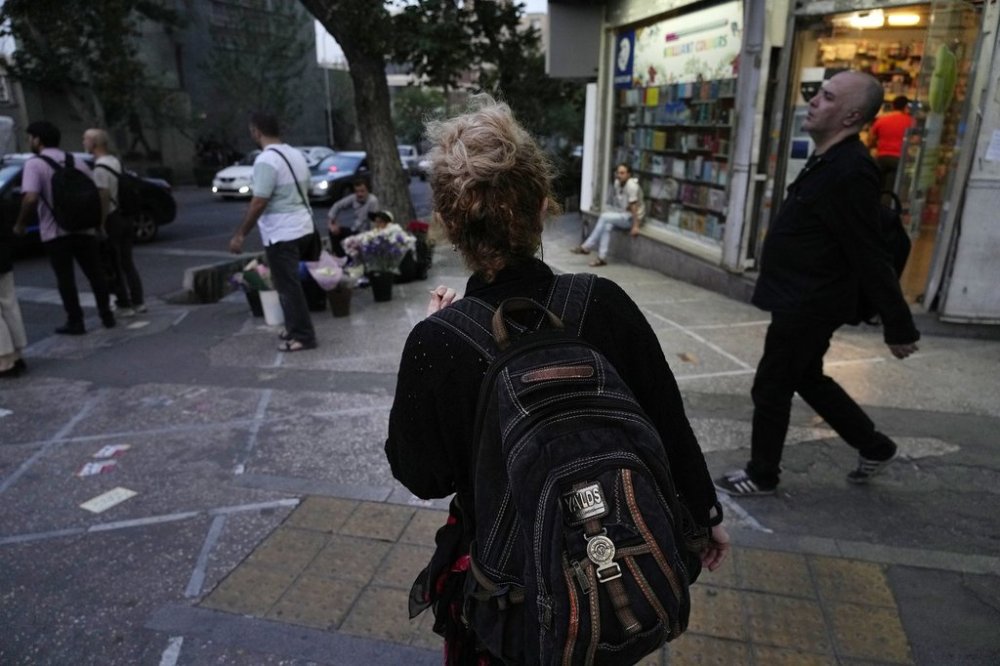
FILE - An Iranian woman, without a mandatory headscarf, or hijab, walks in downtown Tehran, Iran, June 10, 2024. (AP Photo/Vahid Salemi, File)

“Two and a half years after the protests began in September 2022, women and girls in Iran continue to face systematic discrimination, in law and in practice, that permeates all aspects of their lives, particularly with respect to the enforcement of the mandatory hijab,” the report said.

“The state is increasingly reliant on state-sponsored vigilantism in an apparent effort to enlist businesses and private individuals in hijab compliance, portraying it as a civic responsibility,” it added.

Iran’s diplomatic missions to the U.N. in New York and Geneva did not respond to a request for comment on the findings of the 20-page report.

Mission chair Sara Hossain cited two new areas of investigation this year: One involved “the disturbing pattern” of deaths of some protesters, including girls, which the state dismissed as cases of suicide. Families faced “judicial harassment” such as being prevented from mourning loved ones who died, she said.

The mission was also looking at the use of mock executions. “We found that detainees men, women and children had been held — in some cases at gunpoint or had nooses put around their necks — in a form of psychological torture,” Hossain told reporters in Geneva.

The team found that “chronic impunity” exists for those responsible for the repression, she added.

Drones, surveillance cameras monitor women

The investigators outlined how Iran increasingly relies on electronic surveillance. Among the efforts include Iranian officials deploying “aerial drone surveillance” to monitor women in public places. At Tehran’s Amirkabir University, authorities installed facial recognition software at its entrance gate to find women not wearing the hijab, it said.

Surveillance cameras on Iran’s major roadways also are believed to be involved in searching for uncovered women. U.N. investigators said they obtained the “Nazer” mobile phone app offered by Iranian police, which allows the public to report on uncovered women in vehicles, including ambulances, buses, metro cars and taxis.

“Users may add the location, date, time and the license plate number of the vehicle in which the alleged mandatory hijab infraction occurred, which then ‘flags’ the vehicle online, alerting the police,” the report said. “It then triggers a text message (in real-time) to the registered owner of the vehicle, warning them that they had been found in violation of the mandatory hijab laws, and that their vehicles would be impounded for ignoring these warnings.”

Those text messages have led to dangerous situations. In July 2024, police officers shot and paralyzed a woman who activists say had received such a message and was fleeing a checkpoint near the Caspian Sea.

The investigators found that 8,000 vehicles were confiscated because their drivers weren’t wearing the proper hijab.
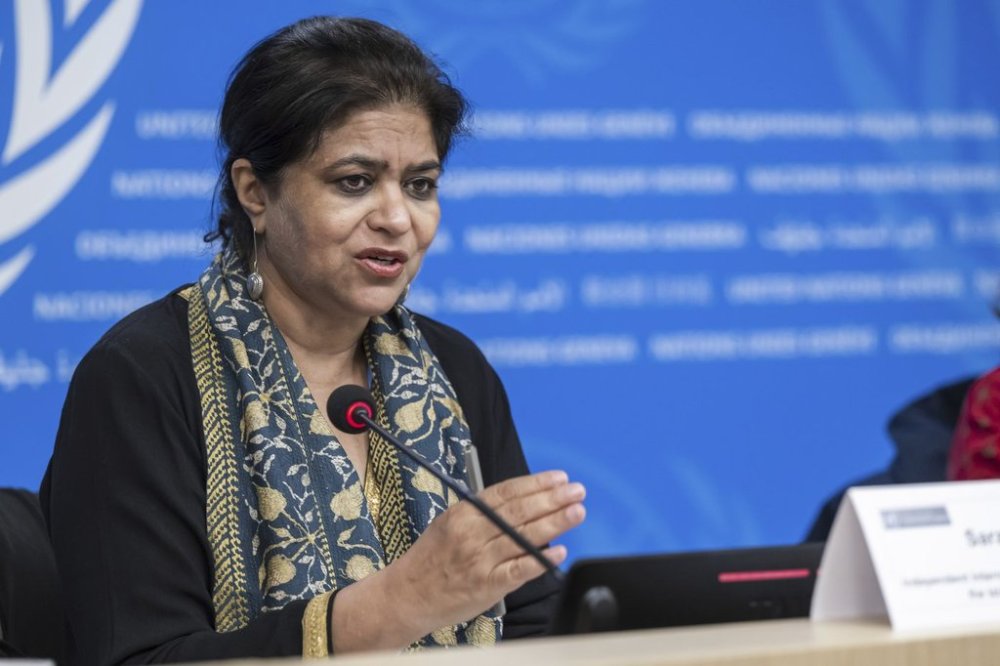
Sara Hossain, Chair of the Iran Fact-Finding Mission, speaks during a press conference about the launch of the Iran Fact-Finding Mission's latest report, at the European headquarters of the United Nations, in Geneva, Switzerland, Friday, March 14, 2025. (Martial Trezzini/Keystone via AP)

“What’s unusual and extraordinary about this is the kind of activity that is being monitored through the use of this app … what a woman wears or doesn’t wear,” Hossain said. “She shouldn’t have to be sanctioned for that.”

Tensions remain after 2022 death of Mahsa Amini

Amini, 22, died on Sept. 16, 2022, in a hospital after her arrest by the country’s morality police over allegedly not wearing her hijab to the liking of the authorities.

Amini’s death sparked months of protests and a security crackdown that killed more than 500 people and led to the detention of more than 22,000. After the mass demonstrations, police dialed down enforcement of hijab laws, but it ramped up again in April 2024 under what authorities called the Noor — or “Light” — Plan.

At least 618 women have been arrested under the Noor Plan, the U.N. investigators said, citing a local human rights activist group in Iran.

Meanwhile, Iran executed at least 938 people last year, a threefold increase from 2021, the U.N. said. While many were convicted of drug charges, the report said the executions “indicate a nexus with the overall repression of dissent in this period.”

As Iran continues its crackdown over the hijab, it also faces an economic crisis over U.S. sanctions due to its rapidly advancing nuclear program. While U.S. President Donald Trump has called for new negotiations, Iran has yet to respond to a letter he sent to its 85-year-old Supreme Leader Ayatollah Ali Khamenei. Social unrest, coupled with the economic woes, remain a concern for Iran’s theocracy.

___

Gambrell reported from Dubai, United Arab Emirates.

Report Error Submit a Tip

The Free Press acknowledges the financial support it receives from members of the city’s faith community, which makes our coverage of religion possible.
More Stories

Longtime voice of the Blue and Gold marks major milestone

David Sanderson 8 minute read Preview

Longtime voice of the Blue and Gold marks major milestone

David Sanderson 8 minute read Friday, Oct. 9, 2026

Bob McGregor made his debut as the Winnipeg Blue Bombers’ public-address announcer on June 7, 1997, during a pre-season game at Winnipeg Stadium between the hometown Blue Bombers and their western rivals, the Calgary Stampeders.

McGregor will be behind the microphone again this Saturday, detailing the action on the field in addition to leading a boisterous Princess Auto Stadium crowd through what has become his signature call, “And that is another Winnipeg Blue Bombers first down!”

The Bombers’ final home date of the 2026 regular season will mark a major milestone for McGregor, and the former newscaster feels it’s only fitting the same two teams as 10,717 days ago — the Bombers and Stampeders — will be the ones butting helmets.

“I knew at the start of the season I was closing in on 300 games as the PA guy, only it wasn’t until I went through the schedule that I realized my 300th would be Winnipeg-Calgary, which struck me as kind of cool,” McGregor says, seated in a St. James breakfast nook, dressed in dark trousers and a blue-and-gold Blue Bombers golf shirt.

Read
Friday, Oct. 9, 2026

Carney: Trump’s ‘energy ceasefire’ could ‘de-escalate’ war in Ukraine

Kyle Duggan, The Canadian Press 4 minute read Preview

Carney: Trump’s ‘energy ceasefire’ could ‘de-escalate’ war in Ukraine

Kyle Duggan, The Canadian Press 4 minute read Updated: Yesterday at 5:18 PM CDT

OTTAWA - Mark Carney thanked U.S. President Donald Trump for “his leadership toward securing an energy ceasefire" between Ukraine and Russia, the Prime Minister's Office said on Sunday.

But on the same day, Carney also expressed to Ukraine's leader that Trump's new diesel supply agreement with Russia undermines Canada's efforts to end the war in Europe.

Trump posted on his Truth Social account on Sunday that Ukraine and Russia have agreed to an "energy ceasefire," but did not immediately offer any details.

Carney expressed “strong support for this agreement," according to a readout from the PMO that followed a conversation between the two leaders. And on his own social media account, Carney offered that Trump’s newly announced “energy ceasefire” could help wind down Russia’s war against Ukraine.

Read
Updated: Yesterday at 5:18 PM CDT

Puzzles Palace

1 minute read Monday, Jul. 27, 2026

To solve our puzzles, please subscribe with this special offer: |

Puerto Vallarta boards up as Hurricane Simon hits Category 4 strength

The Associated Press 3 minute read Preview

Puerto Vallarta boards up as Hurricane Simon hits Category 4 strength

The Associated Press 3 minute read Saturday, Oct. 10, 2026

PUERTO VALLARTA, Mexico (AP) — Simon has strengthened into a powerful Category 4 hurricane as it barrels toward Mexico’s coast.

The National Hurricane Center in Miami said Saturday that Simon’s maximum sustained winds increased to 150 mph (240 kph). A storm of that strength or greater is considered a major hurricane.

The center said it expected Simon “to be near or just inland” of Mexico's west-central coast on Sunday. The hurricane could bring as much as 10 to 20 inches (25-50 cm) of rain over parts of southwestern Mexico, with some areas in the states of Michoacan, Colima and Jalisco receiving up to 30 inches (76 centimeters).

“This rainfall will produce life-threatening flooding and mudslides, especially in areas of steep terrain,” the center warned in a bulletin that also urged residents to take immediate action to prepare as tropical-storm conditions were expected to arrive Saturday afternoon.

Read
Saturday, Oct. 10, 2026

Business in brief: Kinew, Canadian ambassador to U.S. discuss trade

Free Press staff 2 minute read Saturday, Oct. 10, 2026

Canada’s ambassador to the United States met Manitoba Premier Wab Kinew and local business leaders during a visit to Winnipeg this week.

Mark Wiseman and Kinew spoke about trade uncertainty with the United States and opportunities for Manitoba businesses, a government news release says.

The provincial U.S. Trade Council, the Business Council of Manitoba and part of the Premier’s Business and Jobs Council spoke to Wiseman about the impacts of trade uncertainty.

Province down 4,400 jobsEmployment dropped 0.6 per cent in Manitoba in September, Statistics Canada reported Friday.

Landlords will face fines for breaching confidentiality

Carol Sanders 4 minute read Preview

Landlords will face fines for breaching confidentiality

Carol Sanders 4 minute read Friday, Oct. 9, 2026

The province is amending legislation to allow landlords to be penalized if they breach the confidentiality of tenants who break their lease by obtaining a domestic violence certificate.

“Hopefully, now there’s going to be measures in place so that if this happens again, and God forbid it happens again to anyone else, that there would be penalties imposed on landlords who do that,” said one victim whose concerns were published on the front page of the Free Press last month.

Under current legislation, landlords must ensure that any information received from those tenants regarding the termination of the tenancy is kept confidential, but there are no penalties for landlords who violate that section of the act. After hearing from victims put at risk when landlords broke the law by violating their confidentiality, the government announced Monday that it is amending the Residential Tenancies Act to allow for penalties.

The young woman who spoke to the Free Press showed that her landlord copied her alleged abuser in email correspondence that included her personal email address and the domestic violence certificate she obtained in 2025 to end a tenancy agreement early and leave an abusive relationship.

Read
Friday, Oct. 9, 2026