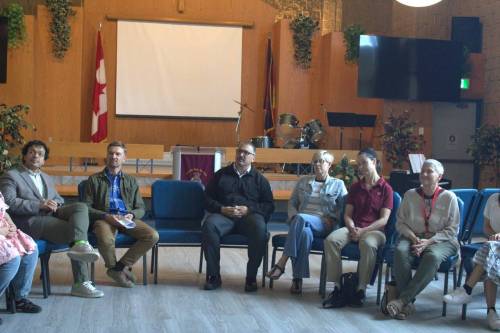
What goes on in a Christian Science reading room?
Advertisement
Read this article for free:
or
Already have an account? Log in here »
To continue reading, please subscribe:

Digital Subscription
One year of digital access for only $205*
- Enjoy unlimited reading on winnipegfreepress.com
- Read the E-Edition, our digital replica newspaper
- Access News Break, our award-winning app
- Play interactive puzzles
*First annual payment billed as $205.00 + GST for one year. This annual subscription will automatically renew at $233.00 + GST every 52 weeks (10% off the regular annual price of $259.35). Offer available to new and qualified returning subscribers only. Cancel any time.
To continue reading, please subscribe:
Add Free Press access to your Brandon Sun subscription for only an additional
$1 for the first 4 weeks*
- Enjoy unlimited reading on winnipegfreepress.com
- Read the E-Edition, our digital replica newspaper
- Access News Break, our award-winning app
- Play interactive puzzles
*Your next Brandon Sun subscription payment will increase by $1.00 and you will be charged $17.95 plus GST for four weeks. After four weeks, your payment will increase to $24.95 plus GST every four weeks.
Read unlimited articles for free today:
or
Already have an account? Log in here »
Hey there, time traveller!
This article was published 17/03/2025 (563 days ago), so information in it may no longer be current.
In nearly every major American city and in many small towns, Christian Science reading rooms are found mixed in with storefronts. Passersby may hardly notice them, but to those who stop to wonder what goes on inside, their purpose may seem inscrutable: a few shelves of books and some chairs and tables with pamphlets and other reading materials. It’s like a waiting room without a doctor.
Is it a church, and what does it have to do with science? Are they Scientologists?
Christian Science reading rooms are not churches — although they are run by one — and they’re not affiliated with Scientologists. They are a ministry of a homegrown American religious tradition, namely the Church of Christ, Scientist, founded in 1879 in Boston based on the thought of Mary Baker Eddy.
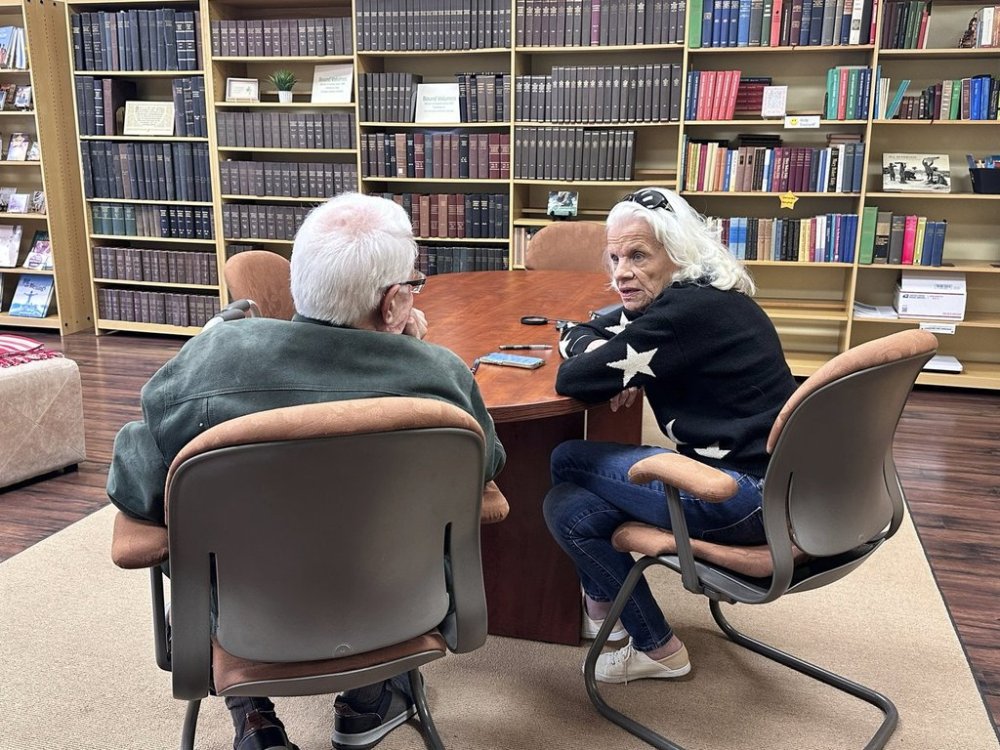
Unlike other Christian denominations, their pastor is not a flesh-and-blood human. Instead, their pastor is two books that guide their faith: the Bible and “Science and Health with Key to the Scriptures,” essentially the church’s textbook, authored by Eddy. It aims to provide an explanation of both the Bible and Christian Science theology, which has a special focus on healing through prayer and spirituality.
“The reading room is like a parsonage,” said Jasmine Holzworth, librarian of the Christian Science Reading Room at the First Church of Christ, Scientist, in Boston, the tradition’s first congregation, known as the Mother Church. “We don’t have a personal pastor — we have the books. People can come and sit and read. They’re here for people to trust as a pastor and ask their questions.”
___
This content is written and produced by Religion News Service and distributed by The Associated Press. RNS and AP partner on some religion news content. RNS is solely responsible for this story.
___
Operating a reading room, which also offers Christian Science literature for sale, is not an optional ministry for a Christian Science church. Some smaller churches may jointly operate one with another local church, or may only have one open for a few hours a week, but all must offer a reading room, Eddy wrote in her “Manual of the Mother Church.”
Conversely, reading rooms are always connected to a church. While they may not always be directly next to the church, they are all maintained by one, often in separate storefronts. Christian Scientists see this as a good thing, Holzworth said.
“Someone may not always want to walk into a church building — there’s a hesitancy about religion today,” Holzworth said
At a Christian Science Sunday service, there is no homily. Instead, it includes readings from the Bible and “Science and Health,” tied to a particular subject that Eddy set for each week of the year. The 26 subjects that repeat twice a year range from topics like “love” and “sacrament,” to “ancient and modern necromancy, alias mesmerism and hypnotism, denounced” and “Is the universe, including man, evolved by atomic force?”
“‘Science and Health’ is a book that continually turns us back to our Bible,” said Alex Griffin, who is the Deputy Committee on Publication for the state of Massachusetts.
Eddy, who died in 1910, was concerned that people interested in Christian Science would not be able to find adequate or legitimate books about the faith at regular bookstores, leading to an emphasis on the reading rooms, Holzworth said. During Eddy’s lifetime, New Thought leader Ursula Newell Gestefeld and others reused Eddy’s writings in a non-Christian context, which Eddy saw as a problem that could cause confusion about the faith. And even today, Christian Science is confused by some with Scientology, hence the importance of the reading rooms as places where those interested in Christian Science can find literature authorized by the church.
“You have to have the heart driving it,” Holzworth said. “What’s driving it is that congregation’s love for the teachings of Christian Science. When you’re motivated by love, all things are possible.”
Like many American religious groups, Christian Science churches have struggled in recent decades to maintain older buildings with dwindling numbers of practitioners and teachers. About 1,220 Christian Science churches are located throughout the world, and about half are in the United States. The denomination does not report its number of congregants in accordance with the Manual of the Mother Church, which states, “According to the Scripture they shall turn away from personality and numbering the people.”
Some Christian Science churches have sold their buildings and moved into the reading rooms. In other cases, the reading room has moved in with the church.
The Christian Science church in Cambridge, Massachusetts, purchased its Harvard Square building during the Great Depression and now rents out parts of it. Other churches lease storefronts like any other commercial entities. While the churches sell religious books for children and adults to help cover costs, church sources declined to give further details about how storefront rents are funded.
However, San Francisco International Airport has a reading room that, according to an SFGATE report, has its “exorbitant” rent paid for, in part, by pledges from 10 area churches. And in Naples, Florida, a reading room lost its storefront to a gelato shop after its landlord decided not to continue its lease in 2017. The Naples reading room, which opened in the 1960s, had been paying $790 per month in an area where rents went as high as $3,000 per month for a similar-size space. The reading room had negotiated the rent with a former landlord and lost the space after the building was sold.
While they see the reading rooms as a way to spread their faith, the church doesn’t aggressively proselytize to newcomers.
“It’s a gift to the community. You can come in and ask questions. Everyone’s on their own spiritual path. We’re meant to be welcoming to everyone,” Holzworth said. “You’re not going to find someone trying to sign you up for anything. We’re doing this because we love God, but people don’t need to love God to come in here.”
The Mother Church’s reading room is located next to Berklee College of Music in Boston, and Holzworth said it has hosted Berklee students of other denominations seeking a place to pray and read their Bibles. Students of no religion who just want a quiet space to be are also invited.
But for those in the religion, reading the week’s Bible lessons is an important part of the practice, she said.

“Christian Scientists use reading rooms as a place to study and dig in,” Holzworth said.
The reading room of the Mother Church also hosts a weekly event where participants read The Christian Science Monitor and pray for those impacted by world events.
“It’s not just a Sunday faith,” Holzworth said. “It’s meant to be applied to the whole week, and not just our own life, but the world around us.”
At larger reading rooms, like the one operated by the Mother Church, staff are paid. At smaller churches, however, congregants volunteer.
“I figured I was going to be studying the Bible and Christian Science anyway, so I might as well be doing it in a way that serves the community,” said Teddy Crecelius, a tour guide at the Mother Church who has previously been involved in Christian Science branch churches. “It’s not a burden.”
The Free Press acknowledges the financial support it receives from members of the city’s faith community, which makes our coverage of religion possible.