

Albania’s Orthodox Church enthrones its new Archbishop Joan
Advertisement
Read this article for free:
or
Already have an account? Log in here »
To continue reading, please subscribe:
Monthly Digital Subscription
$0 for the first 4 weeks*
- Enjoy unlimited reading on winnipegfreepress.com
- Read the E-Edition, our digital replica newspaper
- Access News Break, our award-winning app
- Play interactive puzzles
*No charge for 4 weeks then price increases to the regular rate of $19.95 plus GST every four weeks. Offer available to new and qualified returning subscribers only. Cancel any time.
Monthly Digital Subscription
$4.99/week*
- Enjoy unlimited reading on winnipegfreepress.com
- Read the E-Edition, our digital replica newspaper
- Access News Break, our award-winning app
- Play interactive puzzles
*Billed as $19.95 plus GST every four weeks. Cancel any time.
To continue reading, please subscribe:
Add Free Press access to your Brandon Sun subscription for only an additional
$1 for the first 4 weeks*
*Your next subscription payment will increase by $1.00 and you will be charged $16.99 plus GST for four weeks. After four weeks, your payment will increase to $23.99 plus GST every four weeks.
Read unlimited articles for free today:
or
Already have an account? Log in here »
Hey there, time traveller!
This article was published 29/03/2025 (285 days ago), so information in it may no longer be current.
TIRANA, Albania (AP) — Albania’s Orthodox Church on Saturday held an enthronement ceremony for its new Archbishop Joan, who succeeded Archbishop Anastasios following his death in January.
The ceremony was held at the Cathedral of Resurrection of Christ in downtown Tirana, formally launching Joan’s leadership as the archbishop of Tirana, Durres and all of Albania and also head of the Autocephalous Orthodox Church of Albania.
Earlier this month a seven-member Holy Synod unanimously elected Joan, the metropolitan of Korca, in the post left vacant after Anastasios’ death in January.
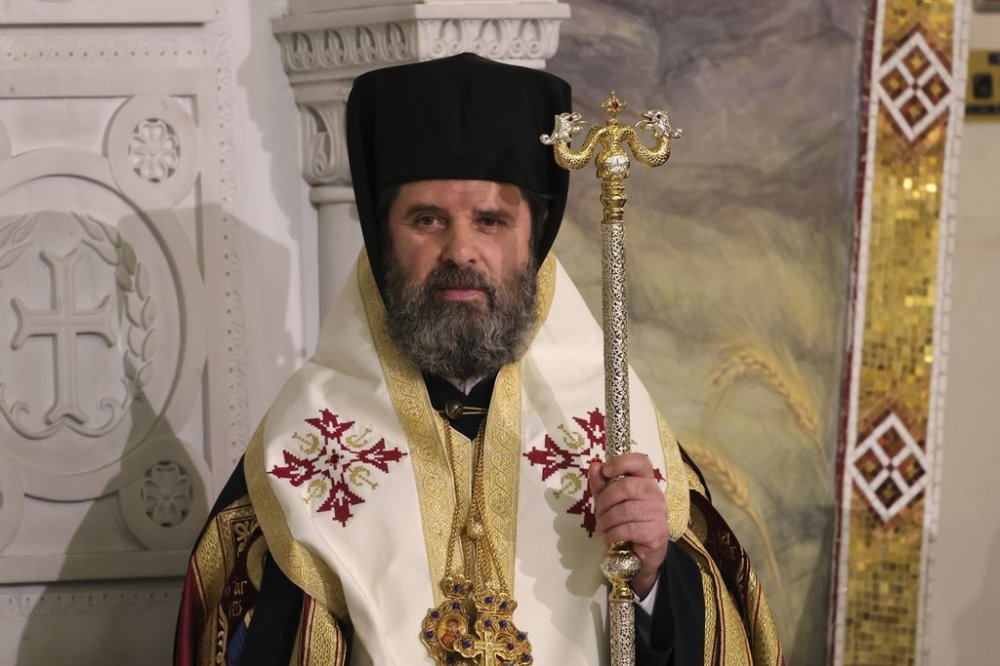
Albania’s religious leaders, top officials and politicians, Orthodox religious leaders from around the world, a Vatican representative and Greece’s ministers of defense and social cohesion attended the ceremony. Hundreds of faithful packed into the cathedral.
Bishop Nikolla of Apollonia and Fieri, speaking on behalf of the Holy Synod, said that Joan would continue “preserving religious harmony and co-existence,” like his predecessor Anastasios, who resuscitated the country’s church after the fall of communism.
“Albania’s Autocephalous Orthodox Church wants to live in peace with all,” said Archbishop Joan, adding that religious co-existence but should be “defended and further enriched.”
Albanian President Bajram Begaj said the ceremony sends a message “that transcends borders of faith and invites all goodwill citizens in building up a fairer, more humble, more united and fraternal society.”
The Orthodox Church of Albania was declared autocephalous in September in 1922, ending its subordination to the archbishopric of Ohrid and the patriarchate of Constantinople.
Archbishop Joan, 69, born Fatmir Pelushi, grew up in a Muslim family. He was secretly baptized in 1979 by priest Kosmas Kyrios, who later became the bishop of Apollonia.
All forms of religion were banned in Albania for 23 years starting in 1967, when the country was completely isolated from the outside world and the communists seized the property of Islamic, Orthodox, Catholic and other churches.

Joan, whose family was persecuted by the communists, joined a small underground church group. He worked at the Tirana Psychiatric Hospital until 1990, when the communist leadership collapsed. In 1990, he fled to Italy and then to Boston, where he studied at the Holy Cross Greek Orthodox School of Theology.
In 1992, when Albanians fled the poor country en masse, Joan contacted Archbishop Anastasios offering his return to contribute to the church’s reconstruction. He is the sixth head of the Albanian Orthodox Church.
According to the 2023 census, Orthodox believers in Albania make up about 7% of the 2.4 million population, although the church says the actual number is higher. The tiny Western Balkan country is about half Muslim, followed by the Catholics, Orthodox and other religious communities and nonbelievers, who all live in harmony.
___
Associated Press religion coverage receives support through the AP’s collaboration with The Conversation US, with funding from Lilly Endowment Inc. The AP is solely responsible for this content.
The Free Press acknowledges the financial support it receives from members of the city’s faith community, which makes our coverage of religion possible.