

Artisans in Guatemala hand-stitch velvet cloaks for Holy Week processions
Advertisement
Read this article for free:
or
Already have an account? Log in here »
To continue reading, please subscribe:
Monthly Digital Subscription
$1 per week for 24 weeks*
- Enjoy unlimited reading on winnipegfreepress.com
- Read the E-Edition, our digital replica newspaper
- Access News Break, our award-winning app
- Play interactive puzzles
*Billed as $4.00 plus GST every four weeks. After 24 weeks, price increases to the regular rate of $19.95 plus GST every four weeks. Offer available to new and qualified returning subscribers only. Cancel any time.
Monthly Digital Subscription
$4.99/week*
- Enjoy unlimited reading on winnipegfreepress.com
- Read the E-Edition, our digital replica newspaper
- Access News Break, our award-winning app
- Play interactive puzzles
*Billed as $19.95 plus GST every four weeks. Cancel any time.
To continue reading, please subscribe:
Add Free Press access to your Brandon Sun subscription for only an additional
$1 for the first 4 weeks*
*Your next subscription payment will increase by $1.00 and you will be charged $16.99 plus GST for four weeks. After four weeks, your payment will increase to $23.99 plus GST every four weeks.
Read unlimited articles for free today:
or
Already have an account? Log in here »
Hey there, time traveller!
This article was published 17/04/2025 (343 days ago), so information in it may no longer be current.
SAN MIGUEL ESCOBAR, Guatemala (AP) — Stitch by stitch, artisans have worked for months on the elaborate garments that will debut this week in Holy Week processions across Guatemala and beyond.
The hefty velvet cloaks, finely embroidered with gold thread will cover the wooden Virgin Mary and Christ figures carried by the faithful down cobblestone streets lined by thousands.
Palm Sunday commemorates the Christian belief in the triumphal entry of Jesus into Jerusalem, when he was greeted by cheering crowds waving palm branches that they set out on the ground along his path, according to the Bible. The most sacred week of the Christian year also includes the Good Friday re-enactment of Jesus’ crucifixion story and death, and their belief in his resurrection on Easter.
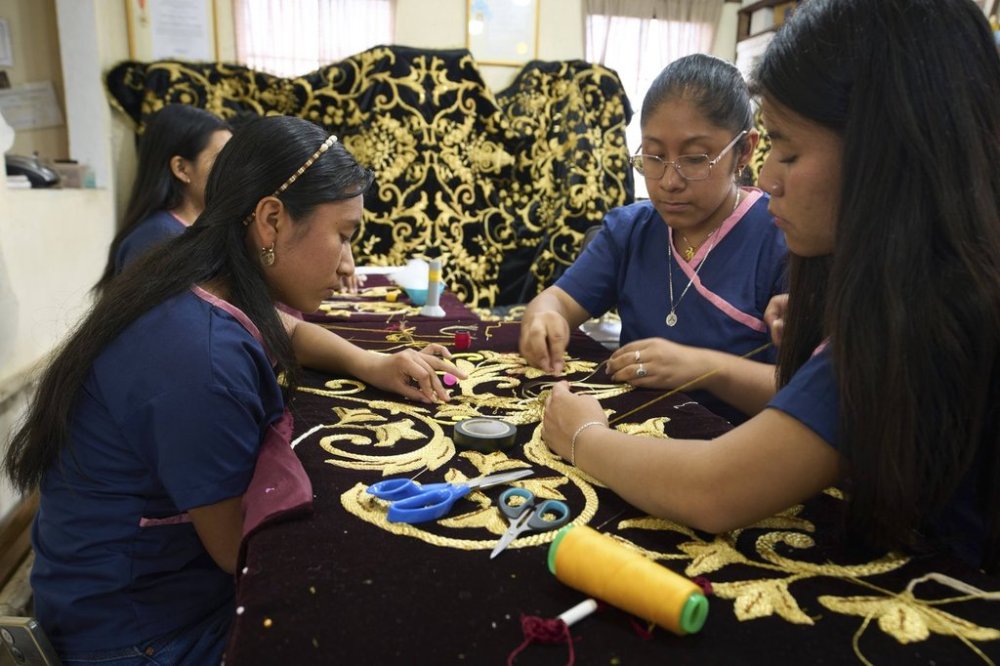
At Alejandro Juárez Toledo’s María Auxiliadora workshop about 25 miles (41 kilometers) southwest of Guatemala City, 28 artisans — mostly women — lean over yards of rich velvet spread across tables, hand-stitching the cloaks, embroidering gold floral designs. The dormant Volcano of Water, one of Guatemala’s highest, acts as an impressive backdrop to their workshop.
A cloak for the Virgin Mary can measure 4 square yards (about 3 meters) and weigh more than 50 pounds, requiring a metal frame to support the weight of the fabric without damaging the wooden figure.
Juárez Toledo has been crafting the pieces for 26 years but is still moved to tears when they robe the figures at the center of the Holy Week processions.
“The moment most important for me is when the embroidery is attached to the fabric, that’s when you start to live the process with your client, it starts to generate more emotion, you start to enjoy (the work) even more,” he said.

His workshop’s creations have clothed figures from Guatemala to El Salvador, Honduras, Costa Rica and Panama.
Guatemala’s Holy Week celebrations are especially exuberant. UNESCO, the United Nations cultural arm, designated them as part of the Intangible Cultural Heritage of Humanity in 2022.
Walter Gutiérrez, a history professor at San Carlos University in Guatemala, said that “the processions are the true expression of Guatemala in all cultural, spiritual and traditional areas.”
____
Follow AP’s coverage of Latin America and the Caribbean at https://apnews.com/hub/latin-america
The Free Press acknowledges the financial support it receives from members of the city’s faith community, which makes our coverage of religion possible.