Those devoted to bullfighting in Mexico feel recent bans harm a sacred tradition
Advertisement
Read this article for free:
or
Already have an account? Log in here »
To continue reading, please subscribe:

Digital Subscription
One year of digital access for only $205*
- Enjoy unlimited reading on winnipegfreepress.com
- Read the E-Edition, our digital replica newspaper
- Access News Break, our award-winning app
- Play interactive puzzles
*First annual payment billed as $205.00 + GST for one year. This annual subscription will automatically renew at $233.00 + GST every 52 weeks (10% off the regular annual price of $259.35). Offer available to new and qualified returning subscribers only. Cancel any time.
To continue reading, please subscribe:
Add Free Press access to your Brandon Sun subscription for only an additional
$1 for the first 4 weeks*
- Enjoy unlimited reading on winnipegfreepress.com
- Read the E-Edition, our digital replica newspaper
- Access News Break, our award-winning app
- Play interactive puzzles
*Your next Brandon Sun subscription payment will increase by $1.00 and you will be charged $17.95 plus GST for four weeks. After four weeks, your payment will increase to $24.95 plus GST every four weeks.
Read unlimited articles for free today:
or
Already have an account? Log in here »
Hey there, time traveller!
This article was published 07/05/2025 (517 days ago), so information in it may no longer be current.
AGUASCALIENTES, Mexico (AP) — Mexican matador Diego Silveti performs a ritual ahead of each bullfight.
In each hotel room where he dresses in the garment that may bring him glory or death, he sets up an altar where he leaves his wedding band and prays before heading to the arena.
“By leaving my ring behind, I’m telling God: Here’s everything I am as a father, a husband, a son and a brother,” Silveti said. “I commit to what I was born to be — a bullfighter.”
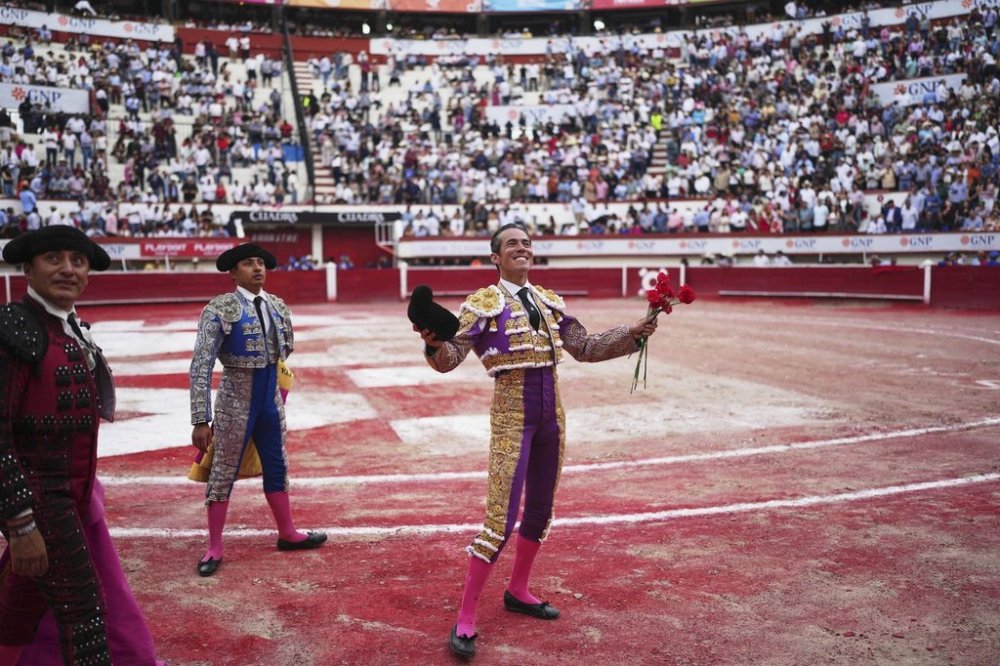
He last encountered a bull in late April in Aguascalientes, a state in central Mexico where bullfighting is considered a cultural heritage. Weeks before, though, Mexico City lawmakers banned violent bullfighting in the nation’s capital.
While matadors there are still allowed to fight bulls, piercing their muscles with laces or running a sword through their body is prohibited under that ban.
Animal rights advocates celebrated the ruling and Environment Secretary Julia Álvarez said the lawmakers made history. But matadors like Silveti, as well as fans and cattle breeders, contend this long-time Spanish tradition bears a profound significance that would be undermined if bulls can’t be killed in the arena.
“What they propose goes against the essence and the rituals of bullfighting,” Silveti said. “It’s a veiled prohibition that opposes the ways in which it has been done since its origins.”
Bullfighting in Mexico traces its roots to Spain
The European conquerors of Mesoamerican territories in the 16th century brought along Catholicism and cultural practices that are now intertwined with Indigenous customs.
Researcher and bullfighting fan Antonio Rivera lives in Yucatán, a southeastern state where bullfights reflect ancient Mayan traditions.
“In local celebrations, the roots of bullfighting are sacrificial rites,” Rivera said. “Ancient cultures believed the gods requested sacrifices and blood fertilizes the earth.”
Every year, the Yucatán peninsula celebrates about 2,000 events featuring bulls, he said.
In 2021, Yucatán’s Congress declared bullfighting part of its cultural heritage. It was a way to keep the ancestral memory alive, the official declaration said, and a way to honor its people’s identity.
“When I see a bull, I feel an immense devotion,” Rivera said. “It’s a mirror of myself. It’s like looking at a living museum containing all the rituals from our collective memory.”
Like father, like son
Instead of soccer balls, Silveti grew up playing with “muletas” and “capotes” — the brightly colored capes matadors use to channel the bull’s charge.
His father was one of Mexico’s most beloved and renowned bullfighters. Until his death in 2003, fans called him “King David” and many remember him fondly when his son is in the ring.
“No one asked us where we wanted to be born,” Silveti said. “The love towards the bull and the feast of bullfighting has been my life and my ancestors’ life.”
His grandfather and his father before him were also matadors. Silveti emphasizes that his sons — now ages 6 and 2 — will decide their profession, but he would proudly support them if they followed in his footsteps.
Neither the boys nor his wife watch him at the bullring, but Silveti conveys his passion in other ways. His family often visit ranches where bulls are breed. Occasionally, with his sons in his arms, Silveti bullfights baby cows.
“My youngest loves it,” the matador said. “When he watches a bullfight, he plays with a napkin or a cloth and says ‘Olé!’ How is that possible?”
Each bullfight has its rituals
“The King” was no longer alive when Silveti became a professional bullfighter in Spain in 2011, but he senses his father’s presence constantly.
“I feel his spirit in my soul,” Silveti said. “On certain days, when I’m alone and focused, I try to speak to him and follow his example.”
As a child, Silveti never watched his father at the ring. He stayed home with his mother and brothers. With no social media at hand to monitor live updates, they asked God to protect him.
Many matadors, like Silveti, pray ahead of each bullfight. At the Aguascalientes plaza, the Rev. Ricardo Cuéllar blesses them.
“My job is to attend the religious needs of the bullfighting family,” Cuéllar said. “Not only matadors, but also aficionados, those selling food at the arena and the bullfighters’ assistants.”
According to Tauromaquia Mexicana, Mexico’s biggest bullfighting organization, more than 20,000 jobs depend on this tradition.
A take on bulls
One of the organizations opposed to violent bullfighting, Cultura sin Tortura, was pleased by the Mexico City measure and said it would continue its efforts elsewhere. Another half a dozen Mexican states have also imposed bans.
“We will keep advocating for the prohibition, given that no animal must be seen as entertainment,” the group said on social media.
Cattle breeders, meanwhile, say they view bulls not as sources of income but as fascinating creatures they spend years caring for. Manuel Sescosse, who owns a ranch, said that breeding this specific type of bull is as thrilling as bullfighting.
“They must look good at the arena,” Sescosse said. “Offensive but noble. They must charge and simultaneously spark a sensitivity driving the crowds to deep emotion.”
The perfect bull for a fight is 4 or 5 years old and weighs between 900-1,200 pounds.
According to Sescosse, each rainy season a bull is mated with 30 cows and their offspring are carefully monitored. Most receive a name. All are fed exclusively with grass and large areas are secured for them to exercise and grow strong. At the proper age, only a handful will be selected for bullfighting.
“You watch them since they are born and become calves and grow,” Sescosse said. “That affection grows when they turn out good for a bullfight, leave a mark and are revered.”
Long live Centinela
Not everyone attending bullfights is drawn to the sacred aspect, but some do find deeper purpose.
Daniel Salinas says matadors follow strict norms to demonstrate their appreciation toward the bull’s life, even as they end it. “We celebrate death deriving from a rite in which a human being confronts a wild animal,” he said.
At Aguascalientes, when his second bull died, Silveti caressed him and respectfully closed his eyes before stepping out of the arena.
“I’m aware the bull is offering me everything he has and I’m also willing to present him with my life,” Silveti said. “I’ve been gored 13 times and I’ve taken those hits willingly because I do this for a bigger purpose.”
It rarely happens, but when a bull has a unique, artistic connection with its matador, his life is spared. Instead of a sword, he gets a “banderilla” (a dart-like stick). Then he returns to his ranch and breeds a progeny that fans will revere.

Following Silveti’s performance in Aguascalientes, Spanish matador Alejandro Talavante faced one of those bulls.
Centinela — pitch-black hide, four years old, 1,140 pounds — won the fans’ hearts as Talavante’s passes made him spin and dance. The matador aimed to kill more than once, but the crowd pleaded for him not to. And in the end, the judge indulged.
Centinela gave a final, vigorous run and vanished through the tunnel while thousands cheered. It was a day of glory for him as well.
____
Associated Press religion coverage receives support through the AP’s collaboration with The Conversation US, with funding from Lilly Endowment Inc. The AP is solely responsible for this content.
The Free Press acknowledges the financial support it receives from members of the city’s faith community, which makes our coverage of religion possible.