What’s in a name? Pope Leo XIV’s choice signals a commitment to social justice
Advertisement
Read this article for free:
or
Already have an account? Log in here »
To continue reading, please subscribe:

Digital Subscription
One year of digital access for only $205*
- Enjoy unlimited reading on winnipegfreepress.com
- Read the E-Edition, our digital replica newspaper
- Access News Break, our award-winning app
- Play interactive puzzles
*First annual payment billed as $205.00 + GST for one year. This annual subscription will automatically renew at $233.00 + GST every 52 weeks (10% off the regular annual price of $259.35). Offer available to new and qualified returning subscribers only. Cancel any time.
To continue reading, please subscribe:
Add Free Press access to your Brandon Sun subscription for only an additional
$1 for the first 4 weeks*
- Enjoy unlimited reading on winnipegfreepress.com
- Read the E-Edition, our digital replica newspaper
- Access News Break, our award-winning app
- Play interactive puzzles
*Your next Brandon Sun subscription payment will increase by $1.00 and you will be charged $17.95 plus GST for four weeks. After four weeks, your payment will increase to $24.95 plus GST every four weeks.
Read unlimited articles for free today:
or
Already have an account? Log in here »
Hey there, time traveller!
This article was published 08/05/2025 (515 days ago), so information in it may no longer be current.
SCHIAVON, Italy (AP) — Pope Leo XIV ‘s choice of name signals a commitment to social justice that is very much in line with the late Pope Francis ‘ global ministry.
“I think a lot us had a question mark when they elected an American, and then he selected the name Pope Leo XIV,” said Natalia Imperatori-Lee, the chair of religious studies at Manhattan University. “It really means to me he will continue the work of Leo XIII.”
Pope Leo XIII, who was head of the Catholic Church from 1878 to 1903, laid the foundation for modern Catholic social thought, most famously with his 1891 encyclical Rerum Novarum, which addressed workers’ rights and capitalism at the dawn of the industrial age. He criticized both laissez-faire capitalism and state-centric socialism, giving shape to a distinctly Catholic vein of economic teaching.
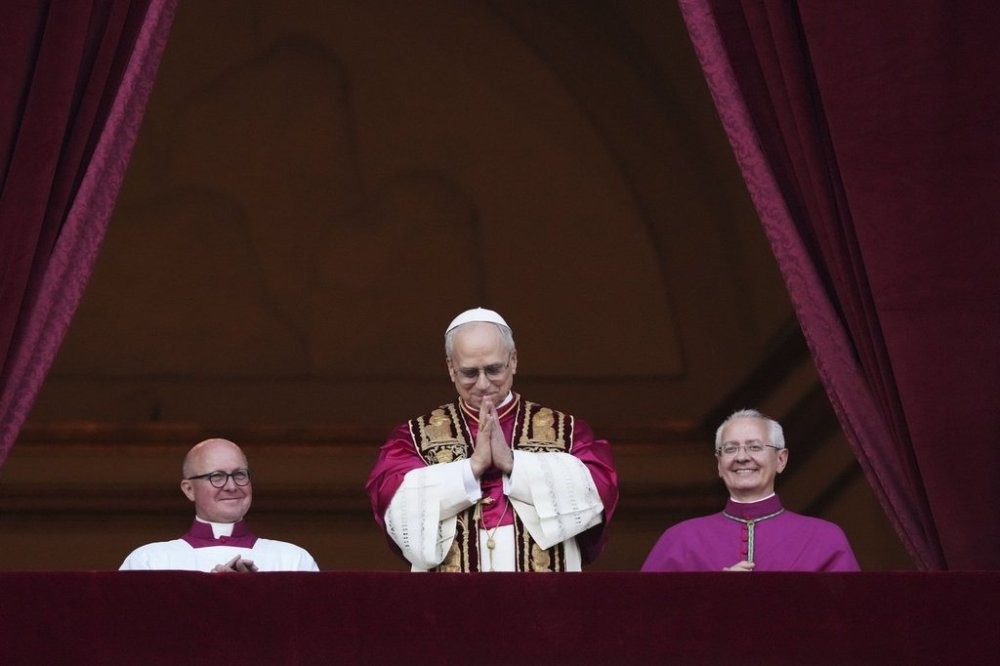
The name “is a deep sign of commitment to social issues,” said Imperatori-Lee. “I think this (new) pope is saying something about social justice, by choosing this name, that it is going to be a priority. He is continuing a lot of Francis’ ministry.”
Vatican spokesman Matteo Bruni confirmed that choice of the name Leo was a reference to Leo XIII and the social doctrine of the church, in particular the Rerum Novarum encyclical, considered the Catholic Church’s first social encyclical.
Another predecessor, Pope Leo I, was known for repelling the barbarian invasion of Attila the Hun in 452 A.D. and dissuading him from sacking Rome through diplomacy, Italian Cardinal Mauro Piacenza told RAI Italian state TV. He also noted that Pope Leo XIII elevated the Sanctuary of Our Lady of the Rosary of Pompeii to a papal basilica in 1901.
Leo could also refer to Brother Leo, the 13th century friar who was a great companion of St. Francis of Assisi. By choosing such a name, the new pope could be signaling also a very strong continuity with Francis, who named himself after the saint.
For most of the Catholic Church’s first millennium, popes used their given names. The first exception was the 6th century Roman Mercurius, who had been named for a pagan god and chose the more appropriate name of John II.
The practice of adopting a new name became ingrained during the 11th century, a period of German popes who chose names of early church bishops out of “a desire to signify continuity,” according to Rev. Roberto Regoli, a historian at Rome’s Pontifical Gregorian University.
For many centuries, new popes tended to choose the name of the pope who had elevated them to cardinal. John was the most popular, chosen by 23 popes, followed by Benedict and Gregory, each with 16.

It was from the mid-20th century that new popes began to choose names signaling the aim of their papacy, Regoli said.
_____
AP writers Nicole Winfield and Vanessa Gera contributed from Rome.
____
Associated Press religion coverage receives support through the AP’s collaboration with The Conversation US, with funding from Lilly Endowment Inc. The AP is solely responsible for this content.
Related Articles
Robert Prevost, first pope from US in history of the Catholic Church, takes the name Leo XIV
Advertisement Advertise With Us
Advertisement Advertise With Us
The Free Press acknowledges the financial support it receives from members of the city’s faith community, which makes our coverage of religion possible.