How Silicon Valley is using religious language to talk about AI

Advertisement

Advertise with us

TORONTO (AP) — As the rapid, unregulated development of artificial intelligence continues, the language people in Silicon Valley use to describe it is becoming increasingly religious.

Read this article for free:


or

Already have an account? Log in here »

To continue reading, please subscribe:

Subscribe and receive a limited-edition Free Press branded hat or tote.

Digital Subscription

One year of digital access for only $205*

  • Enjoy unlimited reading on winnipegfreepress.com
  • Read the E-Edition, our digital replica newspaper
  • Access News Break, our award-winning app
  • Play interactive puzzles

*First annual payment billed as $205.00 + GST for one year. This annual subscription will automatically renew at $233.00 + GST every 52 weeks (10% off the regular annual price of $259.35). Offer available to new and qualified returning subscribers only. Cancel any time.

To continue reading, please subscribe:

Add Free Press access to your Brandon Sun subscription for only an additional

$1 for the first 4 weeks*

  • Enjoy unlimited reading on winnipegfreepress.com
  • Read the E-Edition, our digital replica newspaper
  • Access News Break, our award-winning app
  • Play interactive puzzles
Start now

*Your next Brandon Sun subscription payment will increase by $1.00 and you will be charged $17.95 plus GST for four weeks. After four weeks, your payment will increase to $24.95 plus GST every four weeks.

Hey there, time traveller!
This article was published 29/08/2025 (348 days ago), so information in it may no longer be current.

TORONTO (AP) — As the rapid, unregulated development of artificial intelligence continues, the language people in Silicon Valley use to describe it is becoming increasingly religious.

From predicting the potential destruction of humanity to a transhumanist apocalypse where people merge with AI, here’s what some of the key players are saying.

___
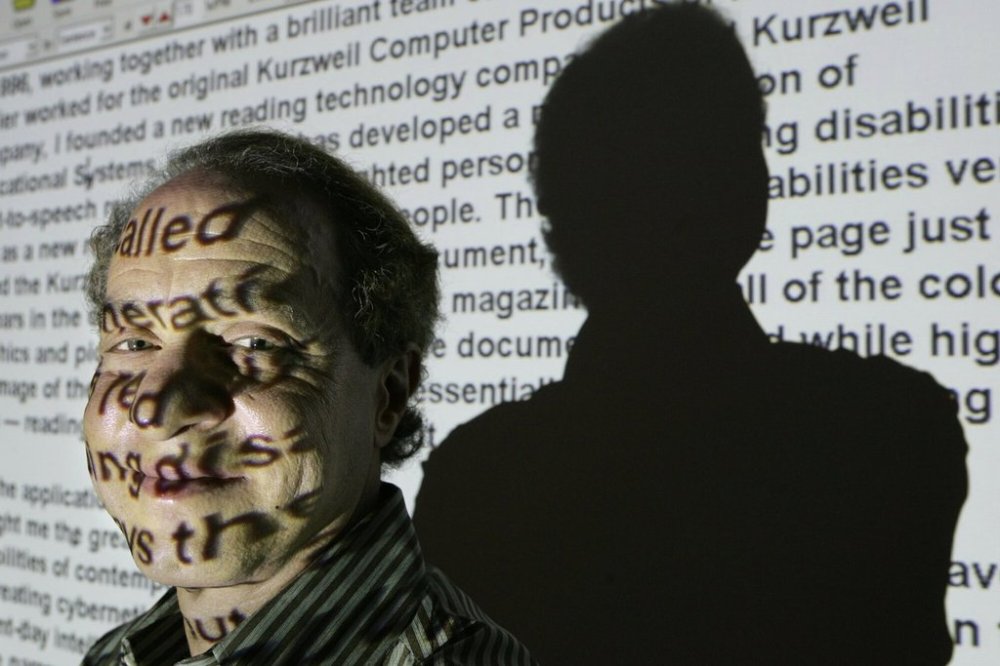
FILE - Author and inventor Ray Kurzweil, 56, stands for a portrait in front of words from his internet site projected on a screen in his office in Wellesley, Mass., Jan. 12, 2005. (AP Photo/Steven Senne, File)

“I think religion will be in trouble if we create other beings. Once we start creating beings that can think for themselves and do things for themselves, maybe even have bodies if they’re robots, we may start realizing we’re less special than we thought. And the idea that we’re very special and we were made in the image of God, that idea may go out the window.”

— Nobel Prize winner Geoffrey Hinton, often dubbed the “Godfather of AI” for his pioneering work on deep learning and neural networks.

___

“By 2045, which is only 20 years from now, we’ll be a million times more powerful. And we’ll be able to have expertise in every field.”

— author and computer scientist Ray Kurzweil, who believes humans will merge with AI.

___

“There certainly are dimensions of the technology that have become extremely powerful in the last century or two that have an apocalyptic dimension. And perhaps it’s strange not to try to relate it to the biblical tradition.”

— PayPal and Palantir co-founder Peter Thiel speaking to the Hoover Institution at Stanford University.

___

“I feel that the four big AI CEOs in the U.S. are modern-day prophets with four different versions of the Gospel and they’re all telling the same basic story that this is so dangerous and so scary that I have to do it and nobody else.”

— Max Tegmark, a physicist and machine learning researcher at the Massachusetts Institute of Technology.

___

“When people in the tech industry talk about building this one true AI, it’s almost as if they think they’re creating God or something.”

— Meta CEO Mark Zuckerberg on a podcast promoting his company’s own venture into AI.

___

“Everyone (including AI companies!) will need to do their part both to prevent risks and to fully realize the benefits. But it is a world worth fighting for. If all of this really does happen over 5 to 10 years — the defeat of most diseases, the growth in biological and cognitive freedom, the lifting of billions of people out of poverty to share in the new technologies, a renaissance of liberal democracy and human rights — I suspect everyone watching it will be surprised by the effect it has on them.”

— Anthropic CEO Dario Amodei in his essay, “Machines of Loving Grace: How AI Could Transform the World for the Better.”

___

“You and I are living through this once-in-human-history transition where humans go from being the smartest thing on planet Earth to not the smartest thing on planet Earth.”

— OpenAI CEO Sam Altman during an interview for TED Talks.

___

“These really big, scary problems that are complex and challenging to address — it’s so easy to gravitate towards fantastical thinking and wanting a one-size-fits-all global solution. I think it’s the reason that so many people turn to cults and all sorts of really out there beliefs when the future feels scary and uncertain. I think this is not different than that. They just have billions of dollars to actually enact their ideas.”

— Dylan Baker, lead research engineer at the Distributed AI Research Institute.

___

Associated Press religion coverage receives support through the AP’s collaboration with The Conversation US, with funding from Lilly Endowment Inc. The AP is solely responsible for this content.

Report Error Submit a Tip

The Free Press acknowledges the financial support it receives from members of the city’s faith community, which makes our coverage of religion possible.


More Stories

Gridlock by design: no excuses for bed backlog

Jason M. Sutherland 5 minute read 2:00 AM CDT

Imagine waking up in a hospital bed and being told by a doctor that you are well enough to leave, only to discover you cannot. Not because you want to stay, but because there is nowhere safe for you to go. No home-care support, no rehabilitation space, no long-term care bed.

This is unfortunately the daily reality for thousands of Canadians.

Being stuck in a hospital bed is a crisis from coast to coast. Our acute care hospitals are functioning as wildly expensive beds for vulnerable citizens awaiting a more suitable place to take them in.

A decade ago, policymakers fretted over this exact issue. Today, despite an aging population with increasingly complex needs and higher demand for hospital beds, the crisis has only deepened.

RCMP investigating four-year-old girl’s death, two younger girls’ injuries in home on First Nation

Free Press staff 2 minute read Preview

RCMP investigating four-year-old girl’s death, two younger girls’ injuries in home on First Nation

Free Press staff 2 minute read Yesterday at 1:05 PM CDT

RCMP are investigating after a four-year-old girl died in suspicious circumstances at a home in Long Plain First Nation over the weekend.

Paramedics called Manitoba First Nations Police Service officers at about 7:45 a.m. on Sunday, asking for assistance at a home where the girl was reported as injured and in medical distress.

Officers helped paramedics with emergency treatment, but she was pronounced dead at the scene.

Two other girls — a one-year-old and a two-year-old — were also found injured at the home. Paramedics took both to hospital. One of the girls was in critical condition, while the other was stable. Both are now stable.

Read
Yesterday at 1:05 PM CDT

Missing pet tortoise found at Oak Hammock Marsh

Zoe Pierce 3 minute read Preview

Missing pet tortoise found at Oak Hammock Marsh

Zoe Pierce 3 minute read Yesterday at 6:58 PM CDT

Nobody at Oak Hammock Marsh expected to find an African spurred tortoise wandering through the wetlands. Least of all one that had travelled more than 20 kilometres from home to get there.

Read
Yesterday at 6:58 PM CDT

AI bio-weapons loom

Gwynne Dyer 4 minute read 2:00 AM CDT

‘Artificial intelligence’ based on large language models is shaping up to be the most efficient destroyer of value since the South Sea Bubble. After “the Crash”, which is inevitably coming, some specific functions of AI will eventually turn out to be genuinely revenue-generating, and a lot of jobs will duly disappear. But the biggest winner (and potentially biggest loser) is medical science.

Dr. Brian Hie, a chemical engineer at Stanford University in California, has just revealed that his team has made the first viruses designed by artificial intelligence. They are ‘bacteriophages’, viruses that only infect bacteria and are widely used to treat people with infections that resist other treatments.

However, natural bacteriophages sometimes fail, so Dr. Hie used generative AI to design new ones that might do the job. The AI generated thousands of designs for new genomes that more or less fit the bill, and he chose around 300 of them to build in the lab. It’s hard work, not magic, but he ended up with 16 ‘novel’ bacteriophages that might work.

He applied them to petri dishes containing two harmful strains of E. coli, a common bacteria that lives in the human gut, and they killed the bacteria off. It’s still early days, but if it is truly becoming possible to tailor-make bacteriophages that target specific bacteria, then we may be getting a major new weapon in the struggle against antibiotic resistance.

How Silicon Valley is using religious language to talk about AI

Krysta Fauria, The Associated Press 4 minute read Preview

How Silicon Valley is using religious language to talk about AI

Krysta Fauria, The Associated Press 4 minute read Friday, Aug. 29, 2025

TORONTO (AP) — As the rapid, unregulated development of artificial intelligence continues, the language people in Silicon Valley use to describe it is becoming increasingly religious.

From predicting the potential destruction of humanity to a transhumanist apocalypse where people merge with AI, here’s what some of the key players are saying.

___

“I think religion will be in trouble if we create other beings. Once we start creating beings that can think for themselves and do things for themselves, maybe even have bodies if they’re robots, we may start realizing we’re less special than we thought. And the idea that we’re very special and we were made in the image of God, that idea may go out the window.”

Read
Friday, Aug. 29, 2025

First Nations leaders offer sympathies after girl’s death

Morgan Modjeski 3 minute read Preview

First Nations leaders offer sympathies after girl’s death

Morgan Modjeski 3 minute read 3:19 PM CDT

Two First Nation leaders are offering their condolences to the family of a four-year-old girl who died under suspicious circumstances in Long Plain First Nation.

“The death of a child is unimaginable, and our thoughts are first and foremost with these children, their family and everyone who has been affected by this devastating situation,” said a joint statement from Long Plain Chief David Meeches and Waywayseecappo Chief Murray Clearsky.

RCMP were sent to a home on the First Nation, located approximately 110 kilometres west of Winnipeg, Sunday morning, and found three children in distress, including the four-year-old who required emergency treatment. She was pronounced dead at the scene.

Two other girls — a one-year-old and a two-year-old — were taken to hospital. Both are now in stable condition.

Read
3:19 PM CDT