Assembly of First Nations says it’s talking to Vatican about returning sacred items

Advertisement

Advertise with us

OTTAWA - The Assembly of First Nations says it's talking to the Vatican Museum about repatriating a number of sacred items currently in its collection.

Read this article for free:


or

Already have an account? Log in here »

To continue reading, please subscribe:

Subscribe and receive a limited-edition Free Press branded hat or tote.

Digital Subscription

One year of digital access for only $205*

  • Enjoy unlimited reading on winnipegfreepress.com
  • Read the E-Edition, our digital replica newspaper
  • Access News Break, our award-winning app
  • Play interactive puzzles

*First annual payment billed as $205.00 + GST for one year. This annual subscription will automatically renew at $233.00 + GST every 52 weeks (10% off the regular annual price of $259.35). Offer available to new and qualified returning subscribers only. Cancel any time.

To continue reading, please subscribe:

Add Free Press access to your Brandon Sun subscription for only an additional

$1 for the first 4 weeks*

  • Enjoy unlimited reading on winnipegfreepress.com
  • Read the E-Edition, our digital replica newspaper
  • Access News Break, our award-winning app
  • Play interactive puzzles
Start now

*Your next Brandon Sun subscription payment will increase by $1.00 and you will be charged $17.95 plus GST for four weeks. After four weeks, your payment will increase to $24.95 plus GST every four weeks.

Hey there, time traveller!
This article was published 21/10/2025 (340 days ago), so information in it may no longer be current.

OTTAWA – The Assembly of First Nations says it’s talking to the Vatican Museum about repatriating a number of sacred items currently in its collection.

National Chief Cindy Woodhouse Nepinak said Tuesday some logistical issues still need to be addressed before the items can be returned, including protocols to ensure their safe transfer.

The AFN said it will only announce further details once plans are finalized with the Vatican.
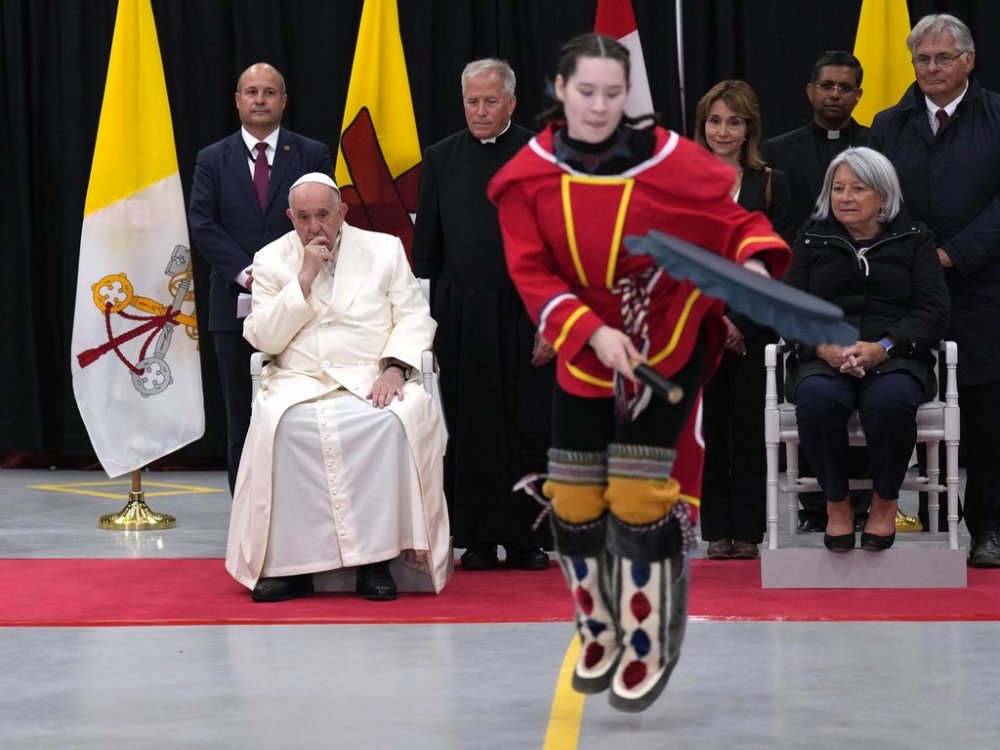
Pope Francis and Gov. Gen. Mary Simon watch a traditional dance during the final public event of his papal visit to Canada as he prepares to leave Iqaluit, Nunavut on Friday, July 29, 2022. THE CANADIAN PRESS/Nathan Denette

“For First Nations, these items are not artifacts. They are living, sacred pieces of our cultures and ceremonies and must be treated as the invaluable objects that they are,” Woodhouse Nepinak said.

“We appreciate the collaborative efforts of all the parties involved as this work is very important to First Nations.”

First Nations have for years called on the Vatican to repatriate Indigenous items in their collection. First Nations leaders brought up the artifacts when they met with Pope Francis in Rome in 2022 to discuss the legacy of church-run residential schools.

That visit happened after the Tk’emlúps te Secwépemc First Nation announced the year prior that potential unmarked graves had been found at the former residential school in Kamloops, B.C. The news sparked global outrage and a national push for reconciliation with Indigenous Peoples.

During the Rome visit, First Nations delegates were given a private viewing of some of the items held by the church, including embroidered gloves, a kayak and a sling for carrying a baby. Some of the artifacts had not been viewed by the public in decades.

They left the Vatican empty-handed but with a renewed determination to bring the items back where they belong.

Inuit Tapiriit Kanatami, the national group representing Inuit, and the Métis National Council have also called on the Vatican to return their items.

After Pope Francis died in April, Woodhouse Nepinak issued a statement praising him for his work in advancing repatriation of the artifacts.

The Vatican has said parts of its collection were originally gifts to previous popes and to the church. In 2019, Pope Francis committed to putting many more objects on display, including items from Indigenous cultures.

Indigenous Peoples maintain the items in Vatican custody were improperly taken from their communities.

The collection is known to contain masks, wampum belts, pipes and rugs, among other items from Indigenous communities in North America.

Many objects were taken from Indigenous people after the Canadian government outlawed certain cultural practices through the Indian Act in 1876. Ceremonial items and other important objects were seized and then sold, given to museums or destroyed.

This report by The Canadian Press was first published Oct. 21, 2025.

Report Error Submit a Tip

The Free Press acknowledges the financial support it receives from members of the city’s faith community, which makes our coverage of religion possible.

More Stories

Sequestered skivvies seem like last straw

Maureen Scurfield 5 minute read Yesterday at 2:00 AM CDT

DEAR MISS LONELYHEARTS: My husband, who earns a hefty income, stayed in the city most of the summer working, except for a few long weekends with the kids and me at the cottage. He has giant work projects that need daily tending.

I work hard, too, with our four kids, two dogs and a cat. But I have to tell you I got a shock last week after coming home to organize my family team for a thorough cleaning of our three-storey home.

You’ll never guess what they found up in the attic — hidden boxes of sexy women’s lingerie that all looks brand-new.

I’ve kept my mouth shut so far, but my mind is spinning.

Positive anticipation is growing about major housing developments underway in Winnipeg’s downtown

Gabrielle Piché 10 minute read Preview

Positive anticipation is growing about major housing developments underway in Winnipeg’s downtown

Gabrielle Piché 10 minute read Yesterday at 6:00 AM CDT

If traffic is light and the wind is down, Somia Sadiq is able to hear the roar of Winnipeg Jets fans twice: first through her window, then on TV.

From her apartment view high above downtown, she can look out at Graham Avenue’s painted pedestrian landscape, see construction cranes and hear the heavy equipment at work as massive housing projects take shape at The Forks, at what used to be Portage Place shopping centre and at the former Hudson’s Bay building.

Sadiq has lived at 300 Main for 2 1/2 years, a few steps from the city’s famous, windy and reopened-to-pedestrians Portage Avenue intersection. At 42 storeys, it’s the tallest building in Winnipeg.

She is among 18,000 downtown residents who will soon be joined by thousands of others attracted to the city’s core by the new wave of major construction projects.

Read
Yesterday at 6:00 AM CDT

Time for the PUB to review Winnipeg water rates

Editorial 4 minute read Preview

Time for the PUB to review Winnipeg water rates

Editorial 4 minute read 2:01 AM CDT

We take you now to just over a month ago, to the Public Utilities Board and its decision about water and sewer rates for Russell, Binscarth, Angusville, Rossburn and Gambler First Nation.

Why? Just wait.

The area is supplied with water and sewage services by the Russell-Binscarth Water and Wastewater Utility, which has a total of 1,014 customers.

As the PUB noted in an Aug. 27, 2026 order on the utility’s rates, “The [water treatment plant] gets water from two groundwater wells that were upgraded in 2016 and the raw water main was installed in 1984. The water distribution system is primarily cast iron pipe. The raw water line will need to be upgraded in the near future to keep up with demand.”

Read
2:01 AM CDT

Gordon Bell students relish — ‘of all things’ — new pickleball courts

Maggie Macintosh 4 minute read Preview

Gordon Bell students relish — ‘of all things’ — new pickleball courts

Maggie Macintosh 4 minute read 6:00 AM CDT

Manitoba’s newest public school sports facility is bringing the pickleball craze to an inner-city campus.

Gordon Bell High School unveiled four custom-made courts for the popular paddle sport this fall as part of a multi-faceted makeover.

Grade 12 student Matea Thiessen Unger called the courts “the cherry on top,” of a multi-year construction project that consumed much of her high school career.

“It was happening for so long — it felt like it was never going to end,” the 16-year-old said.

Read
6:00 AM CDT

Public versus private schooling

John R. Wiens 5 minute read 2:01 AM CDT

A Recent Maggie Macintosh piece (Enrolment up at alternative schools, Sept. 7) and several letters to the editor touted the benefits and values of private schooling. The executive director of the Manitoba Federation of Independent Schools, Andrew Micklefield, emphasized schools of choice and governmental cost-saving. A private, formerly public, schoolteacher emphasized finances, academics and parental support.

None are wrong in their arguments, but they are missing the main reasons for the existence of public schools, which has less to do with money and academics than with inclusion and equality. Nor do they adequately acknowledge the downsides of exclusion and elitism fostered by some aspects of choice and inequality. The increase in numbers of private schools and their attendees is a cause for some public concern.

Micklefield’s assertion is that private schools save the government money. Letter-writer Paulo Borges intimates he saves the province $52,500 ($15,000 each for three home-schooled children and $7500 for one private-school tuition), further suggesting that the savings are not used wisely by governments in supporting public schools.

In the front-page article, Micklefield and others go further to suggest that the main reason parents choose private schools is to receive an education in a Christian setting. That is a very limited rationale and certainly does not include the much larger variety of reasons why people choose private schooling or an even more restricted version of schools of choice, home schooling.

Letters, Sept 26

7 minute read 2:01 AM CDT

Important lessons lost

Re: Parents still in charge amid health curriculum overhaul: premier, Sept. 23

The premier’s assurance that parents could continue to “opt-out” their children from health education classes on the premise that specific topics clash with their “personal beliefs” is, at once, disappointing and concerning.

To be blunt, such an approach is Trumpian. It condones “othering.”