‘He took us to the mountaintop’: 30th Sacred Assembly celebrates Elijah Harper’s legacy

Advertisement
Read this article for free:
or
Already have an account? Log in here »
To continue reading, please subscribe:

Digital Subscription
One year of digital access for only $205*
- Enjoy unlimited reading on winnipegfreepress.com
- Read the E-Edition, our digital replica newspaper
- Access News Break, our award-winning app
- Play interactive puzzles
*First annual payment billed as $205.00 + GST for one year. This annual subscription will automatically renew at $233.00 + GST every 52 weeks (10% off the regular annual price of $259.35). Offer available to new and qualified returning subscribers only. Cancel any time.
To continue reading, please subscribe:
Add Free Press access to your Brandon Sun subscription for only an additional
$1 for the first 4 weeks*
- Enjoy unlimited reading on winnipegfreepress.com
- Read the E-Edition, our digital replica newspaper
- Access News Break, our award-winning app
- Play interactive puzzles
*Your next Brandon Sun subscription payment will increase by $1.00 and you will be charged $17.95 plus GST for four weeks. After four weeks, your payment will increase to $24.95 plus GST every four weeks.
Read unlimited articles for free today:
or
Already have an account? Log in here »
Hey there, time traveller!
This article was published 25/01/2026 (263 days ago), so information in it may no longer be current.
Several hundred people from across Canada, including church and Indigenous leaders, gathered in Winnipeg on the weekend to commemorate the 30th anniversary of the 1995 Sacred Assembly, and to discuss ways to keep its vision alive.
The Assembly was the brainchild of then-Manitoba MLA Elijah Harper. It brought together roughly 3,000 Indigenous leaders, clergy and politicians, including then-prime minister Jean Chretien, in Gatineau, Que., to hear Harper’s vision for justice and reconciliation between Indigenous and non-Indigenous Canadians.
Harper believed the missing element in discussions about land claims, self-government and reconciliation was spirituality. “The political process has failed us, and I believe that what is missing is the spiritual element,” Harper said.

MIKE DEAL / FREE PRESS
Fred Harper, brother of Elijah Harper, shakes hands with Chief Tuifa’asisina Vaeluaga Eli, who is from the Royal Family of Samoa.
Participants in the Winnipeg anniversary event were welcomed by Wallace McKay, Grand Chief emeritus of the Nishnawbe- Aski Nation in northern Ontario, who had helped organize the 1995 Assembly along with Harper.
“I realize it is difficult for Indigenous communities to embrace walking together with the churches, yet we all claim to acknowledge God, our Creator, and we pray to the same God,” he said.
He hoped the event would cause participants to “learn, understand and respect the choices that all people make as they pray, worship and seek a better tomorrow.”
In his welcome to participants, Winnipeg Mayor Scott Gillingham noted he had been a pastor for 20 years before taking on his new role.
“Harper spoke a truth,” he said of the politician and community leader, who is known for being key to the rejection of the 1990 Meech Lake Accord.
“The spiritual element is who we are as people, as a nation,” Gillingham said. “We have a political process, but politics alone doesn’t always work.”
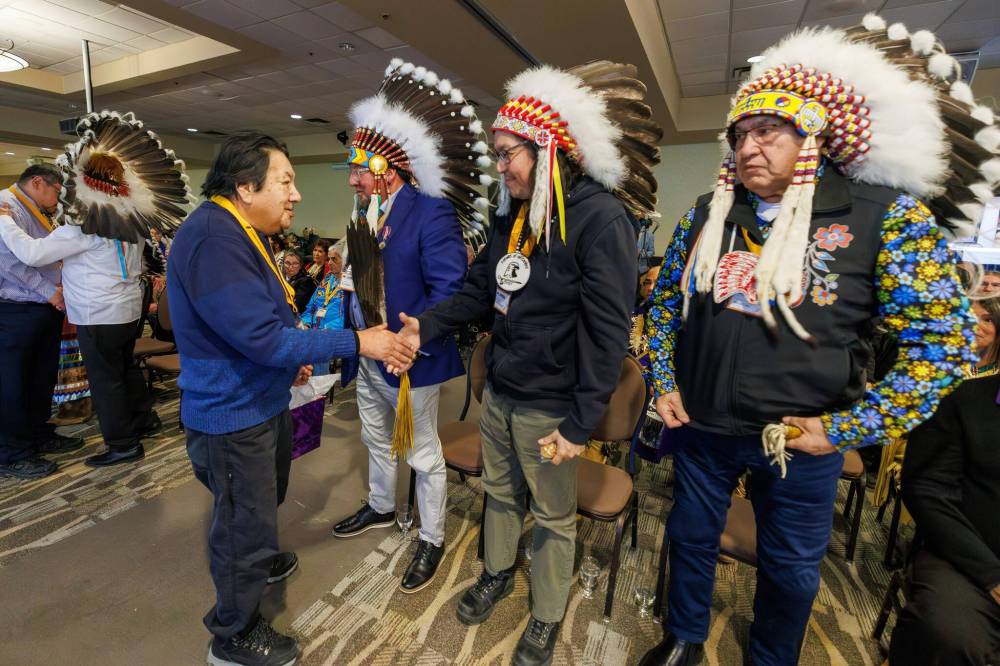
MIKE DEAL / FREE PRESS
Fred Harper, brother of Elijah Harper, meets with chiefs after making a speech.
While politicians can do many things, they can’t “pass a bylaw that restores a broken relationship. That is the world of the spirit on the journey of reconciliation,” he said.
In her remarks, National Chief Cindy Woodhouse-Nepinak said the sacred assembly was a turning point for many churches when they heard the truth about residential schools. “From that time, religious leaders started to apologize,” she said.
She was “full of gratitude” for Harper, Woodhouse-Nepinak said, because he “gave us courage to get up and pursue reconciliation… he took us to the mountaintop.”
Also addressing the event was Adrian Jacobs, a member of Ontario’s Cayuga Nation and Senior Leader for Indigenous Justice and Reconciliation for the Christian Reformed Church in North America.
“The Creator wants to restore justice in this country,” he said. “The Creator wants to restore land to the original people. That’s why we have this gathering, to do justice… without justice you can’t have reconciliation.”
Apologies and healing funds from churches “are a good start,” Jacobs said, but true reconciliation and healing also requires repentance for “stealing land.”
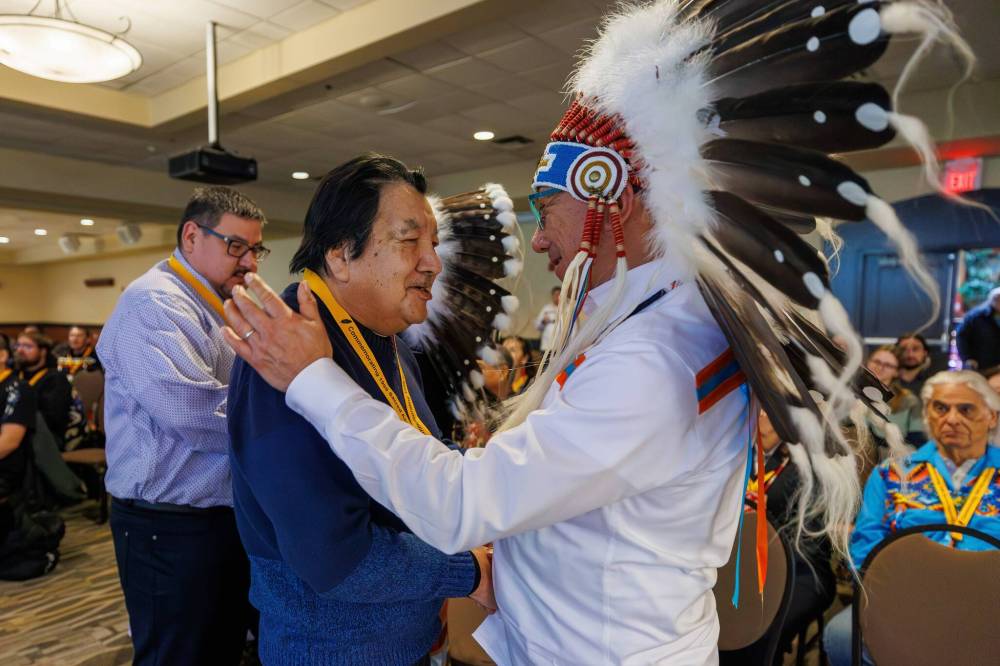
MIKE DEAL / FREE PRESS
Fred Harper, Elijah Harper brother, meets with chiefs after making a speech.
Some churches are responding, “but we have a long, long way to go. There’s a lot of work to do.”
Chief Derek Nepinak of Pine Creek First Nation, north of Dauphin, told the gathering that Canadians are “on a life journey, trying to piece together what it means… the journey of reconciliation is the longest journey of all.”
Paul Gehrs, who directs justice and ecumenical and interfaith relations for the Evangelical Lutheran Church in Canada, which is headquartered in Winnipeg, said the event underscored the importance of being in right relationship with Indigenous people.

Churches should “take every opportunity to work for justice for Indigenous people and the healing of the land,” he said, adding that they need to not just hear messages but “take action.”
David Guretzki is president and CEO of the Evangelical Fellowship of Canada. For him, the 1995 Sacred Assembly was the impetus for evangelicals in Canada to become involved with Indigenous people.
The event in Winnipeg “reminds us we need to still be at the table, to hear what we need to hear, to repent, and to hear about doing justice, not just making apologies,” he said.

MIKE DEAL / FREE PRESS
Assembly of First Nations National Chief Cindy Woodhouse-Nepinak speaks during the opening presentation.
During the event, participants also heard from representatives from the Anglican, Roman Catholic and evangelical churches.
faith@freepress.mb.ca
The Free Press is committed to covering faith in Manitoba through our Religion in the News project. This reporting continues because readers like you step forward to fund it.
Donate now to support our reporting on religion.
Your donation is eligible for a charitable tax receipt.
BECOME A FAITH JOURNALISM SUPPORTER
Our newsroom depends on a growing audience of readers to power our journalism. If you are not a paid reader, please consider becoming a subscriber.
Our newsroom depends on its audience of readers to power our journalism. Thank you for your support.
The Free Press is committed to covering faith in Manitoba through our Religion in the News project. This reporting continues because readers like you step forward to fund it.
Donate now to support our reporting on religion.
Your donation is eligible for a charitable tax receipt.
BECOME A FAITH JOURNALISM SUPPORTER
Our newsroom depends on a growing audience of readers to power our journalism. If you are not a paid reader, please consider becoming a subscriber.
Our newsroom depends on its audience of readers to power our journalism. Thank you for your support.
Advertisement Advertise With Us
Advertisement Advertise With Us
The Free Press acknowledges the financial support it receives from members of the city’s faith community, which makes our coverage of religion possible.