

Barcelona’s Sagrada Familia reaches its maximum height after more than a century
Advertisement
Read this article for free:
or
Already have an account? Log in here »
To continue reading, please subscribe:
Monthly Digital Subscription
$1 per week for 24 weeks*
- Enjoy unlimited reading on winnipegfreepress.com
- Read the E-Edition, our digital replica newspaper
- Access News Break, our award-winning app
- Play interactive puzzles
*Billed as $4.00 plus GST every four weeks. After 24 weeks, price increases to the regular rate of $19.95 plus GST every four weeks. Offer available to new and qualified returning subscribers only. Cancel any time.
Monthly Digital Subscription
$4.99/week*
- Enjoy unlimited reading on winnipegfreepress.com
- Read the E-Edition, our digital replica newspaper
- Access News Break, our award-winning app
- Play interactive puzzles
*Billed as $19.95 plus GST every four weeks. Cancel any time.
To continue reading, please subscribe:
Add Free Press access to your Brandon Sun subscription for only an additional
$1 for the first 4 weeks*
*Your next subscription payment will increase by $1.00 and you will be charged $16.99 plus GST for four weeks. After four weeks, your payment will increase to $23.99 plus GST every four weeks.
Read unlimited articles for free today:
or
Already have an account? Log in here »
BARCELONA, Spain (AP) — Barcelona’s towering Sagrada Familia basilica reached its maximum height on Friday, though the magnum opus of Catalan architect Antoni Gaudí remains years away from completion.
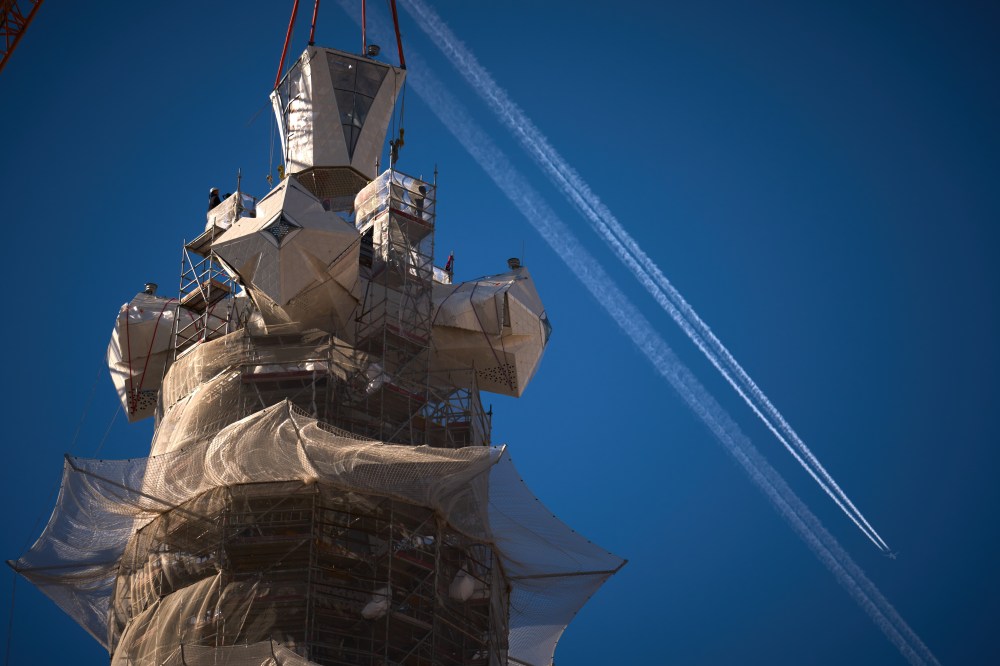
A crane placed the upper arm of a cross atop the Tower of Jesus Christ, the church’s soaring central piece, which now stands 172.5 meters (566 feet) above the city.
With Friday’s addition, the Sagrada Familia inched closer to being done. The unfinished monument became the world’s tallest church last year after another part of its central tower was lifted into place.
The first stone of the Sagrada Familia was placed in 1882, but Gaudí never expected it to be completed in his lifetime. Only one of its multiple towers was finished when he died at the age of 73 in 1926, after being hit by a tram.
In recent decades, work has sped up as the basilica became a major international tourist attraction, with people enthralled by Gaudí’s radical aesthetic that combines Catholic symbolism and organic forms.
Inside, the Tower of Jesus Christ is still being worked on. Those who wish to actually see the cross will have to wait until the tower’s inauguration this summer, when the scaffolding surrounding it will be removed, according to the church.
Topping the central tower, which soars above the transept, has been a priority ahead of celebrations this June that will mark the centenary of Gaudí’s death.
As Gaudí had planned, the cross has four arms so its shape can be recognized from any direction, said Sagrada Familia’s rector, the Rev. Josep Turull. If Barcelona’s city government will allow it, the original plan also includes a light beam shining from each of the cross’s arms, symbolizing the church’s role as a spiritual lighthouse, he added.
Millions of tourists visit the Sagrada Familia every year, and entrance fees largely fund the ongoing construction.
This year, the Sagrada Familia will hold several events to celebrate the Catalan Modernist’s legacy, which includes other stunning buildings in Barcelona and elsewhere in Spain.
The Sagrada Familia became the world’s tallest church last October, when it rose above the spire of Germany’s Ulmer Münster, a Gothic Lutheran church built over more than 500 years, starting in 1377. That church tops out at 161.53 meters (530 feet).
At Sagrada Familia, a prayer verse is included at the base of the cross installed Friday afternoon, said church rector Turull.

It reads: “You alone are the Holy One, you alone are the Lord, you alone are the Most High.”
___
Associated Press journalists Joseph Wilson in Barcelona, Spain, and Giovanna Dell’Orto in Minneapolis contributed reporting.
___
This story corrects the date that construction began on Germany’s Ulmer Münster church, to 1377, and the time took to build it, to over 500 years. A previous version incorrectly said construction began in 1543 and that the work took 347 years.
The Free Press acknowledges the financial support it receives from members of the city’s faith community, which makes our coverage of religion possible.