In ‘El Mencho’s’ last redoubt, a crucifix, saint candles and a handwritten psalm
Advertisement
Read this article for free:
or
Already have an account? Log in here »
To continue reading, please subscribe:

Digital Subscription
One year of digital access for only $205*
- Enjoy unlimited reading on winnipegfreepress.com
- Read the E-Edition, our digital replica newspaper
- Access News Break, our award-winning app
- Play interactive puzzles
*First annual payment billed as $205.00 + GST for one year. This annual subscription will automatically renew at $233.00 + GST every 52 weeks (10% off the regular annual price of $259.35). Offer available to new and qualified returning subscribers only. Cancel any time.
To continue reading, please subscribe:
Add Free Press access to your Brandon Sun subscription for only an additional
$1 for the first 4 weeks*
- Enjoy unlimited reading on winnipegfreepress.com
- Read the E-Edition, our digital replica newspaper
- Access News Break, our award-winning app
- Play interactive puzzles
*Your next Brandon Sun subscription payment will increase by $1.00 and you will be charged $17.95 plus GST for four weeks. After four weeks, your payment will increase to $24.95 plus GST every four weeks.
Read unlimited articles for free today:
or
Already have an account? Log in here »
Hey there, time traveller!
This article was published 26/02/2026 (222 days ago), so information in it may no longer be current.
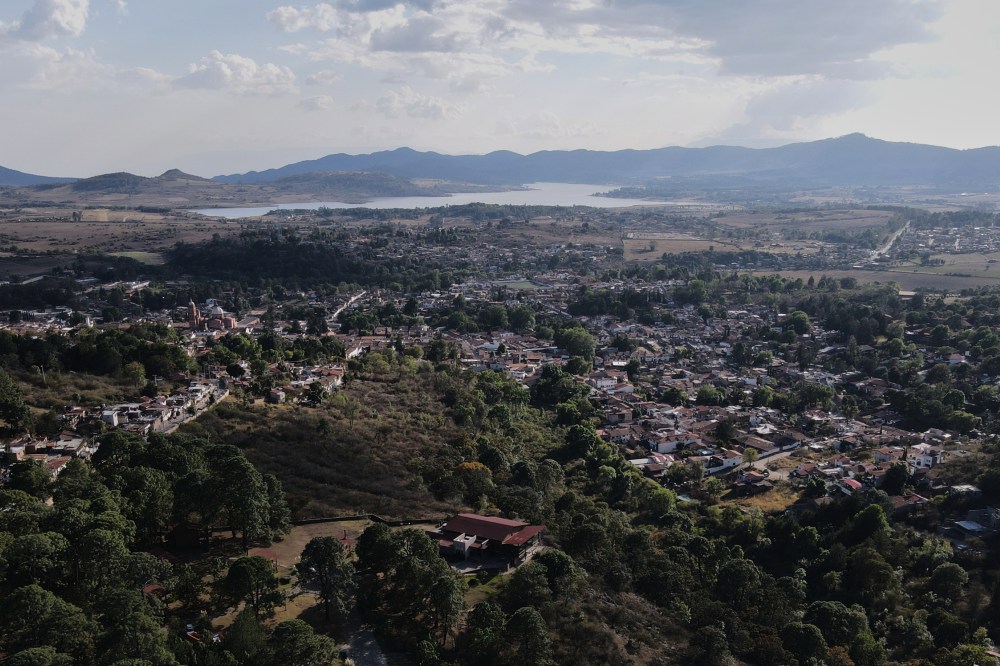
MEXICO CITY (AP) — Items found inside the final redoubt in Jalisco state of Nemesio Oseguera Cervantes, “El Mencho,” who was killed by the Mexican army on Sunday, revealed a side to the feared cartel boss few would have imagined: his religious fervor.
The house inside an exclusive subdivision in southern Jalisco state contained a crucifix, as well as a makeshift altar with religious figurines of Our Lady of Guadalupe, Saint Jude Thaddeus and Saint Charbel Makhlouf, along with votive candles with images of saints. In the backyard, images of the Virgin and Saint Jude were carved into large rocks.
On Sunday, Mexican special forces encircled Oseguera Cervante s and captured him after a firefight on the outskirts of Tapalpa. The leader of the Jalisco New Generation Cartel died en route to hospital, authorities said.
Images of the house’s inside captured by local media showed a handwritten copy of Psalm 91, which Catholics often invoke to ask God for protection from danger, fear and adversity.
There were also letters, apparently written to Oseguera Cervantes and addressing him familiarly, that made reference to St. Jude, who has a following among criminals, drug users and the marginalized in Mexico.
Drug culture and religion
Oseguera Cervantes maintained a low profile during the nearly two decades that he led the Jalisco cartel. The group was known for spectacular acts of violence and rapid growth, but little was known about his personal life.
Mexican authorities said they tracked one of his lovers to the hideout.
For those who study drug culture like Fabián Acosta Rico, a researcher at the University of Guadalajara and the Center of Religious Studies in Mexico, his apparent religious devotion comes as no surprise.
“We cannot disentangle religion from violence,” Acosta Rico said, noting that the world is full of such examples from the Bushido code of the samurai that included Buddhist beliefs to Italy’s feared Cosa Nostra that often incorporated images of the Virgin Mary or a patron saint in its initiation rituals.
Acosta Rico said that in Oseguera Cervantes’ case it is not so much a traditional Christian religious fervor, but rather a “popular religiousness, a religiousness of the immediate, of everyday life.”
“Man goes to God not expecting forgiveness of sins, or salvation of his soul, but rather because he’s hungry, because he’s cold, because he feels attacked or threatened by danger,” he said.
Mexican capos get religion
The links between drug trafficking and religious imagery are not new in Mexico, a majority Catholic country.

Mexico’s Catholic Bishops Conference had previously questioned the use of religious imagery by criminal groups and openly rejected the Santa Muerte, “Holy Death,” cult figure, which fuses pre-Hispanic and Catholic traditions into a representation of a cloaked skeleton that is not recognized by the Roman Catholic Church.
There are documented cases of drug traffickers like Édgar Valdez Villarreal, better known as “La Barbie,” who according to journalist Anabel Hernández’s book “Emma and Other Narco Women,” were deeply devoted to Mexico’s patron saint, Our Lady of Guadalupe.
Ovidio Guzmán López, one of the sons of former Sinaloa Cartel leader Joaquín “El Chapo” Guzmán, was seen during his first capture in 2019 wearing a scapular of the Holy Infant of Atocha, a popular image of the Christ Child around his neck.
Acosta Rico said there is little the Roman Catholic Church can do about the association of drug traffickers and religious imagery in these times of religious freedom. Any person “can, without a problem, use religious symbols as they please and according to their idea,” he said.
“The church already lost its power to be able to implement standards and regulations on the use of religious symbols,” he said.

Advertisement Advertise With Us
Advertisement Advertise With Us
The Free Press acknowledges the financial support it receives from members of the city’s faith community, which makes our coverage of religion possible.