

Panellists look at social services for vulnerable people through a spiritual lens

Advertisement
Read this article for free:
or
Already have an account? Log in here »
To continue reading, please subscribe:
Monthly Digital Subscription
$1 per week for 24 weeks*
- Enjoy unlimited reading on winnipegfreepress.com
- Read the E-Edition, our digital replica newspaper
- Access News Break, our award-winning app
- Play interactive puzzles
*Billed as $4.00 plus GST every four weeks. After 24 weeks, price increases to the regular rate of $19.95 plus GST every four weeks. Offer available to new and qualified returning subscribers only. Cancel any time.
Monthly Digital Subscription
$4.99/week*
- Enjoy unlimited reading on winnipegfreepress.com
- Read the E-Edition, our digital replica newspaper
- Access News Break, our award-winning app
- Play interactive puzzles
*Billed as $19.95 plus GST every four weeks. Cancel any time.
To continue reading, please subscribe:
Add Free Press access to your Brandon Sun subscription for only an additional
$1 for the first 4 weeks*
*Your next subscription payment will increase by $1.00 and you will be charged $16.99 plus GST for four weeks. After four weeks, your payment will increase to $23.99 plus GST every four weeks.
Read unlimited articles for free today:
or
Already have an account? Log in here »
Spiritual care has an important role to play when addressing social issues such as homelessness and mental health in Winnipeg.
That was the message shared Wednesday during a panel discussion at the Salvation Army’s Centre of Hope on Main Street.
The discussion was part of a half-day event titled Beyond the Physical: Spiritual Care in Community Care and Support. It was organized by the Interfaith Health Care Association of Manitoba, in partnership with the Manitoba Multifaith Council.
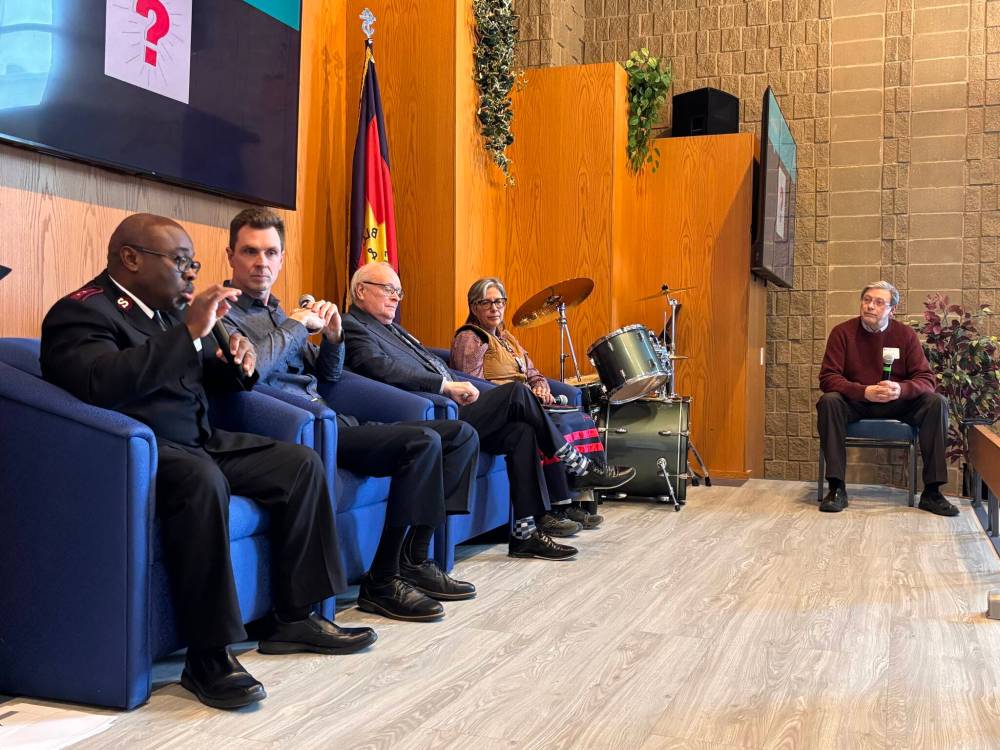
JOHN LONGHURST / FREE PRESS
Samuel Tim speaks at a Feb. 25 panel discussion on spiritual care
The goal of the event was to give people working in various community health and social service fields an opportunity to learn more about the role spiritual care can play in assisting people who experiencing homelessness, trauma, poverty and addiction.
Moderator Nick Chubenko, a retired geriatric clinician and social worker, asked panelists how spiritual care shows up in their daily work.
“It’s how we make the Centre of Hope a more welcoming place,” said Corinne Peterkin, who co-ordinates Indigenous relations at the Centre of Hope.
Peterkin, a Catholic-raised ’60s scoop survivor, has recently become more connected with her Indigenous roots. There, she said, there is no separation between emotional, mental and physical life — it’s all part of an interconnected circle, with nothing in front or behind.
Those who work with Indigenous people need to keep that in mind, Peterkin said, adding Indigenous people see spirituality in everything.
Workers also need to acknowledge the intergenerational trauma caused by residential schools, she said.
“It’s important to recognize that since it is the cause behind many other issues,” she said.
Centre of Hope chaplain Randy Leavitt said spirituality isn’t necessarily expressed verbally.
“It can be seen body language, in a downcast gaze, a bowed head,” he said of his encounters with people at the centre. “It’s not always something you hear.”
Leavitt boiled down his belief about spirituality to a single sentence.
“Every human being is created in the image of God with dignity destiny and design,” he said, adding that people sometimes feel abandoned by God when they are homeless, anxious, afraid and alone.
Helping people see their worth as being created in the image of God is key to spiritual care, he said. Listening is important — not to provide an answer, but to understand and help people know they are not alone.
“That is how we give value to people,” he said. “Listening is a wonderful gift.”
Samuel Tim, also a chaplain with the Salvation Army, came to Canada from Nigeria. In some African countries, a common greeting in their native languages is “I see you.”
Sometimes providing spiritual care is just as simple as “saying you see somebody,” he said.
“It’s felt in the heart. It means you matter,” he said.
That is especially important for people on the street.
“People who are homeless can feel ashamed, hopeless, like a failure,” he said.
Being seen by someone, even if just over a cup of coffee, can help them see they are worthwhile.
Leighton Knapp directs residential programs for Eden Health Care Services.
“We can’t just address a problem without looking at all the pieces,” he said, adding that includes spirituality.

That means making sure people have the supports they need to thrive, and also helping them have a sense of internal direction.
“That makes a big difference in people’s lives — having goals and a vision,” he said.
Gladys Hrabi, CEO of the Interfaith Health Care Association of Manitoba, said spiritual care is not about religion or imposing beliefs.
“It’s about recognizing that when someone is vulnerable, (and) then questions of meaning, dignity and belonging matter. Ignoring that dimension leaves care incomplete.”
faith@freepress.mb.ca
The Free Press is committed to covering faith in Manitoba. If you appreciate that coverage, help us do more! Your contribution of $10, $25 or more will allow us to deepen our reporting about faith in the province. Thanks! BECOME A FAITH JOURNALISM SUPPORTER
John Longhurst has been writing for Winnipeg's faith pages since 2003. He also writes for Religion News Service in the U.S., and blogs about the media, marketing and communications at Making the News.
Our newsroom depends on a growing audience of readers to power our journalism. If you are not a paid reader, please consider becoming a subscriber.
Our newsroom depends on its audience of readers to power our journalism. Thank you for your support.
The Free Press is committed to covering faith in Manitoba. If you appreciate that coverage, help us do more! Your contribution of $10, $25 or more will allow us to deepen our reporting about faith in the province. Thanks! BECOME A FAITH JOURNALISM SUPPORTER
John Longhurst has been writing for Winnipeg's faith pages since 2003. He also writes for Religion News Service in the U.S., and blogs about the media, marketing and communications at Making the News.
Our newsroom depends on a growing audience of readers to power our journalism. If you are not a paid reader, please consider becoming a subscriber.
Our newsroom depends on its audience of readers to power our journalism. Thank you for your support.
Advertisement Advertise With Us
Advertisement Advertise With Us
The Free Press acknowledges the financial support it receives from members of the city’s faith community, which makes our coverage of religion possible.