A project to save rural synagogues grows from Maine to Montana

Advertisement

Advertise with us

WATERVILLE, Maine (AP) — Rabbi Rachel Isaacs spent the days leading up to Passover overseeing the preparation of ceremonial foods at Beth Israel Congregation, a synagogue in central Maine where membership has quadrupled over the last 15 years.

Read this article for free:


or

Already have an account? Log in here »

To continue reading, please subscribe:

Subscribe and receive a limited-edition Free Press branded hat or tote.

Digital Subscription

One year of digital access for only $205*

  • Enjoy unlimited reading on winnipegfreepress.com
  • Read the E-Edition, our digital replica newspaper
  • Access News Break, our award-winning app
  • Play interactive puzzles

*First annual payment billed as $205.00 + GST for one year. This annual subscription will automatically renew at $233.00 + GST every 52 weeks (10% off the regular annual price of $259.35). Offer available to new and qualified returning subscribers only. Cancel any time.

To continue reading, please subscribe:

Add Free Press access to your Brandon Sun subscription for only an additional

$1 for the first 4 weeks*

  • Enjoy unlimited reading on winnipegfreepress.com
  • Read the E-Edition, our digital replica newspaper
  • Access News Break, our award-winning app
  • Play interactive puzzles
Start now

*Your next Brandon Sun subscription payment will increase by $1.00 and you will be charged $17.95 plus GST for four weeks. After four weeks, your payment will increase to $24.95 plus GST every four weeks.

Hey there, time traveller!
This article was published 08/04/2026 (187 days ago), so information in it may no longer be current.

WATERVILLE, Maine (AP) — Rabbi Rachel Isaacs spent the days leading up to Passover overseeing the preparation of ceremonial foods at Beth Israel Congregation, a synagogue in central Maine where membership has quadrupled over the last 15 years.

These days, growing congregations is very much on Isaacs’ mind, as she’s leading a movement to strengthen rural synagogues and Jewish communities around the country. They’ve reached dozens, and they’re hoping for many more.

“Rural Jewish life is important for the Jewish people and it’s important for rural America,” Isaacs said. “Those people deserve to be served and shepherded.”
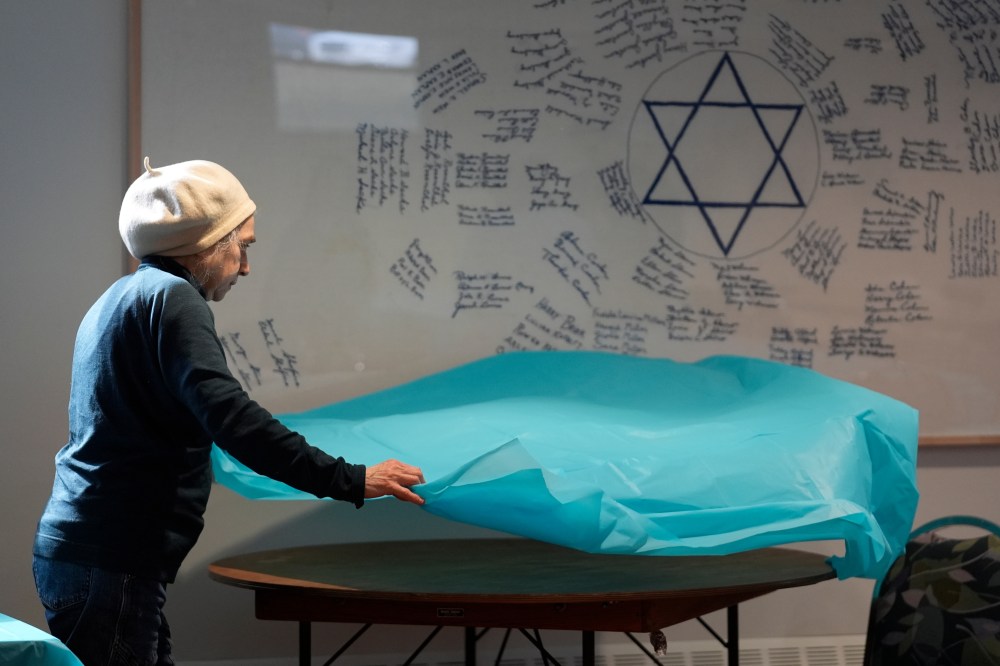
Volunteer Marlene Ring spreads a table cloth while preparing a room for a passover meal Monday, March 30, 2026, at the Beth Israel Synagogue in Waterville, Maine. (AP Photo/Robert F. Bukaty)

Isaacs is executive director of the Center for Small Town Jewish Life at Colby College, a liberal arts school in Waterville, Maine. The center began a decade ago with a goal of supporting Jewish congregations that are far from big cities and it has grown to run programs for more than 60 communities in 22 states.

A little less than 2.4% of Americans are Jewish. Of those millions of people, one in eight lives outside a major urban area, and the center exists to help them thrive, Isaacs said.

The center’s work is taking place at a vital time, as there are roughly 20% fewer synagogues in America than there were in 1990, according to data compiled by Alanna E. Cooper, a Jewish studies professor at Case Western Reserve University in Ohio. The trend is even more pronounced in rural America, where aging populations and the relocations of residents has hit congregations hard.

The outreach to rural synagogues is also happening as Jewish Americans confront a rising tide of antisemitism and violent attacks against Jewish communities. The Anti-Defamation League noted a nearly 900% increases in antisemitic incidents for the decade ending 2024. Some of the states with a high rate of incidents include largely rural states like Maine, New Hampshire and Wyoming, the ADL’s report said.

The center’s work can help reverse that trend, Isaacs said.

“You have more Jews that experience joy, who can locate strength, form connections with other Jews across the country and around the world,” Isaacs said. “In a world of rising antisemitism it’s more and more important that Jewish communities are joyful, strong and connected.”

Since forming, the center has helped congregations from Maine to California, Montana and Texas.

From Maine to Montana

Isaacs is also the rabbi at Beth Israel, a century-old synagogue down the road from Colby that is the only one within 20 miles of the college. The synagogue has grown along with the center, but the Center for Small Town Jewish Life’s work stretches far beyond Maine, she said.

And congregations that have relied on the center said its contributions are vital in a country where the Jewish population has overwhelmingly been urban since the early days of immigration. In Helena, Montana, Rebecca Stanfel, the executive director of the Montana Jewish Project, said the center was instrumental in helping bring together the relatively small Jewish community in her vast state.

Linking far-flung faith communities together is critically important in a place like Montana, Stanfel said.

“In Helena, we have no choice but to rely on volunteers. And if we want to have something like a seder, High Holidays, it’s got to come from the community,” Stanfel said. “That is also a really important model for people outside rural America.”

A plan to help

The center assists congregations through three strategies designed to boost rural synagogues. One is Makom, a two-year mentorship program for rabbis earlier in their service to rural synagogues.

Another trains lay leaders to lead prayer and support congregations, which helps them thrive without a full-time rabbi. The third is board leadership coaching, which trains synagogue presidents and boards on how to manage small town Jewish institutions.

Rabbi Lisa Rappaport, who leads Congregation Beth Israel in Chico, California, was among the first to go through the Makom program. Rural rabbis often lead the only Jewish congregation in town, and that makes the work “special and it’s beautiful and it’s challenging,” she said.

Strengthening rural communities

The Makom fellowship program lifts up rural rabbis to that challenge, Rappaport said.

“We have felt very validated as rabbis in small communities that our work is as important,” she said.

In Waterville, volunteers ranging from Colby students to retirees were getting ready to host about 100 people for Passover. It might be a small community, but it’s a strong and loving one, said Jeff Lovitz, a synagogue member, as he folded napkins.

“We’ve been here since the early ‘70s. Our kids went to Hebrew school here,” he said. “I think it’s important to have a Jewish community in Waterville.”

Report Error Submit a Tip

The Free Press acknowledges the financial support it receives from members of the city’s faith community, which makes our coverage of religion possible.


More Stories

Eagles’ Jeremiah Trotter Jr. gets ejected in London 21 years after his father was tossed from a game

The Associated Press 2 minute read Preview

Eagles’ Jeremiah Trotter Jr. gets ejected in London 21 years after his father was tossed from a game

The Associated Press 2 minute read Updated: Yesterday at 4:00 PM CDT

LONDON (AP) — Philadelphia linebacker Jeremiah Trotter Jr.'s ejection from Sunday's 19-17 loss to the Jacksonville Jaguars in London came 21 years after his father was also tossed from an NFL game.

Bryan Thomas Jr. of the Jaguars also was ejected after a scrum at midfield at Tottenham Hotspur Stadium that followed the opening kickoff.

Trotter’s father, Jeremiah Trotter, was tossed in 2005 with Philadelphia after a pre-game scuffle in a meeting with Atlanta.

Jacksonville rookie Josh Cameron returned the kickoff 90 yards for a would-be touchdown, but it was called back because of offsetting penalties that included a hold by Branson Combs of the Jaguars.

Read
Updated: Yesterday at 4:00 PM CDT

Phoneless concert a beautiful chance to bask in moment

Jen Zoratti 5 minute read Preview

Phoneless concert a beautiful chance to bask in moment

Jen Zoratti 5 minute read Saturday, Oct. 10, 2026

Outside the Scotiabank Arena in Toronto, digital billboards flashed fans their singular photo op for the night: “I took this photo before I saw Phoebe Bridgers: The Lost Tour 2026.”

It is, as it is for so many other people, my only documentation of a concert by one of my favourite artists. The American singer-songwriter — who I discovered at the Winnipeg Folk Festival in 2018 — has had a meteoric rise in the past few years, winning three Grammys in 2024 as one third of Boygenius, the indie-rock supergroup rounded out by Lucy Dacus and Julien Baker, and opening for Taylor Swift on select dates of her titanic Eras Tour.

Now, Bridgers is touring in support of Lost Weekend, her third album and first since 2020’s Punisher. It’s a feat of a record, a richly textured meditation on loss and grief, written in the aftermath of the death of her dad, with whom she had a complicated relationship.

So she is in a position to not only play multiple sold-out arena shows, but also insist that those shows be phone-free.

Read
Saturday, Oct. 10, 2026

Manitoba e-scooter legislation changes set to impose speed limit, age restrictions, sidewalk ban

Matthew Frank 5 minute read Preview

Manitoba e-scooter legislation changes set to impose speed limit, age restrictions, sidewalk ban

Matthew Frank 5 minute read Updated: Yesterday at 5:14 PM CDT

People riding e-scooters and other personal electric vehicles in Manitoba will have to strap on a helmet, stay off sidewalks and follow new age limits once new provincial rules for the devices take effect next year.

The vehicles, which also include electric skateboards, hoverboards and unicycles, will fall under The Highway Traffic Act starting in 2027, according to the province’s website. E-bikes are excluded from the new rules, according to the province’s frequently-asked-questions page.

All riders must be at least 16 years old and wear properly fitting helmets — that goes for passengers, too, the province said.

The proposed new legislation sets a speed limit of 25 km/h and would prohibit personal electric vehicles from sidewalks unless signs specifically allow sidewalk use. Riders would be using shared paths or roads with speed limits of 50 km/hr or less. They won’t be allowed to operate the vehicles under the influence of alcohol or drugs and they must use hand signals and obey traffic signs.

Read
Updated: Yesterday at 5:14 PM CDT

A Life's Story: Writer built bridges with genuine curiosity, compassion for diversity of religious practices

Janine LeGal 6 minute read Preview

A Life's Story: Writer built bridges with genuine curiosity, compassion for diversity of religious practices

Janine LeGal 6 minute read Saturday, Oct. 10, 2026

Brenda Suderman knew how to make people feel comfortable. For a journalist, that character trait is a real strength, and it made people trust and appreciate her.

Whether covering musicals, worship spaces, the effects of pandemic shutdowns, death rituals and practices of different traditions, the discovery of the burial of 2,284 infants in unmarked graves, or any other of the countless topics she wrote about in her four- decade career, Suderman did it with genuine interest and care.

Born and raised in Winkler, Suderman grew up on a farm. Much of her childhood was spent in gardens and sugar beet fields.

Baptized at 16, she became a member of the Winkler Bergthaler Mennonite Church. The restrictions against women at the time contributed to planting the seeds of Suderman’s feminist perspective.

Read
Saturday, Oct. 10, 2026

Landlords will face fines for breaching confidentiality

Carol Sanders 4 minute read Preview

Landlords will face fines for breaching confidentiality

Carol Sanders 4 minute read Friday, Oct. 9, 2026

The province is amending legislation to allow landlords to be penalized if they breach the confidentiality of tenants who break their lease by obtaining a domestic violence certificate.

“Hopefully, now there’s going to be measures in place so that if this happens again, and God forbid it happens again to anyone else, that there would be penalties imposed on landlords who do that,” said one victim whose concerns were published on the front page of the Free Press last month.

Under current legislation, landlords must ensure that any information received from those tenants regarding the termination of the tenancy is kept confidential, but there are no penalties for landlords who violate that section of the act. After hearing from victims put at risk when landlords broke the law by violating their confidentiality, the government announced Monday that it is amending the Residential Tenancies Act to allow for penalties.

The young woman who spoke to the Free Press showed that her landlord copied her alleged abuser in email correspondence that included her personal email address and the domestic violence certificate she obtained in 2025 to end a tenancy agreement early and leave an abusive relationship.

Read
Friday, Oct. 9, 2026

A project to save rural synagogues grows from Maine to Montana

Patrick Whittle, The Associated Press 5 minute read Preview

A project to save rural synagogues grows from Maine to Montana

Patrick Whittle, The Associated Press 5 minute read Saturday, May. 23, 2026

WATERVILLE, Maine (AP) — Rabbi Rachel Isaacs spent the days leading up to Passover overseeing the preparation of ceremonial foods at Beth Israel Congregation, a synagogue in central Maine where membership has quadrupled over the last 15 years.

These days, growing congregations is very much on Isaacs' mind, as she's leading a movement to strengthen rural synagogues and Jewish communities around the country. They've reached dozens, and they're hoping for many more.

“Rural Jewish life is important for the Jewish people and it’s important for rural America,” Isaacs said. “Those people deserve to be served and shepherded.”

Isaacs is executive director of the Center for Small Town Jewish Life at Colby College, a liberal arts school in Waterville, Maine. The center began a decade ago with a goal of supporting Jewish congregations that are far from big cities and it has grown to run programs for more than 60 communities in 22 states.

Read
Saturday, May. 23, 2026