Southern Baptist Convention continues membership slide but grows in attendance and baptisms
Advertisement
Read this article for free:
or
Already have an account? Log in here »
To continue reading, please subscribe:

Digital Subscription
One year of digital access for only $205*
- Enjoy unlimited reading on winnipegfreepress.com
- Read the E-Edition, our digital replica newspaper
- Access News Break, our award-winning app
- Play interactive puzzles
*First annual payment billed as $205.00 + GST for one year. This annual subscription will automatically renew at $233.00 + GST every 52 weeks (10% off the regular annual price of $259.35). Offer available to new and qualified returning subscribers only. Cancel any time.
To continue reading, please subscribe:
Add Free Press access to your Brandon Sun subscription for only an additional
$1 for the first 4 weeks*
- Enjoy unlimited reading on winnipegfreepress.com
- Read the E-Edition, our digital replica newspaper
- Access News Break, our award-winning app
- Play interactive puzzles
*Your next Brandon Sun subscription payment will increase by $1.00 and you will be charged $17.95 plus GST for four weeks. After four weeks, your payment will increase to $24.95 plus GST every four weeks.
Read unlimited articles for free today:
or
Already have an account? Log in here »
Southern Baptist membership sank last year to its lowest level since 1973, even as the United States’ largest Protestant denomination saw increases in baptisms and attendance at services.
Those results for 2025 were released Tuesday by Lifeway Research, the denomination’s research affiliate.
Membership fell by 3% to 12.3 million, continuing a nearly two-decade decline. At the same time, weekly worship attendance was up by nearly 4% to 4.5 million.
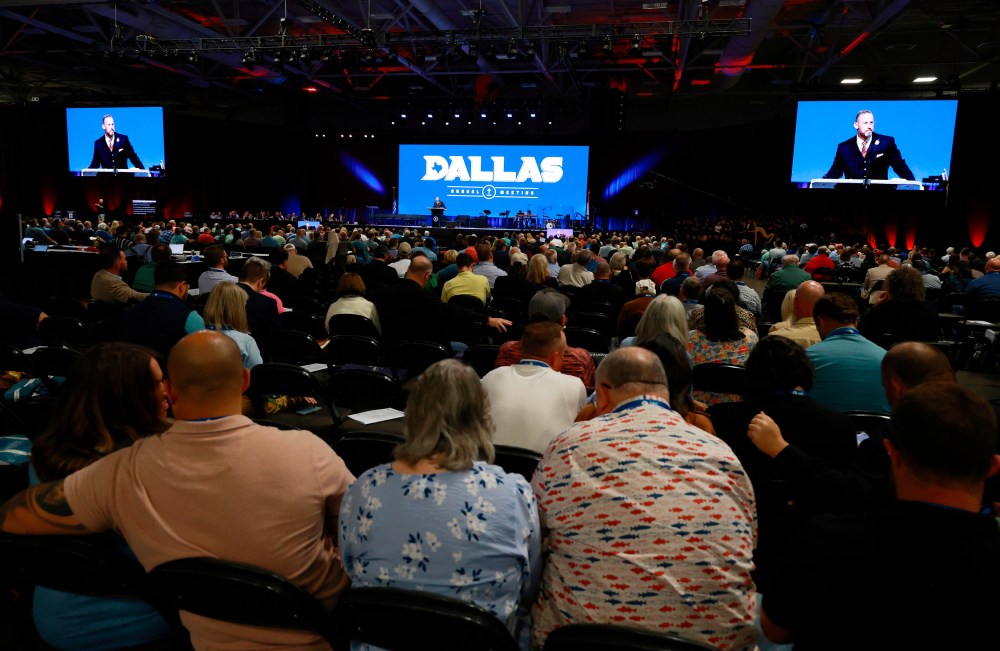
The number of baptisms increased 5% to 263,075. It was the second consecutive year in which the number of baptisms exceeded those before the COVID-19 pandemic.
The denomination often uses baptism as a key spiritual vital sign, a measure of how many people are being brought into the faith.
“We are grateful Southern Baptists continue to show growth in key metrics like baptisms, worship attendance and Bible study participation,” Jeff Iorg, president of the SBC Executive Committee, said in a statement.
Scott McConnell, executive director of Lifeway Research, attributed the membership dip in part to church closures and to congregations cleaning up their membership rolls.
The SBC numbers are based on self-reporting by congregations. Most members are in the denomination’s traditional base of the South, where it was founded by a pro-slavery faction before the Civil War, though it has since developed a presence throughout North America.
The numbers are closely watched by scholars because the SBC has long represented the single-largest body of evangelical Christians and keeps meticulous records.
The SBC remains by far the largest Protestant denomination in the U.S. in part because many other large denominations have been declining even more. The ranks of nondenominational churches — many of them with evangelical beliefs and independent governance similar to Baptists — have been growing. So have the ranks of the “ nones,” people with no religious affiliation, although that decades-long growth has stalled in recent years, according to a survey released last year by the Pew Research Center.
Political scientist Ryan Burge, who studies religious demographics, said that despite the baptism and attendance statistics, the SBC faces a likely future of continued declines The 3% membership decline amounts to nearly 400,000 people — the size of some small denominations.

“We’ve got to put that in perspective. Losing that many people is still losing a lot of people,” said Burge, a professor at the John C. Danforth Center on Religion and Politics at Washington University in St. Louis.
He said the SBC is probably losing members to a combination of factors, including people joining nondenominational churches or leaving the faith. And it’s losing members to deaths, something that will accelerate in a church with many older members.
“The SBC has a baby boomer problem,” he said. “Structurally speaking, it’s hard to outrun that demographic cliff. I just don’t think there’s anything structurally in the data that says the SBC is going to go back to where it was 20 years ago.”
___
Associated Press religion coverage receives support through the AP’s collaboration with The Conversation US, with funding from Lilly Endowment Inc. The AP is solely responsible for this content.
The Free Press acknowledges the financial support it receives from members of the city’s faith community, which makes our coverage of religion possible.