

Exhibit helps tell story of Sikh immigrant who put life on line

Advertisement
Read this article for free:
or
Already have an account? Log in here »
To continue reading, please subscribe:
Digital Subscription
One year of digital access for only $1.44 a week*
- Enjoy unlimited reading on winnipegfreepress.com
- Read the E-Edition, our digital replica newspaper
- Access News Break, our award-winning app
- Play interactive puzzles
*Billed as $5.77 plus GST every four weeks. After 52 weeks, price increases to the regular rate of $19.95 plus GST every four weeks. Offer available to new and qualified returning subscribers only. Cancel any time.
To continue reading, please subscribe:
Add Free Press access to your Brandon Sun subscription for only an additional
$1 for the first 4 weeks*
- Enjoy unlimited reading on winnipegfreepress.com
- Read the E-Edition, our digital replica newspaper
- Access News Break, our award-winning app
- Play interactive puzzles
*Your next Brandon Sun subscription payment will increase by $1.00 and you will be charged $17.95 plus GST for four weeks. After four weeks, your payment will increase to $24.95 plus GST every four weeks.
Read unlimited articles for free today:
or
Already have an account? Log in here »
On an unseasonably warm winter day in January 1916, a 27-year-old man walked into the enlistment office in Winnipeg and volunteered to fight in the First World War that was ravaging Europe.
The only name he provided was Baboo. The official paperwork required a “Christian name,” but the Sikh man didn’t have one.
Born in Punjab, India in 1888, he served for four years in a cavalry unit in Madras before immigrating to Canada. He was married and had a seven-year-old daughter named Margaret.
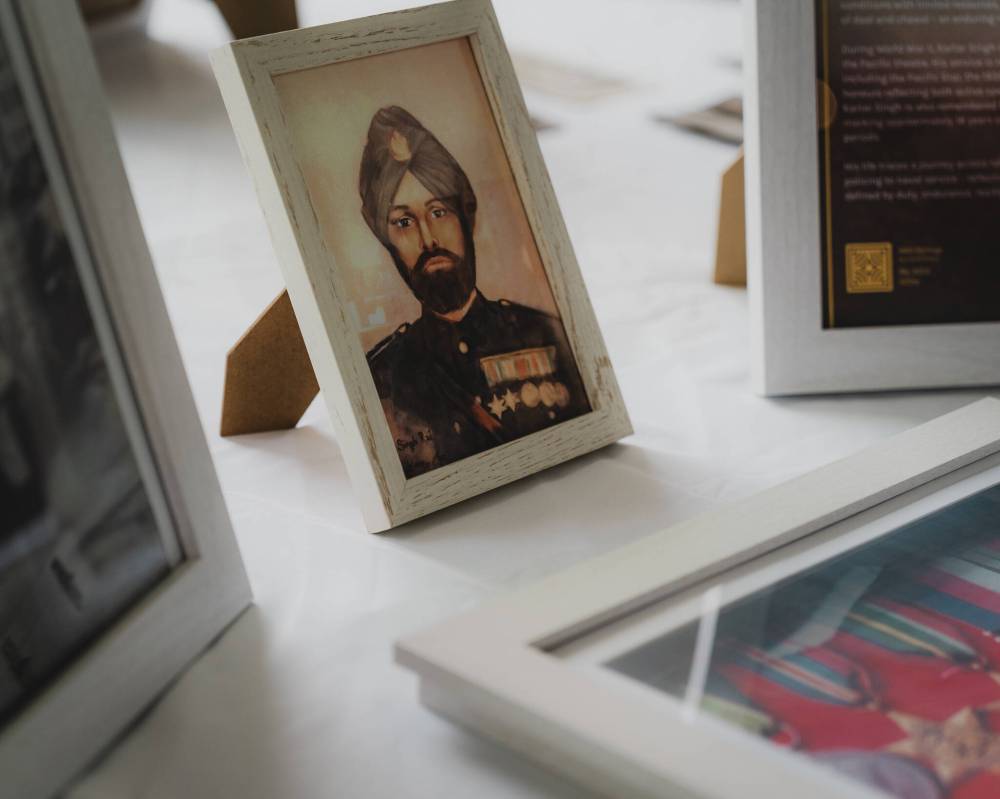
SANDEEP SINGH PHOTO
Despite the racism many immigrants faced at the time, Sikh soldiers still chose to enlist and serve in the First World War.
Someone added the name “John” in handwritten pen next to his typed name, and he became John Baboo.
It was not a popular time to enlist. Hundreds of thousands of soldiers had already died in the war and the horrors of trench warfare were being broadcast on the radio and in newspapers with no end in sight.
But Baboo wanted to help defend his new country.
Despite the racism and barriers many immigrants faced at the time, Sikh soldiers still chose to enlist and serve in the First World War, says Prabhnoor Singh, a spokesperson for Sikh Heritage Manitoba.
Baboo’s attestation papers are part of a new exhibit on display in schools in Winnipeg to commemorate the overlooked stories of Sikh army veterans who have served in Canada’s military. The exhibit is titled A Sikh Century of Service and was brought to Winnipeg by Sikh Heritage Manitoba and the Bhai Kahan Singh Nabha Foundation.
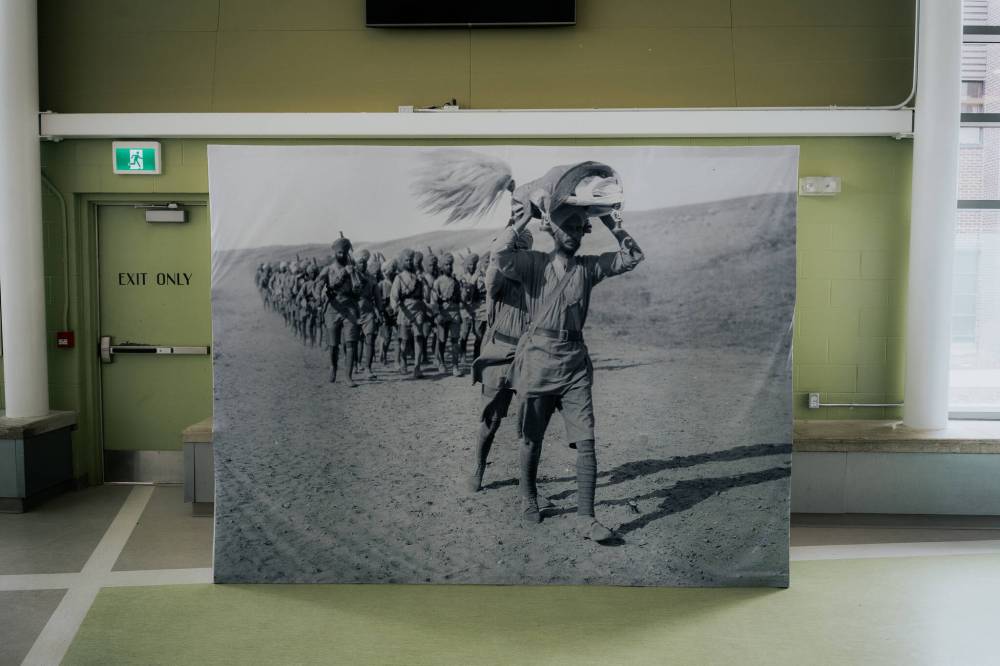
SANDEEP SINGH PHOTO
The exhibit includes a reproduction of a historic photo by photojournalist Ariel Varges
showing men of the 45th Sikhs (52nd Infantry Brigade, 17th Division)
marching with the Guru Granth Sahib to attend a Diwan (religious
service) while on campaign in Mesopotamia.
“In Sikhism, service is one of the highest principles in our faith. As Sikhs we’re always taught to stand up for justice and defend the vulnerable and serve humanity at large selflessly,” Singh said. “Wherever there was injustice, Sikhs were always the first people to stand up for basic human rights. Those teachings are in our sacred text.”
Among the exhibit’s artifacts is a poster-sized black-and-white photo depicting a platoon of turbaned Sikh soldiers marching through the Mesopotamian desert. At the head of the platoon, a man carries the carefully wrapped Sikh scriptures on his head.
“It’s a really cool picture,” Singh said.
The central scripture of Sikhism is the Guru Granth Sahib, which contains devotional poems and guidance for how to live. During the First World War, Sikh soldiers sometimes carried the scriptures with them to battle. Singh said the photo shows the way Sikhs bring their faith with them everywhere.
Singh is a 22-year-old political science student at the University of Manitoba. Before he started his studies, he served as a naval reservist in Winnipeg with HMCS Chippawa.
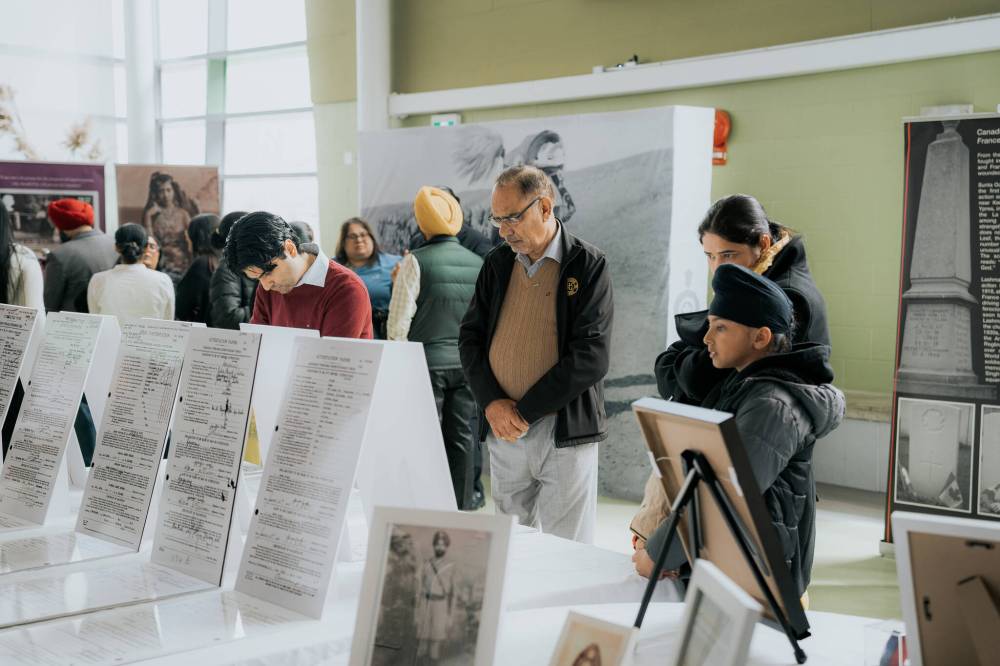
SANDEEP SINGH PHOTO
Visitors view exhibit at Maples Collegiate.
He was motivated to serve by the principle of seva in his faith, which means selfless service. “It reflects the Sikh values of sacrifice, courage, discipline, and protecting others regardless of background or religion,” he said.
Baboo was assigned to the 144th Battalion and sailed for England on Sept. 18, 1916. He fought for four months in France until an artillery shell shattered both of the bones of his lower right leg during the Battle of Vimy Ridge.

He was evacuated to a hospital in London. He recovered, though he never lost his limp. He was discharged from the military in January 1918 and died in 1948 at age 60. He is buried in Victoria, B.C., at the Royal Oak Burial Park.
His discharge papers describe his conduct as “very good.”
A Sikh Century of Service has already been shown at three Winnipeg schools. The exhibit is on display Friday at the University of Winnipeg (Room 2M70, between 1-3 p.m). It’s open to the public.
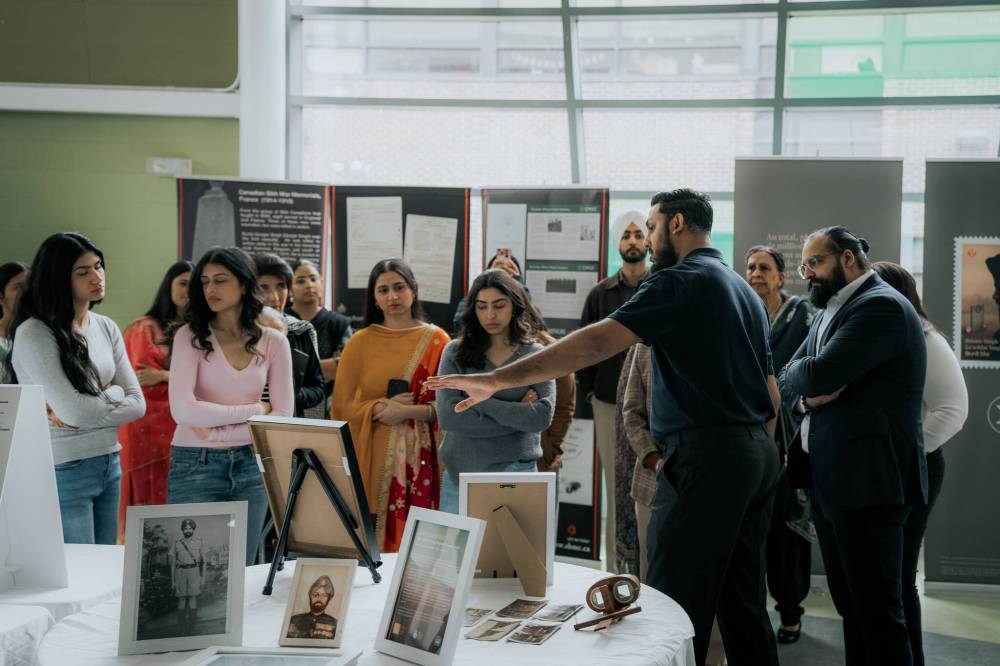
SANDEEP SINGH PHOTO
Visitors view the exhibit at Maples Collegiate.
This story was produced in conjunction with Broadview, as part of a joint Religion in the News partnership covering issues of faith in Manitoba and nationally.
josiah.neufeld@winnipegfreepress.com
The Free Press is committed to covering faith in Manitoba through our Religion in the News project. This reporting continues because readers like you step forward to fund it.
Donate now to support our reporting on religion.
Your donation is eligible for a charitable tax receipt.
BECOME A FAITH JOURNALISM SUPPORTER
Josiah Neufeld
Religion reporter
Josiah Neufeld covers issues of faith in Manitoba and nationally for the Free Press and Broadview as part of a joint Religion in the News partnership. Read more about Josiah.
Every piece of reporting Josiah produces is reviewed by an editing team before it is posted online or published in print — part of the Free Press‘s tradition, since 1872, of producing reliable independent journalism. Read more about Free Press’s history and mandate, and learn how our newsroom operates.
Our newsroom depends on a growing audience of readers to power our journalism. If you are not a paid reader, please consider becoming a subscriber.
Our newsroom depends on its audience of readers to power our journalism. Thank you for your support.
The Free Press is committed to covering faith in Manitoba through our Religion in the News project. This reporting continues because readers like you step forward to fund it.
Donate now to support our reporting on religion.
Your donation is eligible for a charitable tax receipt.
BECOME A FAITH JOURNALISM SUPPORTER
Josiah Neufeld
Religion reporter
Josiah Neufeld covers issues of faith in Manitoba and nationally for the Free Press and Broadview as part of a joint Religion in the News partnership. Read more about Josiah.
Every piece of reporting Josiah produces is reviewed by an editing team before it is posted online or published in print — part of the Free Press‘s tradition, since 1872, of producing reliable independent journalism. Read more about Free Press’s history and mandate, and learn how our newsroom operates.
Our newsroom depends on a growing audience of readers to power our journalism. If you are not a paid reader, please consider becoming a subscriber.
Our newsroom depends on its audience of readers to power our journalism. Thank you for your support.
Advertisement Advertise With Us
Advertisement Advertise With Us
History
Updated on Thursday, May 14, 2026 7:18 AM CDT: Adds photos, adds cutlines
The Free Press acknowledges the financial support it receives from members of the city’s faith community, which makes our coverage of religion possible.