Historic milestone for Muslim community
Manitoba’s first purpose-built mosque officially opened 50 years ago
Advertisement
Read this article for free:
or
Already have an account? Log in here »
To continue reading, please subscribe:

Digital Subscription
One year of digital access for only $205*
- Enjoy unlimited reading on winnipegfreepress.com
- Read the E-Edition, our digital replica newspaper
- Access News Break, our award-winning app
- Play interactive puzzles
*First annual payment billed as $205.00 + GST for one year. This annual subscription will automatically renew at $233.00 + GST every 52 weeks (10% off the regular annual price of $259.35). Offer available to new and qualified returning subscribers only. Cancel any time.
To continue reading, please subscribe:
Add Free Press access to your Brandon Sun subscription for only an additional
$1 for the first 4 weeks*
- Enjoy unlimited reading on winnipegfreepress.com
- Read the E-Edition, our digital replica newspaper
- Access News Break, our award-winning app
- Play interactive puzzles
*Your next Brandon Sun subscription payment will increase by $1.00 and you will be charged $17.95 plus GST for four weeks. After four weeks, your payment will increase to $24.95 plus GST every four weeks.
Read unlimited articles for free today:
or
Already have an account? Log in here »
This year marks the 50th anniversary of the first mosque in Manitoba: the Pioneer Mosque. For me, the anniversary is a cause for celebration, but also a chance to look back on the history of Islam in the province — a history that goes back over 100 years.
Muslim immigrants began arriving in Manitoba in the early 1900s, most of them young men from Syria and Lebanon. Though they spoke little English, they adapted remarkably well to their new surroundings.
As more newcomers arrived, their numbers grew into the hundreds. Some established themselves as merchants, others worked as labourers, and many became peddlers. A few achieved notable business successes.
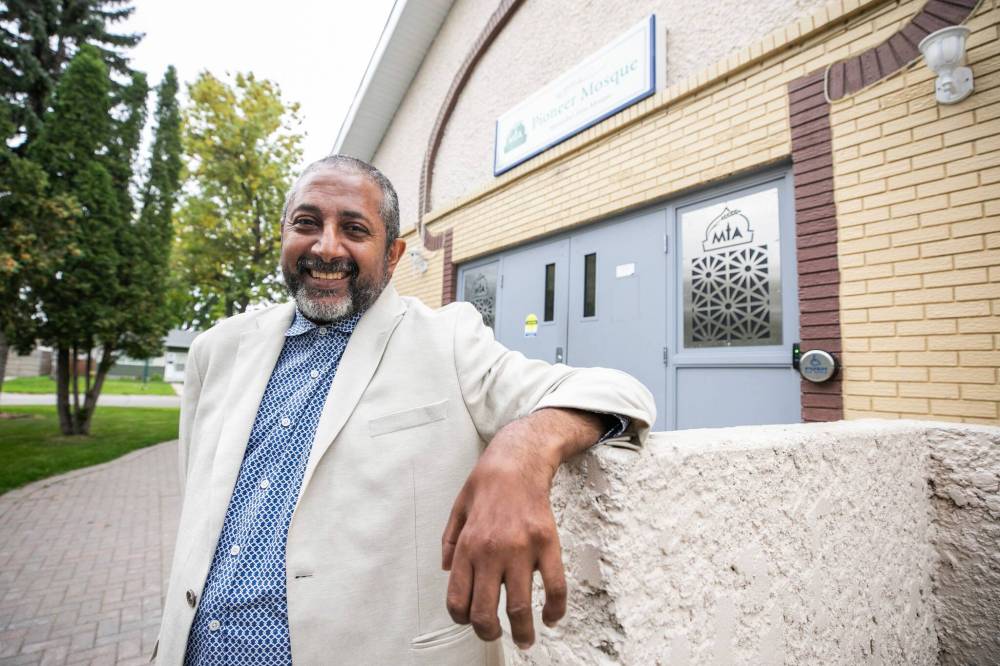
MIKAELA MACKENZIE / FREE PRESS
Ismael Mukhtar stands at Pioneer Mosque, Manitoba’s first purpose-built mosque, which officially opened in September 1976 on Hazelwood Avenue.
Muslim families also settled in farming communities, such as the Abbas family, whose descendants still reside in Hodgson today. While a small number lived in Winnipeg, a larger concentration was found in Brandon.
Despite their growing numbers and relative prosperity, Manitoba’s early Muslim population remained widely dispersed across the province. Although they may have had the financial means to build a mosque, their scattered settlement pattern made an undertaking difficult.
Community growth slowed when many members relocated to Edmonton following the westward extension of the railway, seeking better economic opportunities. There, they helped establish Canada’s first mosque in 1938.
The Muslim farming families who remained in Manitoba were deeply affected by the hardships of the Great Depression. Like many other farmers, they left the province due to economic difficulties and widespread crop failures. Restrictive immigration policies introduced after the First World War further reduced the number of new arrivals, slowing the community’s development even more.
The second sustained phase of Muslim settlement in Manitoba began in the late 1950s, following changes to Canada’s immigration policies. Unlike the earlier wave, many newcomers during this period were professionals and students.
As the community expanded, its members established a formal organization in 1960: the Manitoba Islamic Association (MIA). One of its central goals was the construction of a mosque — a dream that took 16 years to achieve. During this period, the community gathered for prayers and activities in rented facilities, including church basements, such as a church at 790 Banning St., as well as other temporary locations.
After years of dedication and fundraising, their efforts finally bore fruit. On Sept. 25, 1976, Manitoba’s first purpose-built mosque was officially opened at 247 Hazelwood Ave. in Winnipeg, marking a historic milestone for the province’s Muslim community.
The new mosque quickly became much more than a place of worship. It evolved into a vibrant community hub where social gatherings were held, educational programs were offered, newcomers were welcomed and youth were mentored. For 28 years, it remained the only mosque in the city, until the opening of the Winnipeg Central Mosque in 2004, followed by several others.
It also became a centre for interfaith engagement. One of the most remarkable events hosted at the mosque was an iftar — a fast-breaking meal during the month of Ramadan — likely the first of its kind in Winnipeg. Faith leaders from Jewish, Christian and Muslim traditions came together in a spirit of mutual respect and understanding. A Jewish rabbi captured the significance of the moment by expressing appreciation for the gesture and noting how Manitoba stands as a model of peaceful coexistence.
Like many Muslim institutions, the mosque faced difficult times and was repeatedly targeted by hateful acts. The aftermath of Sept. 11, 2001, was particularly challenging, with numerous hateful messages left on its voicemail. Yet the community chose to respond not with fear or isolation, but with openness, outreach and education.

A few weeks after 9/11, the mosque organized its largest and first public open house. Hundreds of Winnipeggers attended to learn about Islam, meet members of the congregation and express their support. This event became a defining moment — one that reflected a growing sense of acceptance, solidarity and belonging within the broader community.
On a personal level, this mosque has been a home for me since my arrival in Manitoba in the late 1980s from Eritrea. It was a place where I experienced global cultural diversity firsthand. People from every region of the world came together not only to worship, but to share cultural cuisines, traditional dress, customs and languages. This was an eye-opening experience that deepened my appreciation of human diversity and our shared universal outlook.
For Manitobans, the mosque became a go-to place for learning. Rather than hearing about Islam solely through media or the lens of international conflicts, visitors encountered it directly and authentically. The mosque welcomed high school students, church groups and members of the media. Through these engagements, it dispelled stereotypes, fostered understanding and strengthened Manitoba’s reputation for openness and friendliness.
Although the community has since outgrown the mosque, the building remains a distinctive Manitoban landmark and an enduring symbol of the province’s history, diversity and interfaith co-existence. In 2014, it was named the Pioneer Mosque to highlight its historical primacy and to honour the visionary undertaking of its founders.
Ismael Mukhtar is the author of Manitoba Muslims: A History of Resilience and Growth.
The Free Press is committed to covering faith in Manitoba through our Religion in the News project. This reporting continues because readers like you step forward to fund it.
Donate now to support our reporting on religion.
Your donation is eligible for a charitable tax receipt.
BECOME A FAITH JOURNALISM SUPPORTER
The Free Press acknowledges the financial support it receives from members of the city’s faith community, which makes our coverage of religion possible.