Whether it’s coffee or tea, think of what’s holy

Advertisement
Read this article for free:
or
Already have an account? Log in here »
To continue reading, please subscribe:

Digital Subscription
One year of digital access for only $205*
- Enjoy unlimited reading on winnipegfreepress.com
- Read the E-Edition, our digital replica newspaper
- Access News Break, our award-winning app
- Play interactive puzzles
*First annual payment billed as $205.00 + GST for one year. This annual subscription will automatically renew at $233.00 + GST every 52 weeks (10% off the regular annual price of $259.35). Offer available to new and qualified returning subscribers only. Cancel any time.
To continue reading, please subscribe:
Add Free Press access to your Brandon Sun subscription for only an additional
$1 for the first 4 weeks*
- Enjoy unlimited reading on winnipegfreepress.com
- Read the E-Edition, our digital replica newspaper
- Access News Break, our award-winning app
- Play interactive puzzles
*Your next Brandon Sun subscription payment will increase by $1.00 and you will be charged $17.95 plus GST for four weeks. After four weeks, your payment will increase to $24.95 plus GST every four weeks.
Read unlimited articles for free today:
or
Already have an account? Log in here »
I was an instructor at a week-long event for aspiring Catholic journalists in Toronto in August. Whenever journalists gather, there will be conversation — and coffee. Lots of coffee. In this case, Catholic coffee.
“Catholic coffee?” you ask. “What is that?”
Catholic Coffee is the name of a small family business in Charlotte, N.C. Its goal is to use a daily habit of drinking coffee, especially in the morning, to focus attention on God through devotion and prayer.
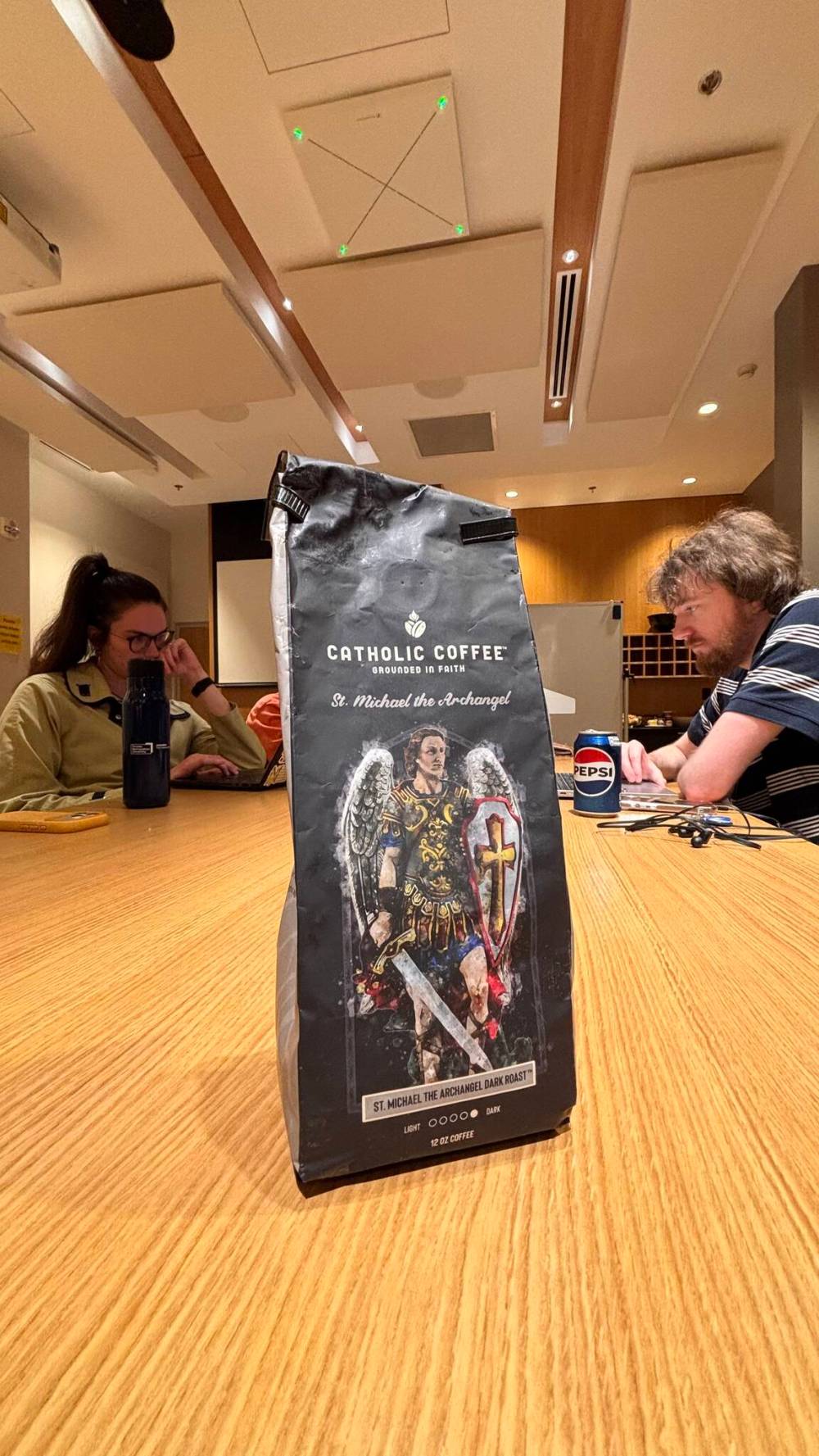
John Longhurst photo
Catholic Coffee sits on a table as students take part in the Canadian Catholic News summer seminar in Toronto in August.
The idea for using coffee in this way came to the founders through their Catholic faith.
“Every Catholic knows the power of ritual,” the company says. “From the sacraments to daily devotions, our faith is woven into the rhythm of life. Yet, there remained one daily habit — a nearly universal practice — that was often disconnected from our spiritual lives: coffee.”
As they say on their website, they want to invite coffee drinkers to make their mornings holy by “sanctifying the first moments of the day.”
To help coffee drinkers do that, the company sells “saint-inspired blends.” Each one honours a Catholic saint and is paired with stories about them and prayers people can use.
You can start your day with a cup of St. Michael dark roast, which reflects the strong and bold character of that saint. There’s also St. John Paul II Peruvian dark roast, with notes of fresh cedar that celebrates his love of the great outdoors, where he found God in creation.
Or you can choose St. Peter roast, which is described as smooth and approachable, appealing to a wide range of tastes and serving as a “daily reminder of our unity within the Catholic Church.”
Altogether, the company sells 18 different roasts, including the All-Saints variety pack for those who can’t quite make up their mind about which coffee to drink or saint to honour.
Catholic thought also permeates how the company is run. It sources its beans using the principles of Catholic social teaching: ethical labour practices, care for creation and human dignity. As well, a portion of each sale goes to support Catholic chaplaincy in the U.S. armed forces.
But it’s not just Catholics who make and sell coffee. A survey found 31 different kinds of Christian branded coffee such as Coffee 4 Missions, The Holy Roast, and Reformed Roasters — its website proclaims it to be 100 per cent “Calvinated” coffee “that chooses you.”
One thing you won’t find is coffee made by members of the Church of Jesus Christ of Latter-day Saints or Seventh Day Adventists; those groups are instructed to avoid drinking coffee as part of their faith.
Historically, coffee drinking has been connected to religion in various ways. This includes how it originated and became popular in Muslim-majority countries; Sufi mystics found it helped them stay alert during nighttime prayer and devotional practices.
That association with Islam caused some Christians to oppose coffee when it became popular in Europe in the 16th century. A story (that is probably apocryphal) is told that some of them went to Pope Clement VIII and asked him to condemn the drink.
According to the story, they gave the pope a cup of coffee to drink so he would know how bad it was. The plan backfired; after his first taste, the pope declared it delicious and quipped it was too good a drink to leave to the devil.
What about tea? It turns out that there is also a relationship between religion and that drink.
Hundreds of years ago, Buddhist monks started drinking tea to help them stay awake during meditation. That led to Buddhist communities promoting tea drinking, with many ancient monasteries maintaining their own tea gardens.

Writing about the practice of drinking tea in Buddhist Door Global, Sarah Beasley said that “tea is a sacred aspect of Buddhist hospitality, of respect, honoring, and deference. It is both literal — a beverage to sate the thirst, to warm or cool the body — and symbolic. Of all possible offerings, real or imagined, tea is a universal gift, a show of gratitude and love.”
Drinking tea is often associated with England. But it was not always lauded there. John Wesley, the founder of Methodism, once preached against consuming it. He argued it was bad for health and that money spent on tea could be better used helping the poor.
In the 19th century, the temperance movement — which had deep religious roots — promoted tea drinking as an alternative to alcohol. According to historian Erika Rappaport, temperance leaders believed it would enable people to “achieve class and gender harmony, political citizenship, and a heavenly home.”
Whatever your drink of choice, next time you brew a cup, you might want to give a few thoughts to its religious roots. Or even now, when you read this column while drinking a cup of coffee or tea.
Jdl562000@yahoo.com
The Free Press is committed to covering faith in Manitoba through our Religion in the News project. This reporting continues because readers like you step forward to fund it.
Donate now to support our reporting on religion.
Your donation is eligible for a charitable tax receipt.
BECOME A FAITH JOURNALISM SUPPORTER
Our newsroom depends on a growing audience of readers to power our journalism. If you are not a paid reader, please consider becoming a subscriber.
Our newsroom depends on its audience of readers to power our journalism. Thank you for your support.
The Free Press is committed to covering faith in Manitoba through our Religion in the News project. This reporting continues because readers like you step forward to fund it.
Donate now to support our reporting on religion.
Your donation is eligible for a charitable tax receipt.
BECOME A FAITH JOURNALISM SUPPORTER
Our newsroom depends on a growing audience of readers to power our journalism. If you are not a paid reader, please consider becoming a subscriber.
Our newsroom depends on its audience of readers to power our journalism. Thank you for your support.
Advertisement Advertise With Us
Advertisement Advertise With Us
The Free Press acknowledges the financial support it receives from members of the city’s faith community, which makes our coverage of religion possible.