Canadian Human Rights Museum could include Quebec’s secularism legislation

Advertisement

Advertise with us

QUEBEC - The Quebec government's latest attempt to legislate on secularism could find its way into the Canadian Museum for Human Rights in Winnipeg.

Read this article for free:


or

Already have an account? Log in here »

To continue reading, please subscribe:

Subscribe and receive a limited-edition Free Press branded hat or tote.

Digital Subscription

One year of digital access for only $205*

  • Enjoy unlimited reading on winnipegfreepress.com
  • Read the E-Edition, our digital replica newspaper
  • Access News Break, our award-winning app
  • Play interactive puzzles

*First annual payment billed as $205.00 + GST for one year. This annual subscription will automatically renew at $233.00 + GST every 52 weeks (10% off the regular annual price of $259.35). Offer available to new and qualified returning subscribers only. Cancel any time.

To continue reading, please subscribe:

Add Free Press access to your Brandon Sun subscription for only an additional

$1 for the first 4 weeks*

  • Enjoy unlimited reading on winnipegfreepress.com
  • Read the E-Edition, our digital replica newspaper
  • Access News Break, our award-winning app
  • Play interactive puzzles
Start now

*Your next Brandon Sun subscription payment will increase by $1.00 and you will be charged $17.95 plus GST for four weeks. After four weeks, your payment will increase to $24.95 plus GST every four weeks.

Hey there, time traveller!
This article was published 23/05/2019 (2641 days ago), so information in it may no longer be current.

QUEBEC – The Quebec government’s latest attempt to legislate on secularism could find its way into the Canadian Museum for Human Rights in Winnipeg.

The Legault government’s Bill 21 would prohibit public servants in positions of authority — including teachers, police officers, Crown prosecutors and prison guards — from wearing religious symbols on the job.

The Coalition Avenir Quebec government intends to see it passed into law within a month.
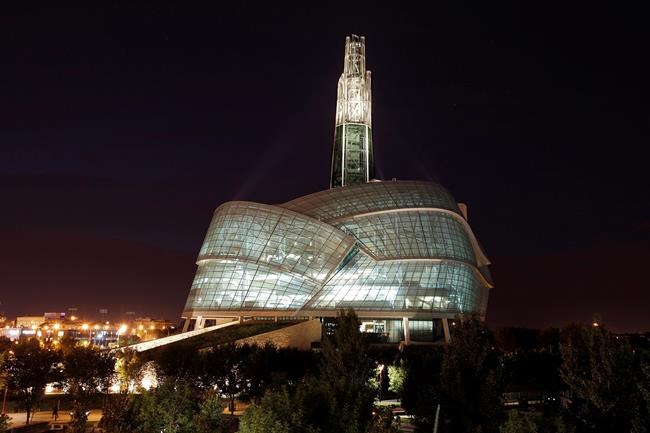
A night view of the Canadian Museum For Human Rights is shown in Winnipeg on September 16, 2014. The Quebec government's latest attempt to legislate on secularism could find its way into the Canadian Museum for Human Rights in Winnipeg. The Legault government's Bill 21 would prohibit public servants in positions of authority -- including teachers, police officers, Crown prosecutors and prison guards -- from wearing religious symbols on the job, and the Coalition Avenir Quebec government intends to see it passed into law within a month. The museum, which has exhibits exploring issues that include freedom of religion and conscience, said it is planning to refresh its exhibit on Quebec's attempts to deal with secularism. THE CANADIAN PRESS/John Woods

The museum, which has exhibits exploring issues that include freedom of religion and conscience, said it is planning to refresh its exhibit on Quebec’s attempts to deal with secularism.

“We are considering ways to update that exhibit, which may include reference to Bill 21, but those decisions have not yet been finalized — partly because the fate of Bill 21 is not yet known,” said museum spokeswoman Maureen Fitzhenry.

Fitzhenry said in an email that the museum already references a 2010 Liberal government attempt to legislate on the matter. Bill 94, which died on the order paper in 2012, would have banned people from giving or receiving government services with their faces covered — mostly affecting Muslim women who wear the niqab or burka.

That prohibition was revived by the Liberals with Bill 62, which became law in 2017 but is currently being challenged in court.

Asked why it was important for the museum to deal with questions about religious beliefs in the country, Fitzhenry replied, “Freedom of religion is a human right that is important and guaranteed by the Canadian Charter of Rights and Freedoms and the Universal Declaration of Human Rights.”

The comments come as a letter from three observers working for the United Nations Human Rights Council raised concerns about Bill 21.

They sent a five-page letter to Canada’s mission office at the UN seeking clarity on Quebec’s bill, which they say undermines “freedom of conscience, religion and equality of citizens.”

The letter, which has now been made public and was dated last Friday, raises several concerns, including a lack of definition of religious symbols, which could result in “a discretionary and potentially discriminatory interpretation of what constitutes religious symbols.”

Quebec Immigration Minister Simon Jolin-Barrette, who is piloting Bill 21, didn’t immediately comment, but the provincial government has defended the proposed law as both moderate and pragmatic.

The museum has a few displays on minorities in Quebec — one looks at the Supreme Court of Canada ruling about the right of a Sikh student in Quebec to wear the kirpan, while another is a photo exhibit called “Ce qui nous voile” (What Covers Us), which is designed to spark conversation about the experience of Muslim women in Quebec who wear the hijab.

“While these exhibits do not specifically refer to Bill 21, they do speak to many of the same human rights issues that are raised by this legislation,” Fitzhenry wrote.

Helene David, the Quebec Liberal critic for secularism, said it’s not ideal for Quebec to be known in this light and expressed concern that it would taint Quebec’s reputation internationally.

“Certainly on the Anglo-Canadian side, there is a lot of skepticism and questioning about our supposedly republican evolution of secularism,” she said in an interview.

Each year, nearly 300,000 people visit the Canadian Museum for Human Rights — which opened in 2014 and whose exhibits are designed to reflect on the treatment of different peoples.

Its mission is to study the theme of human rights with a special but not exclusive focus on Canada. The museum has had themes including the Holocaust, apartheid in South Africa and the persecution of Rohingya people in Myanmar.

Report Error Submit a Tip

The Free Press acknowledges the financial support it receives from members of the city’s faith community, which makes our coverage of religion possible.
More Stories

A Life's Story: Woman fought for better outcomes for others amid cancer fight

Janine LeGal 7 minute read Preview

A Life's Story: Woman fought for better outcomes for others amid cancer fight

Janine LeGal 7 minute read 3:00 AM CDT

Catherine Mary Burke was strong and motivated in ways many of us could never imagine.

She was known for fighting the good fight, and she fought as hard as she could for as long as she could. But something set her apart. Even when it was too late for her, she insisted cancer survival rates had to be better for other women. And they are today because of her fierce determination.

Burke died on Nov. 29, 2025, at age 67 after courageously facing breast cancer for more than a decade.

“Cathy was born happy,” said her husband, Patrick Burke. “She was a glass-half-full person. What a gift this attitude was to me and the boys. She never once said ‘Why me?’ or complained. She was just so happy to be alive.

Read
3:00 AM CDT

Could renewed interest in strategically critical rare earth elements finally make sub-sector profitable?

Joel Schlesinger 6 minute read Preview

Could renewed interest in strategically critical rare earth elements finally make sub-sector profitable?

Joel Schlesinger 6 minute read 3:00 AM CDT

Rare earth elements are among the most critical of mined resources for modern economies.

They’re essential in manufacturing specialized magnets used in a host of technologies from wind turbines and electric vehicles to hard drives, smartphones, television screens, and fibre optics. Most notably, however, rare earth minerals are increasingly vital to the defence industry.

These 17 elements — closely related chemically and usually found all together in mineral deposits — have indeed been growing in geopolitical importance as the United States, Canada and other Western nations recognize their dependence on production from China.

It is the world’s largest producer and processor of rare earths, including the most in-demand elements neodymium and praseodymium used to manufacture very light and powerful magnets for an array of technologies, including the most advanced weapons of modern warfare.

Read
3:00 AM CDT

Wyatt vows to ‘absolutely’ continue serving as city councillor despite latest sex-crime charges

Joyanne Pursaga 5 minute read Preview

Wyatt vows to ‘absolutely’ continue serving as city councillor despite latest sex-crime charges

Joyanne Pursaga 5 minute read Thursday, Aug. 13, 2026

Transcona Coun. Russ Wyatt vowed Thursday to continue doing his job after more criminal charges were laid against him this week, while the mayor called for “better tools” to address elected officials who face serious allegations.

Wyatt, 56, was charged Monday with sexual assault and administering a noxious substance in an October 2023 incident. He was previously charged with sexual assault and administering a noxious substance in March, based on allegations tied to a 2025 gathering.

On Thursday, Wyatt arrived at city hall and quickly walked to his office at 10:20 a.m., nearly an hour after the East Kildonan-Transcona community committee meeting he planned to attend was scheduled to begin.

He answered few questions from reporters.

Read
Thursday, Aug. 13, 2026

City Lego seller continues to build up its business

Gabrielle Piché 4 minute read Preview

City Lego seller continues to build up its business

Gabrielle Piché 4 minute read Updated: Yesterday at 8:54 AM CDT

Brick by brick, a Winnipeg Lego seller is building its third expansion — in less than two years.

Read
Updated: Yesterday at 8:54 AM CDT

Nola chef earns national award

Eva Wasney 2 minute read Preview

Nola chef earns national award

Eva Wasney 2 minute read Yesterday at 2:01 AM CDT

Celebrated Winnipeg chef Emily Butcher has another feather to add to her toque. The executive chef and owner of Nola and Bar Accanto in St. Boniface has received the Culinary Award of Excellence from Restaurants Canada, a national foodservice advocacy organization.

Read
Yesterday at 2:01 AM CDT

Men’s recovery home dedicated to ‘homeless hero’ Faron Hall’s memory

Scott Billeck 14 minute read Preview

Men’s recovery home dedicated to ‘homeless hero’ Faron Hall’s memory

Scott Billeck 14 minute read Yesterday at 12:30 PM CDT

Faron Hall never got the chance to begin recovery. Once heralded as Winnipeg’s “homeless hero” after twice plunging into the Red River to save strangers from drowning, Hall told St. Boniface Street Links executive director Marion Willis shortly before his death in 2014 that he wanted help for his alcoholism.

Read
Yesterday at 12:30 PM CDT