Jewish cemetery designates section for dual-faith couples

Advertisement
Read this article for free:
or
Already have an account? Log in here »
To continue reading, please subscribe:

Digital Subscription
One year of digital access for only $205*
- Enjoy unlimited reading on winnipegfreepress.com
- Read the E-Edition, our digital replica newspaper
- Access News Break, our award-winning app
- Play interactive puzzles
*First annual payment billed as $205.00 + GST for one year. This annual subscription will automatically renew at $233.00 + GST every 52 weeks (10% off the regular annual price of $259.35). Offer available to new and qualified returning subscribers only. Cancel any time.
To continue reading, please subscribe:
Add Free Press access to your Brandon Sun subscription for only an additional
$1 for the first 4 weeks*
- Enjoy unlimited reading on winnipegfreepress.com
- Read the E-Edition, our digital replica newspaper
- Access News Break, our award-winning app
- Play interactive puzzles
*Your next Brandon Sun subscription payment will increase by $1.00 and you will be charged $17.95 plus GST for four weeks. After four weeks, your payment will increase to $24.95 plus GST every four weeks.
Read unlimited articles for free today:
or
Already have an account? Log in here »
Hey there, time traveller!
This article was published 16/07/2011 (5555 days ago), so information in it may no longer be current.
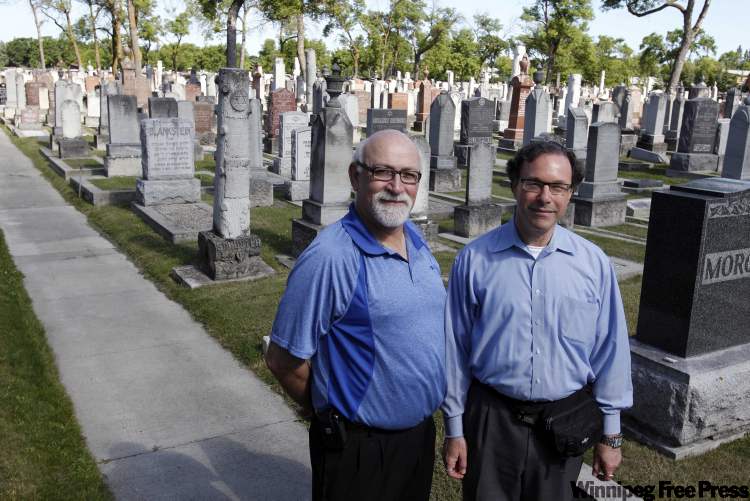
Interfaith couples can rest in peace together, thanks to plans by a Conservative synagogue to open up a new section of its cemetery.
“We want to be as inclusive as possible,” explains Rabbi Alan Green of Congregation Shaarey Zedek’s recent decision to designate part of the Armstrong Avenue cemetery for dual-faith couples.
“We know couples want to be buried together and we know Jews want to be buried in a Jewish cemetery and this makes it possible.”
The northwestern portion of Shaarey Zedek Memorial Park, until now undeveloped, will become a dual-faith cemetery by October, says the synagogue’s executive director.
“With this they must understand one of you must be Jewish to buy this and you must buy the double (plot),” says Ian Staniloff.
A double plot will be priced at about $8,000 for synagogue members and $14,000 for non-members. Plots won’t go on sale until the dual-faith area is completed.
Staniloff says a nearly two-metre high fence will be built around the 203-plot section, and a separate road will lead to it, keeping the dual-faith separate and segregated from the rest of the cemetery.
A Jewish cemetery is considered sanctified land, and only Jewish people may be buried there. Separating the two sections means that Jewish standards and traditions can be respected in the Jewish part of the cemetery, while the other section can accommodate couples where one partner is Jewish, says Green.
“The idea of being a Jew is that one wants to be moving and living and dying in a state of holiness all the time,” says Green, referring to the reason for sanctified land in cemeteries.
“Even in death one wants to leave the world in a holy way.”
Staniloff says this is the first of the four Jewish cemeteries in Winnipeg opening up a dual-faith section.
For the past decade, Temple Shalom, a Reform synagogue, has had a dedicated section at Chapel Lawn’s cemetery to allow for burial of cremated remains and joint plots for interfaith couples.
Jewish bodies will continue to be prepared for burial in a ritual manner at the Jewish funeral chapel Chesed Shel Emes, and be buried in a simple wooden casket. Another funeral home — yet to be announced — will prepare non-Jewish bodies for burial.
A rabbi would conduct a non-denominational service for the non-Jewish partner of the couple, and no symbols from other religions would be allowed on their headstones, says Green.
The 2001 census reported that more than two-thirds of all Jews under the age of 30 have married outside their faith. Among the Jewish population in general, at least one in four marry outside the faith, and that number is growing, says Faye Rosenberg-Cohen of the Jewish Federation of Winnipeg.
Winnipeg philanthropist Gail Asper, who had already purchased a plot at Shaarey Zedek Memorial Park, welcomes the new dual-faith section because now she can have her final resting place beside her husband, who is not Jewish.
“It actually meant something to him that we be buried together,” says the president of the Asper Foundation and driving force behind the new Canadian Museum for Human Rights.
“It mattered to him and it mattered to me and we didn’t have a solution to this.”
Asper plans to exchange her current plot for one in the new section once it opens.

Green says Jewish institutions need to adapt and change to reflect the reality of interfaith marriages. He says Jewish law doesn’t address Jews marrying outside the faith, but members of the synagogue are interested in addressing that issue.
“They clearly saw the need (for the cemetery). They know from their experiences that the old boundaries are falling,” says Green.
“This is something that we can mourn, or we can dance with. I think we can dance with it, and our partner in the dance is God.”
brenda@suderman.com
The Free Press is committed to covering faith in Manitoba through our Religion in the News project. This reporting continues because readers like you step forward to fund it.
Donate now to support our reporting on religion.
Your donation is eligible for a charitable tax receipt.
BECOME A FAITH JOURNALISM SUPPORTER
Brenda Suderman has been a columnist in the Saturday paper since 2000, first writing about family entertainment, and about faith and religion since 2006.
Our newsroom depends on a growing audience of readers to power our journalism. If you are not a paid reader, please consider becoming a subscriber.
Our newsroom depends on its audience of readers to power our journalism. Thank you for your support.
The Free Press is committed to covering faith in Manitoba through our Religion in the News project. This reporting continues because readers like you step forward to fund it.
Donate now to support our reporting on religion.
Your donation is eligible for a charitable tax receipt.
BECOME A FAITH JOURNALISM SUPPORTER
Brenda Suderman has been a columnist in the Saturday paper since 2000, first writing about family entertainment, and about faith and religion since 2006.
Our newsroom depends on a growing audience of readers to power our journalism. If you are not a paid reader, please consider becoming a subscriber.
Our newsroom depends on its audience of readers to power our journalism. Thank you for your support.
Advertisement Advertise With Us
Advertisement Advertise With Us
The Free Press acknowledges the financial support it receives from members of the city’s faith community, which makes our coverage of religion possible.