Mennonite church in Grunthal goes vaxxed only

Advertisement
Read this article for free:
or
Already have an account? Log in here »
To continue reading, please subscribe:

Digital Subscription
One year of digital access for only $205*
- Enjoy unlimited reading on winnipegfreepress.com
- Read the E-Edition, our digital replica newspaper
- Access News Break, our award-winning app
- Play interactive puzzles
*First annual payment billed as $205.00 + GST for one year. This annual subscription will automatically renew at $233.00 + GST every 52 weeks (10% off the regular annual price of $259.35). Offer available to new and qualified returning subscribers only. Cancel any time.
To continue reading, please subscribe:
Add Free Press access to your Brandon Sun subscription for only an additional
$1 for the first 4 weeks*
- Enjoy unlimited reading on winnipegfreepress.com
- Read the E-Edition, our digital replica newspaper
- Access News Break, our award-winning app
- Play interactive puzzles
*Your next Brandon Sun subscription payment will increase by $1.00 and you will be charged $17.95 plus GST for four weeks. After four weeks, your payment will increase to $24.95 plus GST every four weeks.
Read unlimited articles for free today:
or
Already have an account? Log in here »
Hey there, time traveller!
This article was published 21/12/2021 (1730 days ago), so information in it may no longer be current.
One southern Manitoba church is now requiring proof of vaccination for its in-person Sunday services.
Elim Mennonite Church in Grunthal, located about 28 kilometres southwest of Steinbach, made the decision this month in order to accommodate members who were afraid to join community gatherings amid the COVID-19 pandemic, said lay minister David Wiens.
“We knew of members who wouldn’t come because of fear for their safety,” he said, noting this includes elderly people and those with compromised immune systems. One is a resident of a personal care home who is not allowed to go to places where unvaccinated people might be present.
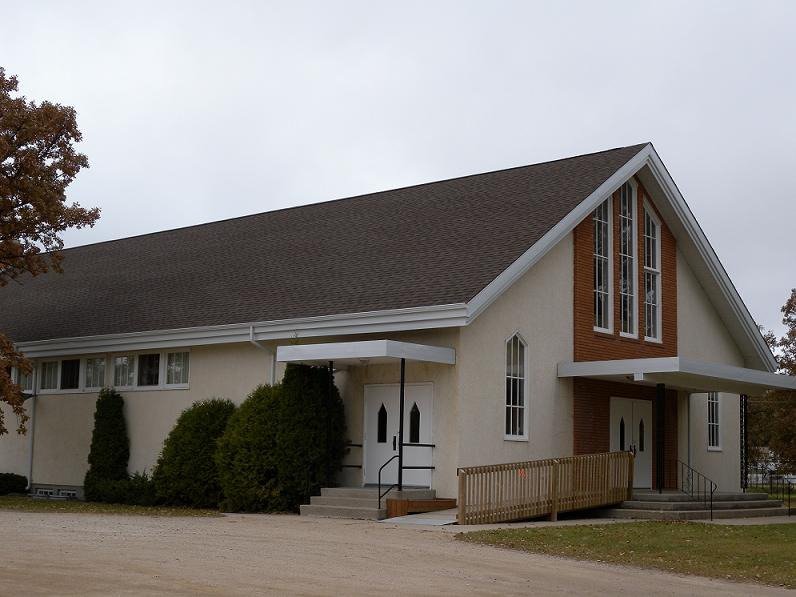
“We wanted to make sure we looked after the most vulnerable in our church,” said Wiens, a local dairy farmer, noting everyone who attends the services also needs to wear a mask and follow social distancing guidelines.
While Elim, which is part of Mennonite Church Manitoba, has been doing online services through the pandemic, “That’s not the same as in-person fellowship,” he said.
As soon as in-person services were permitted by the province, the church started meeting again, following public health guidelines — but not asking about vaccination status.
That changed at the beginning of December, when members were asked to show proof of vaccination against COVID-19 to enter.
Since almost all of the roughly 70 members of the congregation are fully vaccinated, most are very supportive, Wiens said.
However, a few “aren’t happy with our policy,” he said, acknowledging the decision will exclude those who have chosen not to be vaccinated.
“We are exploring ways to make it possible for unvaccinated people to be included,” he said, noting it might mean alternating between vaccinated and unvaccinated member services. “We don’t want to exclude anyone.”
Whatever approach the church takes, “We want to be consistent in our understanding of what is a positive Christian witness,” said Wiens. “Right from the start, we wanted to honour and be respectful of the mandates and protect everyone.”
At the same time, the church isn’t “trying not to make a big statement about vaccinations. We’re just trying to do what is right for our church. We’re not trying to pass judgement on the unvaccinated.”
For Erika Dueck, a deacon at Elim, the decision was about what is best for local seniors.
“They haven’t been able to meet in person, they’re feeling isolated and disconnected,” she said. “The pandemic has been very hard on older members.”
By going to vaccinated-only, the church wants to “rebuild a sense of community.”
While the decision has made most church members happy, reaction outside the congregation has been less so.
Some people “are angry. They think we are rejecting people or in cahoots with the government,” Dueck said.
Transitional interim pastor at Elim, Norm Voth, said, as far as he knows, it is the only church (of roughly eight) in Grunthal to move to vaccinated-only in-person services.

“I expect this will be a topic of conversation at the next ministerial meeting,” he said, adding Elim’s decision seems to have generated a “fair amount of conversation” in town.
The issue continues to be a lively one in the church, too, he said, noting there is a lot of discussion about ways to “maintain the unity of the congregation.”
Through it all, the church’s goal is to “fulfill the commandment to love our neighbour as ourselves,” Voth said.
“If we take care of ourselves, including vaccinations, the mask-wearing, the social distancing, then we are caring for others.”
faith@freepress.mb.ca
The Free Press is committed to covering faith in Manitoba through our Religion in the News project. This reporting continues because readers like you step forward to fund it.
Donate now to support our reporting on religion.
Your donation is eligible for a charitable tax receipt.
BECOME A FAITH JOURNALISM SUPPORTER
Our newsroom depends on a growing audience of readers to power our journalism. If you are not a paid reader, please consider becoming a subscriber.
Our newsroom depends on its audience of readers to power our journalism. Thank you for your support.
The Free Press is committed to covering faith in Manitoba through our Religion in the News project. This reporting continues because readers like you step forward to fund it.
Donate now to support our reporting on religion.
Your donation is eligible for a charitable tax receipt.
BECOME A FAITH JOURNALISM SUPPORTER
Our newsroom depends on a growing audience of readers to power our journalism. If you are not a paid reader, please consider becoming a subscriber.
Our newsroom depends on its audience of readers to power our journalism. Thank you for your support.
Advertisement Advertise With Us
Advertisement Advertise With Us
History
Updated on Tuesday, December 21, 2021 5:18 PM CST: Adds art.
The Free Press acknowledges the financial support it receives from members of the city’s faith community, which makes our coverage of religion possible.