

New peace trail ready for enjoyment starting this spring
Project includes plenty of Mennonite history

Advertisement
Read this article for free:
or
Already have an account? Log in here »
To continue reading, please subscribe:
Digital Subscription
One year of digital access for only $1.44 a week*
- Enjoy unlimited reading on winnipegfreepress.com
- Read the E-Edition, our digital replica newspaper
- Access News Break, our award-winning app
- Play interactive puzzles
*Billed as $5.77 plus GST every four weeks. After 52 weeks, price increases to the regular rate of $19.95 plus GST every four weeks. Offer available to new and qualified returning subscribers only. Cancel any time.
To continue reading, please subscribe:
Add Free Press access to your Brandon Sun subscription for only an additional
$1 for the first 4 weeks*
- Enjoy unlimited reading on winnipegfreepress.com
- Read the E-Edition, our digital replica newspaper
- Access News Break, our award-winning app
- Play interactive puzzles
*Your next Brandon Sun subscription payment will increase by $1.00 and you will be charged $17.95 plus GST for four weeks. After four weeks, your payment will increase to $24.95 plus GST every four weeks.
Read unlimited articles for free today:
or
Already have an account? Log in here »
Hey there, time traveller!
This article was published 21/03/2022 (1531 days ago), so information in it may no longer be current.
People wanting to learn more about the history of Mennonites in Manitoba, while enjoying a long walk or bike ride, will be able to do that this spring with the opening of the new southeastern Manitoba Peace Trail.
The trail, which runs 52-kilometres from the confluence of the Rat and Red rivers, just west of Niverville, to Steinbach, was approved March 16 by the EastMenn Historical Committee, which is affiliated with the Manitoba Mennonite Historical Society.
The trail is the brainchild of Glen Klassen, a retired University of Manitoba professor who lives in Steinbach. For him, the trail has both historical and personal significance.
“Almost all my ancestors were on the first boat that arrived in 1874 at what is known as Mennonite Landing at the Red and Rat rivers,” he said. “They would have travelled along what is now the Peace Trail.”
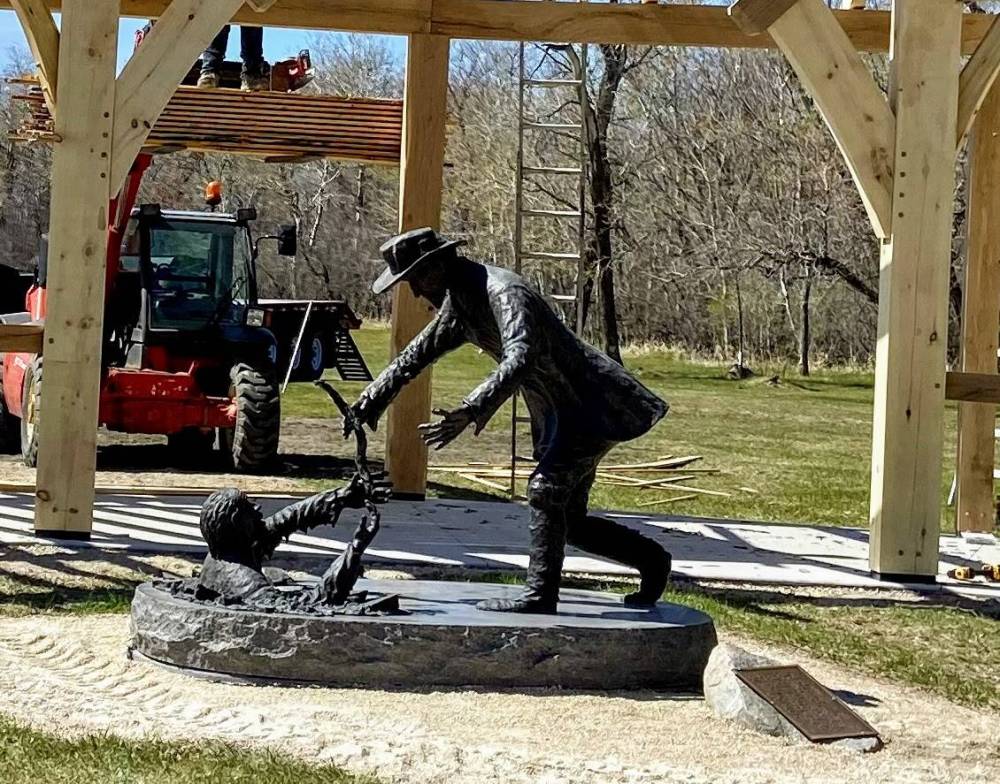
From its start at Mennonite Landing, the trail takes in Mennonite historical sites such as the former site of the Niverville immigration sheds — where the immigrants found shelter after arrival; the Gruenfeld Cemetery, where some early settlers are buried; the Chortitz Church, the first Mennonite church in Manitoba; and the Dirk Willems Peace Garden at the Mennonite Heritage Village in Steinbach.
Klassen envisions the trail appealing to people who are interested in Mennonite history, those who want to undertake a spiritual pilgrimage, those who want to learn more about the ecology of the area, and others who simply want to spend time outside in nature.
The trail could also be used by school, youth and tour groups, Klassen said, adding it will also contribute the local economy.
A passport-type system will be used on the trail, enabling users to chart their progress.
The trail is made up largely of country roads, although there are few trails. It also follows the Tourond Creek for about a kilometre and a half.

“We wanted to avoid busy highways,” Klassen said, adding there are camping spots picked out for those who want to do it in segments. “People can also drive it.”
Right now the committee is raising money for trail guides, maps, signage, toilets and a website, Klassen said.
In addition to a good way of walking and riding, people can use the trail “to pray for peace, something that is needed in the world today,” Klassen said.
Between 1874 and 1880 about 7,000 Mennonites from southern Ukraine came to Manitoba, most arriving by steamboats at the junction of the Rat and Red rivers. Many went on to settle on land given to them by the Canadian government east of the Red River, in what was known as the East Reserve.
faith@freepress.mb.ca
The Free Press is committed to covering faith in Manitoba through our Religion in the News project. This reporting continues because readers like you step forward to fund it.
Donate now to support our reporting on religion.
Your donation is eligible for a charitable tax receipt.
BECOME A FAITH JOURNALISM SUPPORTER
Our newsroom depends on a growing audience of readers to power our journalism. If you are not a paid reader, please consider becoming a subscriber.
Our newsroom depends on its audience of readers to power our journalism. Thank you for your support.
The Free Press is committed to covering faith in Manitoba through our Religion in the News project. This reporting continues because readers like you step forward to fund it.
Donate now to support our reporting on religion.
Your donation is eligible for a charitable tax receipt.
BECOME A FAITH JOURNALISM SUPPORTER
Our newsroom depends on a growing audience of readers to power our journalism. If you are not a paid reader, please consider becoming a subscriber.
Our newsroom depends on its audience of readers to power our journalism. Thank you for your support.
Advertisement Advertise With Us
Advertisement Advertise With Us
The Free Press acknowledges the financial support it receives from members of the city’s faith community, which makes our coverage of religion possible.