Repaying an old kindness
Hutterite-made isolation gowns donated to Jewish-run long-term care home

Advertisement
Read this article for free:
or
Already have an account? Log in here »
To continue reading, please subscribe:

Digital Subscription
One year of digital access for only $205*
- Enjoy unlimited reading on winnipegfreepress.com
- Read the E-Edition, our digital replica newspaper
- Access News Break, our award-winning app
- Play interactive puzzles
*First annual payment billed as $205.00 + GST for one year. This annual subscription will automatically renew at $233.00 + GST every 52 weeks (10% off the regular annual price of $259.35). Offer available to new and qualified returning subscribers only. Cancel any time.
To continue reading, please subscribe:
Add Free Press access to your Brandon Sun subscription for only an additional
$1 for the first 4 weeks*
- Enjoy unlimited reading on winnipegfreepress.com
- Read the E-Edition, our digital replica newspaper
- Access News Break, our award-winning app
- Play interactive puzzles
*Your next Brandon Sun subscription payment will increase by $1.00 and you will be charged $17.95 plus GST for four weeks. After four weeks, your payment will increase to $24.95 plus GST every four weeks.
Read unlimited articles for free today:
or
Already have an account? Log in here »
Hey there, time traveller!
This article was published 30/01/2021 (2063 days ago), so information in it may no longer be current.
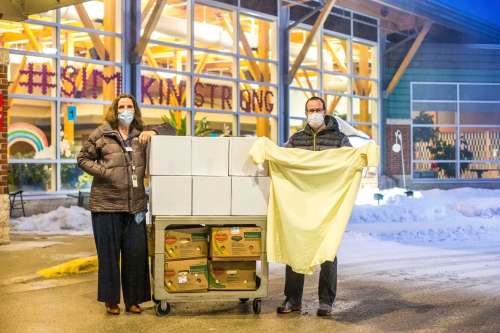
Meant as a practical offer of help, a recent donation of hundreds of Hutterite-made isolation gowns to a Jewish-run long-term care home also repays a decades-old kindness.
“They (Hutterites) were able to get farmland (in 1947) after a group of Jewish men stood up for them,” explains Cindy Greenlay, manager of support services at Saul and Claribel Simkin Centre.
“Someone did a mitzvah back then and it is benefiting us in 2021.”

In Judaism, the word mitzvah means to follow commandments, but it also includes acts of human kindness that go beyond legal duty.
Hutterite teacher and historian Ian Kleinsasser of Crystal Springs Hutterite Community responded to an appeal for volunteers after the 200-bed Jewish personal care home suffered a COVID-19 outbreak.
Initially intending to train some Hutterite volunteers to fold isolation gowns, used by staff each time they entered a room of someone infected by COVID, Greenlay says the conversation quickly turned to sewing more of the yellow polyester gowns, to supplement their supply which had to be washed and folded several times a day.
The Simkin Centre paid for the materials, including 1,400 metres of fabric, 1,000 metres of cotton tape for the closure ties, and another 20 metres of knit fabric for the ribbed cuffs.
By late December, Lillian Kleinsasser, a cousin by marriage to Ian Kleinsasser, started cutting out gowns to distribute kits to fellow members of Crystal Springs, as well as Netley, Decker, New Rosedale, and Elm River communities.
Then dozens of sewists assembled the gowns on their domestic sergers and sewing machines, completing the project in just two weeks. Usually Hutterite women would gather in a large common space to sew together, but restrictions around gathering to limit the spread of the coronavirus meant everyone had to sew at home, says Lillian Kleinsasser.
Despite that limitation, the sewists completed the project quickly because of the urgency of the need, she says.
“It gives you a very nice warm feeling inside if you can help somebody else,” explains the Crystal Springs mother of five, who sewed two gowns in addition to cutting out hundreds.
“We put our own sewing aside and help others out.”
By mid-January, Kleinsasser delivered more than 500 newly completed one-size-fits-all isolation gowns to the southwest Winnipeg personal care home, and also shared the back story.
He gave Greenlay a Winnipeg Free Press clipping from 1947 recounting how a group of Jewish businesspeople spoke out at a legislative hearing opposing the rights of Hutterites to purchase land, arguing the proposed law could affect other minority groups.
“They wanted to go on the record to say they objected to the proceedings,” explains Ian Kleinsasser of the hearing held on April 21, 1947 at the Manitoba Legislature.
“This sort of sealed the deal.”
He says that story is remembered by Hutterite historians, but not widely known within the colonies.
“This relationship with the Jewish community has been there since the beginning,” he says of their shared history, dating back to 1918 when Hutterites moved to Manitoba from South Dakota.
Helping out Simkin Centre deal with a global pandemic allowed Hutterites to give back to the Jewish community as well as expressing Hutterite values of community and generosity.
“This is an opportunity to give back some loving kindness to strangers and just reach out and make a difference,” explains the elementary school teacher, who acted as delivery person.
“I see it as an opportunity to shine a little light in the darkness.”

Making the connection across the decades also demonstrates that good actions repair and change the world in ways we can’t anticipate, says Rabbi Allan Finkel, head of Winnipeg Council of Rabbis.
He said Jews in 1947 were very aware of the potential for discrimination right after the Holocaust and knew standing up for other minorities preserved rights for everyone.
“These stories don’t surprise me and I’m really honoured they shared it in the modern context,” says Finkel, rabbi at Temple Shalom.
“What I love about the story is the idea that Jews in the 1940s knew who they were.”
brenda@suderman.com
The Free Press is committed to covering faith in Manitoba through our Religion in the News project. This reporting continues because readers like you step forward to fund it.
Donate now to support our reporting on religion.
Your donation is eligible for a charitable tax receipt.
BECOME A FAITH JOURNALISM SUPPORTER
Brenda Suderman has been a columnist in the Saturday paper since 2000, first writing about family entertainment, and about faith and religion since 2006.
Our newsroom depends on a growing audience of readers to power our journalism. If you are not a paid reader, please consider becoming a subscriber.
Our newsroom depends on its audience of readers to power our journalism. Thank you for your support.
The Free Press is committed to covering faith in Manitoba through our Religion in the News project. This reporting continues because readers like you step forward to fund it.
Donate now to support our reporting on religion.
Your donation is eligible for a charitable tax receipt.
BECOME A FAITH JOURNALISM SUPPORTER
Brenda Suderman has been a columnist in the Saturday paper since 2000, first writing about family entertainment, and about faith and religion since 2006.
Our newsroom depends on a growing audience of readers to power our journalism. If you are not a paid reader, please consider becoming a subscriber.
Our newsroom depends on its audience of readers to power our journalism. Thank you for your support.
Advertisement Advertise With Us
Advertisement Advertise With Us
The Free Press acknowledges the financial support it receives from members of the city’s faith community, which makes our coverage of religion possible.