Sturgeon stencils reminder of hydro effect on north

Advertisement
Read this article for free:
or
Already have an account? Log in here »
To continue reading, please subscribe:
Digital Subscription
One year of digital access for only $1.44 a week*
- Enjoy unlimited reading on winnipegfreepress.com
- Read the E-Edition, our digital replica newspaper
- Access News Break, our award-winning app
- Play interactive puzzles
*Billed as $5.77 plus GST every four weeks. After 52 weeks, price increases to the regular rate of $19.95 plus GST every four weeks. Offer available to new and qualified returning subscribers only. Cancel any time.
To continue reading, please subscribe:
Add Free Press access to your Brandon Sun subscription for only an additional
$1 for the first 4 weeks*
- Enjoy unlimited reading on winnipegfreepress.com
- Read the E-Edition, our digital replica newspaper
- Access News Break, our award-winning app
- Play interactive puzzles
*Your next Brandon Sun subscription payment will increase by $1.00 and you will be charged $17.95 plus GST for four weeks. After four weeks, your payment will increase to $24.95 plus GST every four weeks.
Read unlimited articles for free today:
or
Already have an account? Log in here »
Hey there, time traveller!
This article was published 12/07/2022 (1565 days ago), so information in it may no longer be current.
MAYBE you’ve seen them around Winnipeg, blue fish stencilled on hydro poles, and wondered: What’s that about?
The fish are sturgeon, and they were put there by members of the Interchurch Council on Hydropower as a way to remind Winnipeggers where their electricity comes from — from dams in the northern part of the province.
“We want to draw a connection between the South and North and remind people of the great impacts of the dams on the people, ecosystems and watersheds in the North,” said council member Amanda Leighton.
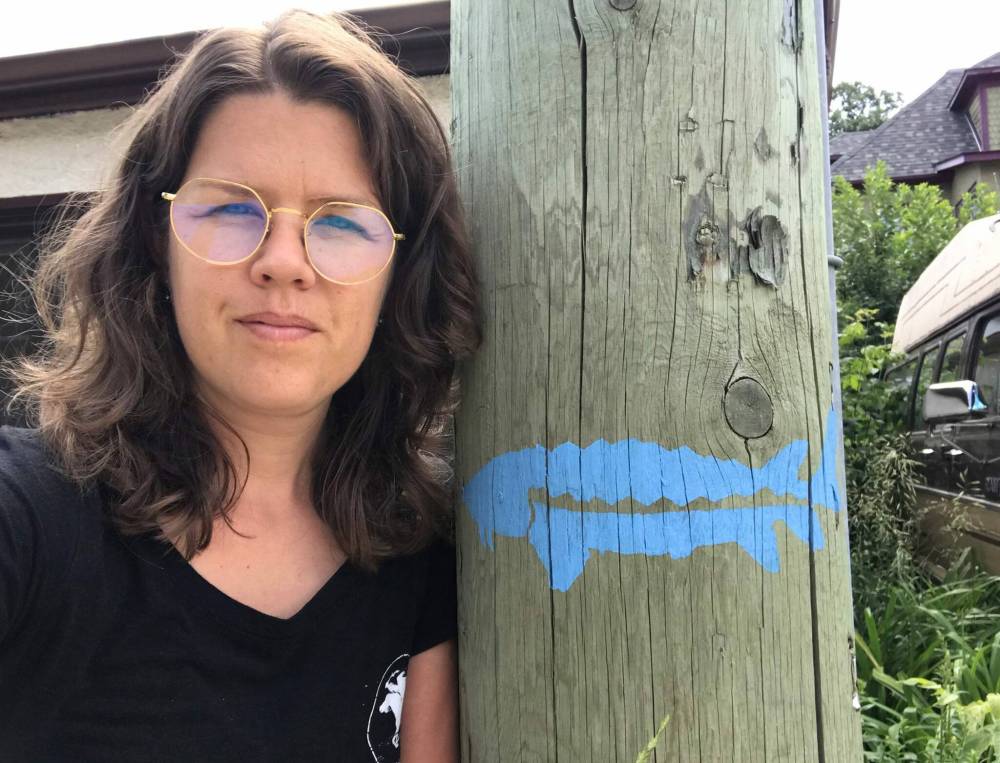
Leighton, who came up with the idea, was inspired by the “Press On” bird stencils found throughout the city.
She modelled the project after salmon stencils that are painted on street drains in B.C. towns and cities to remind people that whatever goes into the drain ends up in the rivers and ocean.
“Most people don’t know about the impact of the dams on people in the North,” she said, noting that some communities were forcibly removed and people lost their livelihoods.
As for why a it’s a sturgeon on the stencil, that’s because the fish is imperilled by the dams, especially on the Lower Churchill River.
These fish, she said, need deep water and lots of space to reproduce, something they only do many years after birth.
“There’s not enough water on the river for them to spawn freely,” she said. “The water is low because so much is diverted to the Nelson River to supply the hydroelectric dam. The river is de-watered most of the time.”
Before hydro development, she said, the Lower Churchill River was fast-moving, with lots of water. Since the completion of the Churchill River Diversion in 1974, that 500-kilometre stretch of the river has been reduced to a trickle.

As well, she noted, many Indigenous people feel connected to the sturgeon socially and spiritually, and the fish is revered by many Indigenous people in Canada.
In the past, when sturgeon were plentiful, it was also a staple for many Indigenous people with one large fish feeding a whole family, she said.
There are about 400 sturgeon stencils on hydro poles in the city, mostly along Henderson Highway, in The Exchange and in the Wolseley and Luxton neighbourhoods. They have been put there by volunteers from the council and from the Manitoba Energy Justice Coalition.
“Our goal is to show we are inter-connected with what we consume,” Leighton said. “Our hope is that the sturgeon symbol will broaden our lens and remind us that we are all in this together.”
faith@freepress.mb.ca
The Free Press is committed to covering faith in Manitoba through our Religion in the News project. This reporting continues because readers like you step forward to fund it.
Donate now to support our reporting on religion.
Your donation is eligible for a charitable tax receipt.
BECOME A FAITH JOURNALISM SUPPORTER
Our newsroom depends on a growing audience of readers to power our journalism. If you are not a paid reader, please consider becoming a subscriber.
Our newsroom depends on its audience of readers to power our journalism. Thank you for your support.
The Free Press is committed to covering faith in Manitoba through our Religion in the News project. This reporting continues because readers like you step forward to fund it.
Donate now to support our reporting on religion.
Your donation is eligible for a charitable tax receipt.
BECOME A FAITH JOURNALISM SUPPORTER
Our newsroom depends on a growing audience of readers to power our journalism. If you are not a paid reader, please consider becoming a subscriber.
Our newsroom depends on its audience of readers to power our journalism. Thank you for your support.
Advertisement Advertise With Us
Advertisement Advertise With Us
The Free Press acknowledges the financial support it receives from members of the city’s faith community, which makes our coverage of religion possible.