Canada’s COVID-19 death toll passes 4,000; feds announce help for farmers

Advertisement

Advertise with us

TORONTO - The number of people in Canada killed by COVID-19 passed the 4,000 mark on Tuesday, as provinces eased anti-pandemic restrictions and the government announced new aid for farmers.

Read this article for free:


or

Already have an account? Log in here »

To continue reading, please subscribe:

Subscribe and receive a limited-edition Free Press branded hat or tote.

Digital Subscription

One year of digital access for only $205*

  • Enjoy unlimited reading on winnipegfreepress.com
  • Read the E-Edition, our digital replica newspaper
  • Access News Break, our award-winning app
  • Play interactive puzzles

*First annual payment billed as $205.00 + GST for one year. This annual subscription will automatically renew at $233.00 + GST every 52 weeks (10% off the regular annual price of $259.35). Offer available to new and qualified returning subscribers only. Cancel any time.

To continue reading, please subscribe:

Add Free Press access to your Brandon Sun subscription for only an additional

$1 for the first 4 weeks*

  • Enjoy unlimited reading on winnipegfreepress.com
  • Read the E-Edition, our digital replica newspaper
  • Access News Break, our award-winning app
  • Play interactive puzzles
Start now

*Your next Brandon Sun subscription payment will increase by $1.00 and you will be charged $17.95 plus GST for four weeks. After four weeks, your payment will increase to $24.95 plus GST every four weeks.

Hey there, time traveller!
This article was published 05/05/2020 (2328 days ago), so information in it may no longer be current.

TORONTO – The number of people in Canada killed by COVID-19 passed the 4,000 mark on Tuesday, as provinces eased anti-pandemic restrictions and the government announced new aid for farmers.

The grim fatality milestone came as the country’s two largest provinces each reported a jump in novel coronavirus-related deaths, although the overall increase in new cases was relatively modest. Canada has now seen 62,000 cases in every province and territory except Nunavut.

Although Ontario reported no new nursing home outbreaks, the number of long-term care deaths in the province passed 1,000, with another 31 residents dying. In all, 61 new deaths were reported, bringing the province’s total to 1,361, according to latest government data.
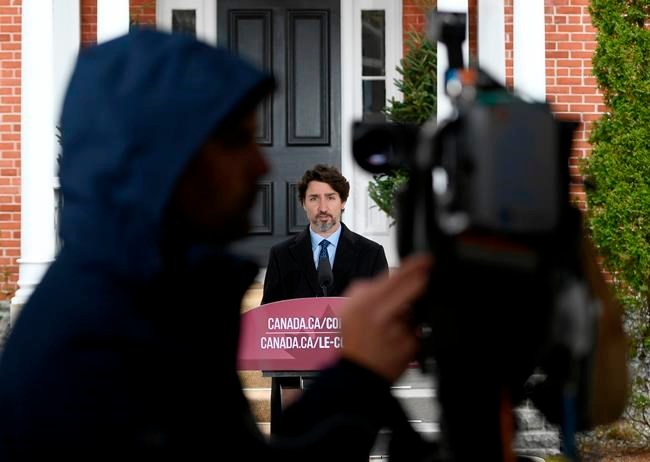
Prime Minister Justin Trudeau speaks during his daily news conference on the COVID-19 pandemic outside his residence at Rideau Cottage in Ottawa, on Monday, May 4, 2020. THE CANADIAN PRESS/Justin Tang

The country’s hardest-hit province, Quebec, also reported 118 new deaths, bringing its total to 2,398. Premier Francois Legault said about 11,200 health-care workers were off the job because of illness, vulnerability to COVID-19 infection, or fear of going to work.

After more than two weeks without any increase, New Brunswick recorded its first new case on Tuesday, while the Assembly of First Nations called an outbreak in Saskatchewan’s far north alarming.

Despite the increases in cases and deaths, chief public health officer Dr. Theresa Tam called the signs encouraging.

“Overall, we are seeing a continual slowing down of the epidemic itself,” Tam said.

In Ottawa, Prime Minister Justin Trudeau announced $252 million for an agri-food sector preparing for spring planting and dealing with sharply reduced meat-processing capacity. The money is significantly less than the $2.6 billion the Canadian Federation of Agriculture had called for in urgent financial help.

“Food security is a preoccupation for everyone,” Trudeau said. “This is only an initial amount of support.”

Part of the money, Trudeau said, will compensate farmers raising beef cattle or hogs who have had to keep their animals longer than planned due to reduced processing capacity. Trudeau also noted that disrupted supply and processing chains have led to an over-supply in areas such as dairy, poultry and potatoes.

“We’ve seen significant disruptions in global supply chains,” Trudeau said. “Some producers have no choice but to throw out their product.”

Trudeau called such a disposal a waste of effort and food. To help deal with the issue, he said Ottawa would spend $50 million as part of its farm strategy to buy large quantities of surplus product for distribution to people in need.

The prime minister’s announcement came one day after the Cargill meat processing plant near High River, Alta., reopened after closing on April 20 as COVID-19 swept through the factory. More than 900 of Cargill’s 2,000 workers have tested positive and one has died.
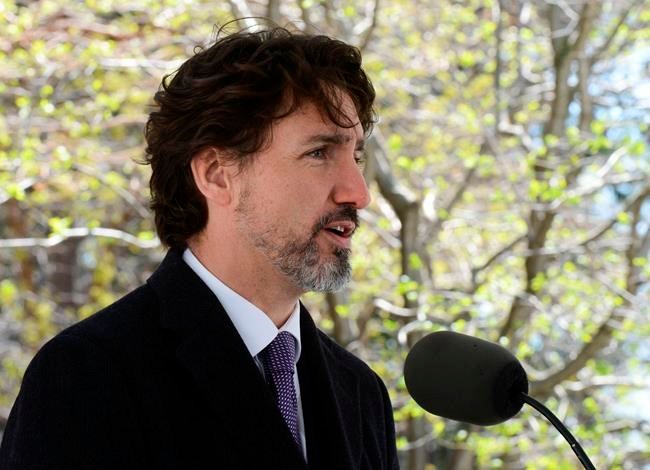
Prime Minister Justin Trudeau delivers an address to Canadians from Rideau Cottage during the COVID-19 pandemic in Ottawa on Tuesday, May 5, 2020. THE CANADIAN PRESS/Sean Kilpatrick

“I just want everyone to remember my wife … was a wonderful lady, very generous and very compassionate,” Nga Nguyen said of Hiep Bui, a Cargill bone picker who died April 19 of coronavirus disease.

Across the country, provinces have been taking tentative steps toward returning to normalcy by easing some of the stiff anti-pandemic stay-home and business closure directives. For example, Quebec has allowed retail stores outside Montreal to reopen, while seasonal businesses such as garden centres have restarted in Ontario. Several provinces are allowing some health services and limited outdoor activities to resume.

Most Canadians, it would appear, are largely happy with the pace of reopening. A new poll by Leger and the Association for Canadian Studies suggests between 60 and 70 per cent of people supported the slow easing of measures, while 16 to 30 per cent indicated wanting to see things move even more slowly.

One consequence of the stay-home measures has been a sharp increase in people dying in fires, Ontario’s fire marshal said. To date this year, fires have killed 51 people, a 65 per cent increase from last year. The office said unattended cooking is the leading cause of home fires.

New data Tuesday showed almost 7.5 million people have received emergency federal aid that started flowing a month ago. The Canada Emergency Response Benefit provides up to $2,000 per month to those who have lost jobs because of the pandemic.

-With files from Canadian Press reporters across the country.

This report by The Canadian Press was first published May 5, 2020.

Report Error Submit a Tip

More Stories

Cabernet Sauvignon star of wine festival

Ben Sigurdson 5 minute read Preview

Cabernet Sauvignon star of wine festival

Ben Sigurdson 5 minute read 3:00 AM CDT

The Winnipeg Wine Festival will celebrate the king of red wine grapes next weekend — the theme of this year’s festival, which takes place Sept. 25 and 26 at the RBC Convention Centre, is Cabernet Sauvignon.

Cab Sauv, as it’s also known, is the world’s most widely planted wine grape of any colour, first coming to prominence in the 1800s in France’s Bordeaux region, where the grape is still popular. Rather than single-variety wines, Bordeaux reds tend to be blends, with those coming from the left bank of the Gironde estuary being Cabernet-dominant, while right-bank wines are Merlot-dominant, with Cabernet Sauvignon playing a supporting role. Cabernet and Merlot work well together and many other countries have followed suit in blending the two.

A team at University of California Davis put Cabernet Sauvignon through a DNA test in 1996 and discovered its parent grapes are Cabernet Franc and Sauvignon Blanc — it’s likely that at some point the two varieties, planted next to each other in some vineyard, crossed and mutated and became the grape we know today. (Someone growing grapes in the 19th century must have had an inkling of what was up, as the grape has been called Cabernet Sauvignon since long before the DNA test.)

Flavour-wise, most Cabernet Sauvignon wines are big and bold, with a core of deep dark berry flavours, some graphite and spice notes and relatively bright acidity. It’s a grape that is well-suited to barrel aging, with most examples seeing at least some time in wood.

Read
3:00 AM CDT

Siloam Mission, WFPS discussing on-site paramedic to reduce staggering number of emergency calls

Scott Billeck 4 minute read Preview

Siloam Mission, WFPS discussing on-site paramedic to reduce staggering number of emergency calls

Scott Billeck 4 minute read Yesterday at 2:00 AM CDT

Winnipeg’s fire-paramedic service and its largest homeless-serving organization are discussing what it would look like to station at least one paramedic at Siloam Mission, as emergency calls to the downtown facility surge.

The ongoing discussions come as Winnipeg Fire Paramedic Service crews were dispatched 1,771 times during the first eight months of the year to the two adjacent Siloam properties at 303 Stanley St. and 300 Princess St.

WFPS said most of the calls were related to overdoses or other consequences of substance use, with the total nearly double the 854 calls recorded over the same period last year. By comparison, there were 831 calls during the same span in 2024, and 591 in 2023.

“The number of emergency calls isn’t sustainable for us as a service, but it’s certainly not sustainable for them as an agency trying to provide services,” WFPS chief Ryan Sneath told the Free Press. “And they recognize that they’re impacting emergency services, not them specifically, but the site in a significant way.”

Read
Yesterday at 2:00 AM CDT

United Way, other charities fight for dollars as donor base shrinks

Scott Billeck 8 minute read Preview

United Way, other charities fight for dollars as donor base shrinks

Scott Billeck 8 minute read Yesterday at 2:00 AM CDT

Winnipeg’s charitable sector is being squeezed from both sides: demand for help is growing while the pool of donors to meet that need is shrinking.

The imbalance is increasingly being carried by a relatively small group of deep-pocketed donors. Last year, 600 people — about three per cent of United Way Winnipeg’s individual donors — accounted for roughly $8 million, or 55 per cent of individual donations.

The fundraising pitch isn’t getting any easier.

Homelessness and public drug use have become increasingly visible, household budgets remain strained and the problems charities are trying to address can seem so entrenched that donors may reasonably wonder what difference another contribution can make.

Read
Yesterday at 2:00 AM CDT

A life’s story: activist, educator, organizer knew the true meaning of community

Janine LeGal 7 minute read Preview

A life’s story: activist, educator, organizer knew the true meaning of community

Janine LeGal 7 minute read 3:00 AM CDT

Somewhere between a love for sharing stories and a love of community connections, Michael (Mike) Maunder lived his life. Giving voice to people and neighbourhoods was a passion for the natural-born community organizer.

An author, teacher and principal, Maunder lived in a one-bedroom apartment in West Broadway and devoted himself to community development, education and neighbourhood renewal.

He maintained a connection with Augustine United Church, whose commitment to social justice he appreciated, volunteered at the Sandy-Saulteaux Spiritual Centre, and found comfort in a Buddhist prayer community.

Maunder died on July 15 at the age of 80.

Read
3:00 AM CDT

Manitoba abandoning spring, fall clock changes

Carol Sanders 8 minute read Preview

Manitoba abandoning spring, fall clock changes

Carol Sanders 8 minute read Updated: Yesterday at 8:48 AM CDT

Time’s up for the time change in Manitoba.

Manitobans won’t be setting their clocks back an hour in November. The province has decided to permanently stay on daylight time after surveying residents on the twice annual clock adjustment.

“We heard from Manitobans loud and clear — no more changing the clocks in Manitoba,” Premier Wab Kinew said in a news release Thursday.

Most of the 72,000 votes submitted in an online EngageMB survey — 92 per cent — said they would like to see the practice end. The survey asked if they preferred earlier sunrises in winter with standard time or the later sunsets in summer with daylight time. More than half of survey participants (58 per cent) indicated a preference to stay on permanent daylight time; 34 per cent voted to eliminate the time change but stay on standard time.

Read
Updated: Yesterday at 8:48 AM CDT

Grieving child builds backyard rocket ship

Harriet Zaidman 4 minute read 2:01 AM CDT

I Built a Rocket Ship (Kids Can Press, 32 pages, hardcover, $22) by Winnipegger Anna Lazowski is a tender story for children ages 4-8 about a little girl trying to make sense of her mother’s death. The child engages in conversation with her late mom, agreeing and disagreeing about things said as she carries objects (and of course, the cat) to the backyard. There, she is building a rocket ship she will pilot into the skies to find her mom again.

Jennica Lounsbury’s varied perspectives show the range of emotions the little girl experiences.

● ● ●

Northwoods Lullaby by Mary Casanova (University of Minnesota Press, 32 pages, hardover, $25) is a bedtime book for readers up to age eight, perfect to bring a busy, happy day to a close. Just like children who are listening to adults reading the book, all the animal babies are being tucked into their nests and burrows by loving parents: “Thump and scamper,/nimble clover./ Soon it’s time to rest. Baby loon/ nestles in/as Papa floats along.”