First aid tips for furry first responders
Advertisement
Read this article for free:
or
Already have an account? Log in here »
To continue reading, please subscribe:

Digital Subscription
One year of digital access for only $205*
- Enjoy unlimited reading on winnipegfreepress.com
- Read the E-Edition, our digital replica newspaper
- Access News Break, our award-winning app
- Play interactive puzzles
*First annual payment billed as $205.00 + GST for one year. This annual subscription will automatically renew at $233.00 + GST every 52 weeks (10% off the regular annual price of $259.35). Offer available to new and qualified returning subscribers only. Cancel any time.
To continue reading, please subscribe:
Add Free Press access to your Brandon Sun subscription for only an additional
$1 for the first 4 weeks*
- Enjoy unlimited reading on winnipegfreepress.com
- Read the E-Edition, our digital replica newspaper
- Access News Break, our award-winning app
- Play interactive puzzles
*Your next Brandon Sun subscription payment will increase by $1.00 and you will be charged $17.95 plus GST for four weeks. After four weeks, your payment will increase to $24.95 plus GST every four weeks.
Read unlimited articles for free today:
or
Already have an account? Log in here »
Hey there, time traveller!
This article was published 14/11/2017 (3166 days ago), so information in it may no longer be current.
An injured dog will bite, even if it is your own.
If there was one takeaway at the first-aid class for K-9 police officers held at Gladwyne Fire Company in Gladwyne, Pa., recently, it was this: don’t take risks when a dog’s teeth are inches from your face.
“They have some deeply wired behaviours,” said Jon Detweiler, an emergency medical technician who was instructing officers on how to recognize and respond to medical emergencies involving their four-legged partners. “Please be ready for that.”
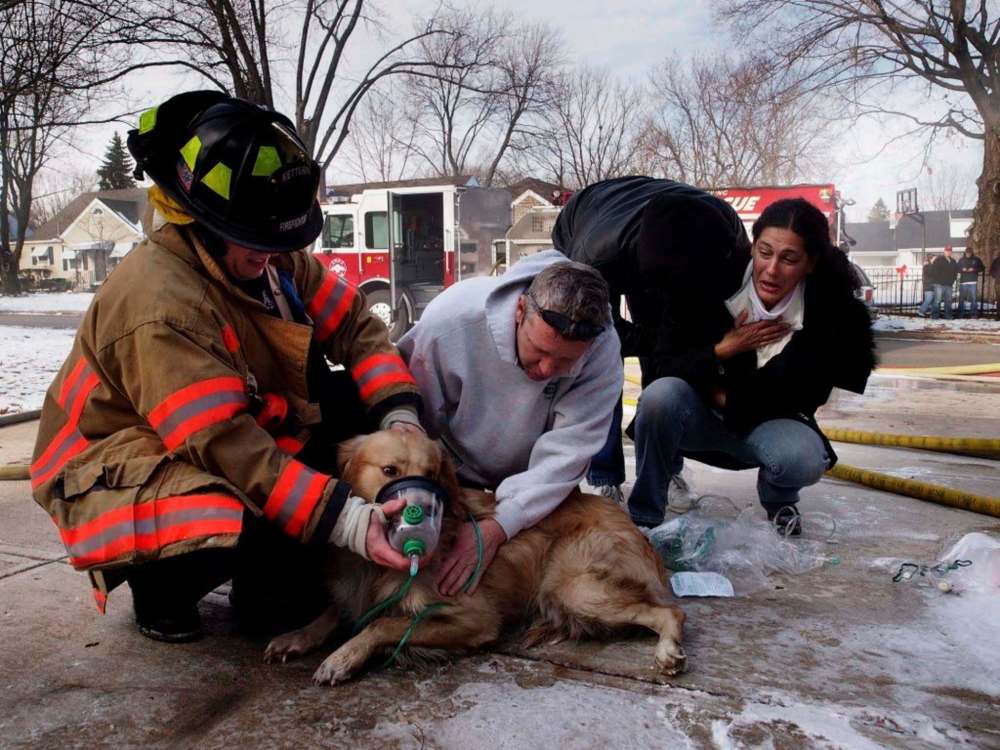
The officers and their companions from Montgomery and Delaware counties gathered for the three-hour class and practice sessions.
An afternoon class for paramedics, emergency medical technicians and nurses addressed issues the group might encounter when responding to emergencies involving working canines. Each working dog is valued as high as $50,000.
Much of what the professionals learned about canine injuries due to car accidents, heatstroke and penetrating trauma would be useful for owners of household pets as well, said Scott Kramer, a paramedic with Narberth Ambulance.
“Anything anybody can do in an emergency situation will help save a life,” said Sharon Minninger, a veterinarian who was teaching the class.
For working dogs with a strong drive to work, it is important their police partners know when to give them a break so they don’t overheat.
Hyperthermia or heatstroke can happen any time, Detweiler said.
“This is huge. This is 100 per cent preventable.”
It’s also an issue for household pets.
“We had a dog die this week,” she said about a case at her veterinary practice. The family pet was accidentally left outside in the sun all day without water.
“They start with a higher body temperature than us. It doesn’t take long to get to a high level.”
You can’t tell by just feeling a dog if its temperature is elevated. Those ear thermometers are built for humans and useless in pets because of their anatomy.
Instead, look for symptoms such as altered behaviour. A pet may collapse or vomit as well.
Placing ice bags under the pet’s armpits, covering them with a wet towel, cooling the pads of their feet with alcohol swabs, or placing them in a pool or stream will help bring down high body temperature, she said.
The class included CPR instruction, recognizing signs and symptoms that would signal a medical crisis, basic first aid and emergency planning for transportation and hospital treatment before it is needed.
The seminar hit home for Whitemarsh police officer Matt Stadulis, who was there with his service dog, Nika, a 3-year-old Belgian Malinois trained as a patrol and explosives dog. A few years ago Stadulis’ first canine partner, Brock, suffered a seizure at a training class, he said.
“I didn’t know what to do,” Stadulis said.

First aid had not been a part of the comprehensive training officers go through with their canine partners, he said.
Brock, now retired at age 9, was rushed to Matthew J. Ryan Veterinary Hospital at the University of Pennsylvania and treated for mild heatstroke. He recovered fully, the officer said.
The first-aid class “gives you the confidence to know what to do,” Stadulis said.
The ASPCA has a 24-hour Animal Poison Control Center that operates year round. The number is 888-426-4435.
— Philadelphia Inquirer
History
Updated on Tuesday, November 14, 2017 7:53 AM CST: Photo added.