France drafts law to extend IVF to lesbians, single women

Advertisement

Advertise with us

PARIS - Single women and lesbians in France no longer would have to go abroad to get pregnant with a doctor's help under a proposed law that would give them access to medically assisted reproduction at home for the first time.

Read this article for free:


or

Already have an account? Log in here »

To continue reading, please subscribe:

Subscribe and receive a limited-edition Free Press branded hat or tote.

Digital Subscription

One year of digital access for only $205*

  • Enjoy unlimited reading on winnipegfreepress.com
  • Read the E-Edition, our digital replica newspaper
  • Access News Break, our award-winning app
  • Play interactive puzzles

*First annual payment billed as $205.00 + GST for one year. This annual subscription will automatically renew at $233.00 + GST every 52 weeks (10% off the regular annual price of $259.35). Offer available to new and qualified returning subscribers only. Cancel any time.

To continue reading, please subscribe:

Add Free Press access to your Brandon Sun subscription for only an additional

$1 for the first 4 weeks*

  • Enjoy unlimited reading on winnipegfreepress.com
  • Read the E-Edition, our digital replica newspaper
  • Access News Break, our award-winning app
  • Play interactive puzzles
Start now

*Your next Brandon Sun subscription payment will increase by $1.00 and you will be charged $17.95 plus GST for four weeks. After four weeks, your payment will increase to $24.95 plus GST every four weeks.

Hey there, time traveller!
This article was published 04/08/2019 (2585 days ago), so information in it may no longer be current.

PARIS – Single women and lesbians in France no longer would have to go abroad to get pregnant with a doctor’s help under a proposed law that would give them access to medically assisted reproduction at home for the first time.

A bioethics law drafted by French President Emmanuel Macron’s government includes language to expand who is eligible for procedures such as artificial insemination and in vitro fertilization, or IVF. French law currently limits assisted reproduction to infertile heterosexual couples only.

While the French government says it is responding to changes in society, its bill is sure to generate debate when it comes up next month in parliament. After France in May 2013 made it legal for same-sex couples to marry and adopt children together, hundreds of thousands of protesters marched in Paris.
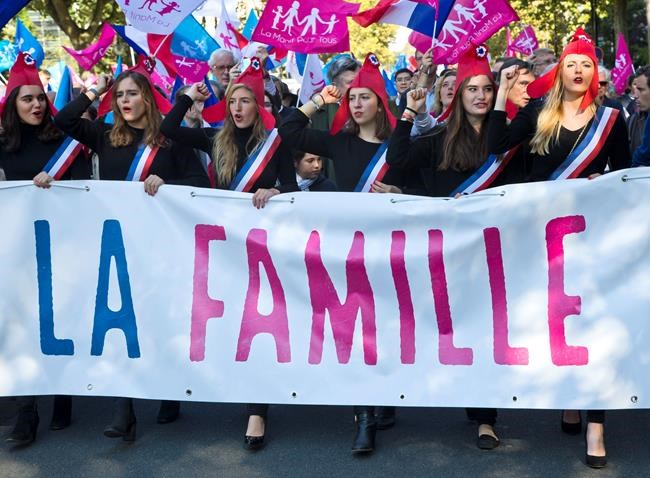
FILE - In this Sunday, Oct. 16, 2016 file photo, demonstrators hold a banner reading
FILE - In this Sunday, Oct. 16, 2016 file photo, demonstrators hold a banner reading "The Family" during a march to protest gay marriage in Paris. Single women and lesbians in France won't have to go abroad to have babies anymore under a proposed new law that would give them access to medically assisted reproduction for the first time. Yet many conservative, religious or far-right activists strongly oppose the change and are planning protests when parliament starts debating the bill next month. (AP Photo/Michel Euler)

The draft calls for France’s national health care system to cover the cost of four rounds of assisted reproduction per pregnancy for all women up to an age limit yet to be set.

The bill also allows children conceived with donated sperm to find out the donor’s identity upon demand when they reach age 18, a change from the strict donor anonymity protections France has now.

However, it would not remove France’s ban on surrogacy arrangements in which a woman carries and delivers a baby for someone else.

French LGBT rights groups lobbied for the proposed provisions after France legalized same-sex marriage2013. They said allowing lesbians and single women to have IVF and other procedures would keep mothers and their babies from running afoul of the French legal system and give them access to the country’s generous health care system.

“This simply is a measure of equality for French female citizens, whatever their sexual orientation is,” the Association of Gay and Lesbian Parents and Future Parents said in a statement.

Twenty conservative groups are already organizing a protest for October to denounce the bill, alleging it will lead to more children raised without fathers. The groups also worry the expanded access to pregnancy procedures would eventually lead to the legalization of surrogate pregnancies.

“Saying that you’re creating new rights … while ignoring the consequences for children on purpose is a revolting and despicable process,” said Alberic Dumont, vice-president of Demonstration for Everyone, a group that is among the bill’s critics.

Lesbian couples, single women or both already have legal access to medically assisted reproduction in 18 of the European Union’s 28 countries.

French women who can’t get procedures at home and can afford it often go to neighbouring Spain or Belgium, where a single round of IVF round costs several thousand euros (dollars).

Virginie, 36, who lives in the southern city of Marseille, married her wife, Cecile, in June. The two women decided not to wait for passage of the government’s proposed law to try to become parents, fearing the parliament debate could last months.

Instead, they chose to use donor sperm mailed from Denmark for 1,000 euros ($1,112). That process is illegal in France, which is why Virginie, who plans to carry the baby, did not want to be identified with her last name.

“If that first try doesn’t work, we are considering using the new French law,” she told The Associated Press.

Virginie said it’s difficult doing something that is illegal and she thinks the proposed law would help many French women. But she also fears it might trigger an anti-gay backlash and encountering medical professionals who balk at serving same-sex couples.

Amandine Zevolino, 35, and her wife, Camille live in Montpellier in southern France and have been married for a year and a half. Zevolino went to Spain to try to get pregnant, but didn’t feel comfortable with the anonymity and commercial aspect of using a sperm donor.

She finally decided to perform at-home insemination with the help of a friend who agreed to donate the sperm.

“We did a contract, even if we know it doesn’t have any legal value,” Zevolino said. “If it works, the child will know how he/she came to the world.”

She is still hesitating about telling French medical workers the truth. The situation “forces us to lie,” she lamented.

Zevolino thinks the parliament debate will ignite political tensions but she hopes the new law will help French society become more accepting of lesbian and single mothers.

“Usually in France on that kind of issue, once the law is passed, it’s definitive,” she said.

Report Error Submit a Tip

More Stories

Former abuser of alcohol, drugs who graduated from recovery program now helping others

Scott Billeck 6 minute read Preview

Former abuser of alcohol, drugs who graduated from recovery program now helping others

Scott Billeck 6 minute read Updated: Yesterday at 9:05 AM CDT

The second time Ray Ducharme overdosed, he was in a Winnipeg hotel room, waiting for a spot in Adult and Teen Challenge Central Canada’s live-in recovery program.

It was Oct. 30, 2024 — not long after his first overdose had landed him in a Red Deer, Alta., hospital for eight days. Ducharme had gone west, trying to outrun the baggage he carried in Winnipeg, before eventually returning home at the behest of an ATCCC employee who assured him there would be a bed available in seven to 10 days.

Then came the second OD.

Three days later, in early November, Ducharme woke up in a Winnipeg hospital with his family around him. Doctors weren’t sure he’d survive.

Read
Updated: Yesterday at 9:05 AM CDT

At last, some good news on homelessness

Editorial 4 minute read Preview

At last, some good news on homelessness

Editorial 4 minute read 2:00 AM CDT

There is no shortage of reasons to be frustrated about homelessness in Winnipeg. But the latest numbers provide something that has been increasingly difficult to find — evidence that at least some things are getting better.

A city tally presented to councillors Friday shows 245 people were living in 72 encampments across Winnipeg in July. Last September, the city counted about 700 people living in 100 encampments.

That is a remarkable drop.

It does not mean Winnipeg has solved homelessness. It does not mean every person displaced from an encampment has found a home. And it certainly does not mean there is no longer a problem in the city’s streets and public spaces.

Read
2:00 AM CDT

Autumn need not be melancholy forever

Maureen Scurfield 5 minute read 2:00 AM CDT

DEAR MISS LONELYHEARTS: Autumn is almost here (the most beautiful time of the year) but it always puts me in mind of my dearest love — a young man from my university days who died tragically in the fall, a couple decades ago. I lost him forever!

How can I get through this time, when it feels like I’ve been punched in the gut every September, and I have to stay home in bed pretending to have flu for a week or more?

— Numbing Out Again, Headingley

Dear Numb: See your physician and confess that you haven’t been able to heal this serious emotional wound. You should really book a visit to a psychiatrist, sooner rather than later, as this tragic loss from the past incapacitates you every fall. A professional therapist can help you to carefully undo these painful “knots,” and a psychiatrist would also be able to prescribe medication that could help you with the process of getting into an improved state of mind. That way, you won’t fall back into a serious state of mourning every autumn.

Man charged with murder, arson in North End blaze

Morgan Modjeski 4 minute read Preview

Man charged with murder, arson in North End blaze

Morgan Modjeski 4 minute read Updated: Yesterday at 7:01 PM CDT

A 22-year-old man has been charged with first-degree murder, two counts of attempted murder and arson in connection with a North End fire Thursday.

Ismail Abdihakim Ali was arrested at the scene of a blaze at a home at 344 St. Johns Ave. just before 10:30 p.m., a Winnipeg Police Service news release said Monday.

Mark Bosadas Marmeto, 35, died from his injuries Saturday.

“It’s devastating to hear somebody has passed,” said Nestor de Quiroz, whose uncle owns the home.

Read
Updated: Yesterday at 7:01 PM CDT

Times of transition can be tough to traverse

Maureen Scurfield 4 minute read Yesterday at 2:01 AM CDT

DEAR MISS LONELYHEARTS: My wife has really enjoyed staying home with the kids all summer, as she is a teacher and has the two months off. Last night she was tearful at bedtime because she has to go back to the classroom and “this perfect summer together is all over.”

I told her I could afford to look after us financially if she ever wanted to quit teaching and stay home, and she blew up and said, “I love to teach and our kids won’t at be home. They’ll all be at school.” Then the tears really came. Sometimes I just can’t win. What’s up with her? Please advise.

— Willing to Help, Winnipeg

Dear Willing: The same thing that’s happened to your wife, you often see with kids at this time of year — over-excitement. It’s hard on everybody when there’s too much new stuff going on and the daily schedule is totally changing from summertime.

Rare and tough to notice, sarcomas may lurk in the body

Jen Zoratti 12 minute read Preview

Rare and tough to notice, sarcomas may lurk in the body

Jen Zoratti 12 minute read Yesterday at 6:00 AM CDT

Last summer, Michelle Finley was going about a normal day.

She had just dropped her car off at a garage and was walking back to her office building downtown when, suddenly, she was stopped in her tracks by a searing cramp on the bottom of her right foot.

“It was so painful it took my breath away,” says Finley, now 52. “I stopped and held on to the side of a building for a second — like, it was bringing tears to my eyes.”

Finley thought she had a really bad case of plantar fasciitis. Nine months later she would lose her foot to sarcoma.

Read
Yesterday at 6:00 AM CDT