What’s wrong with the anti-Keystone argument

Advertisement

Advertise with us

Americans who are concerned about pollution and climate change have traditionally stood with science, in particular the consensus that greenhouse-gas emissions from human activity are warming the earth and changing the climate.

Read this article for free:


or

Already have an account? Log in here »

To continue reading, please subscribe:

Subscribe and receive a limited-edition Free Press branded hat or tote.

Digital Subscription

One year of digital access for only $205*

  • Enjoy unlimited reading on winnipegfreepress.com
  • Read the E-Edition, our digital replica newspaper
  • Access News Break, our award-winning app
  • Play interactive puzzles

*First annual payment billed as $205.00 + GST for one year. This annual subscription will automatically renew at $233.00 + GST every 52 weeks (10% off the regular annual price of $259.35). Offer available to new and qualified returning subscribers only. Cancel any time.

To continue reading, please subscribe:

Add Free Press access to your Brandon Sun subscription for only an additional

$1 for the first 4 weeks*

  • Enjoy unlimited reading on winnipegfreepress.com
  • Read the E-Edition, our digital replica newspaper
  • Access News Break, our award-winning app
  • Play interactive puzzles
Start now

*Your next Brandon Sun subscription payment will increase by $1.00 and you will be charged $17.95 plus GST for four weeks. After four weeks, your payment will increase to $24.95 plus GST every four weeks.

Opinion

Hey there, time traveller!
This article was published 20/02/2013 (4934 days ago), so information in it may no longer be current.

Americans who are concerned about pollution and climate change have traditionally stood with science, in particular the consensus that greenhouse-gas emissions from human activity are warming the earth and changing the climate.

Opponents of the Keystone XL pipeline, in contrast, seem to deliberately ignore the evidence that the pipeline wouldn’t lead to environmental disaster. Missing from their argument — on prominent display in Washington protests this past weekend — are a few salient points. The pipeline would do little to increase greenhouse-gas emissions in North America. It would merely enable Canada to send its crude to Gulf Coast refineries via a north-south pipeline rather than rail or ship, and allow the United States to get more of the eight million barrels of oil it imports each day from a good neighbour.

Now that Nebraska has accepted a revised route for the pipeline around the state’s sensitive Sand Hills region, President Barack Obama is expected to decide this spring whether to allow its construction. He has already encouraged TransCanada Corp. to build the southern part of the line — from Cushing, Okla., to the Gulf Coast, and has only to consider the northern section, which crosses the Saskatchewan-Montana border.
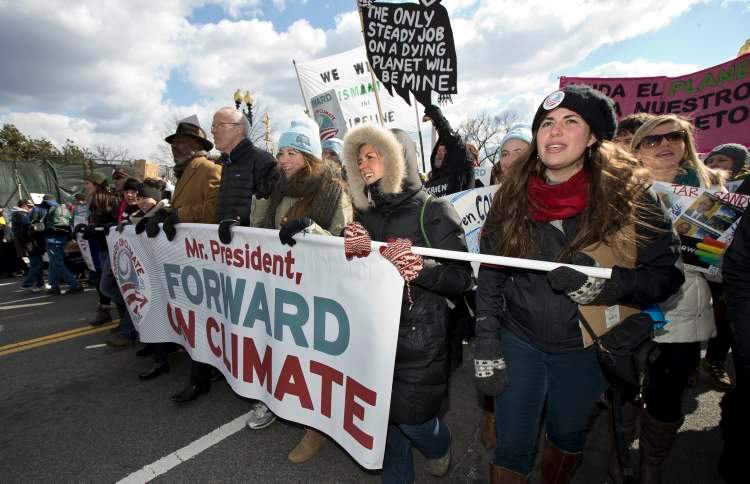
Manuel Balce Ceneta / The Associated Press
From center to right; Bill McKibben, Fiona McRaith, Leah Qusba and Maayan Cohen join a march from the National Mall to the White House in Washington during a rally on calling on President Barack Obama to reject the Keystone XL oil pipeline from Canada, as well as act to limit carbon pollution from power plants and 'move beyond' coal and natural gas, Sunday, Feb. 17, 2013.
Manuel Balce Ceneta / The Associated Press From center to right; Bill McKibben, Fiona McRaith, Leah Qusba and Maayan Cohen join a march from the National Mall to the White House in Washington during a rally on calling on President Barack Obama to reject the Keystone XL oil pipeline from Canada, as well as act to limit carbon pollution from power plants and 'move beyond' coal and natural gas, Sunday, Feb. 17, 2013.

Even if, in making his decision, Obama takes concern for the environment into account, he will have no reason not to approve the project.

Here’s what’s wrong with the environmental argument against the Keystone project. Pipeline foes say that by pumping 700,000 barrels of crude a day to the U.S. it would encourage maximum development of the Athabascan oil sands in Alberta, Canada. Extraction of this thick, dirty crude requires heavy equipment to inject steam underground to unearth the liquefied tar. The process is therefore relatively expensive and high in carbon emissions compared with simple drilling for liquid oil.

Similar steam-injection processes that are used to extract oil from deposits in California’s San Joaquin Valley, however, haven’t received the kind of attention that anti-Keystone forces have aimed at the Alberta oil sands, as an editorial in the journal Nature recently pointed out. If these processes are so intolerable, why would the U.S. oppose Canada’s using them but still allow them to proceed at home?

In any case, extraction methods are getting cleaner. By 2015, carbon-capture technology is expected to reduce emissions from Canadian oil sands by as much as 35 per cent. Even now, when you look at the entire well-to-wheels life cycle of the oil sands crude, its emissions are at most 20 per cent greater than normal, because most of oil’s emissions come from burning the fuel.

Like most every sentient being, the project’s foes are worried about the pipeline’s potential to leak oil within the U.S. TransCanada is taking pains to ensure that the pipeline is designed for the heavy crude it is meant to carry and that it would be safely operated. Even so, we could expect a leak or two a year of more than 2,000 gallons of oil, according to the 2011 environmental impact statement on the project issued by the U.S. State Department. In most cases, however, such spills are expected to be contained in a small area and readily cleanable. This is the calculated risk we take with other oil and gas pipelines, thousands of miles of which crisscross the U.S.

So blocking the Keystone pipeline wouldn’t save the world from environmental catastrophe.

Nor would it save the U.S. economy, as its supporters have argued. The $7 billion project is forecast to bring 20,000 temporary jobs during its construction, but once built it will be operated and maintained by perhaps as few as 20 people.

The reason to approve the pipeline is that it would keep Canadian oil flowing to U.S. refineries in the most efficient way, within the bounds of safety, and this is reason enough.

Report Error Submit a Tip

More Stories

Another downtown eatery bites the dust

Nicole Buffie 6 minute read Preview

Another downtown eatery bites the dust

Nicole Buffie 6 minute read Yesterday at 6:23 PM CDT

Another longtime downtown Winnipeg restaurant has closed its doors, leaving another hole in the city’s core.

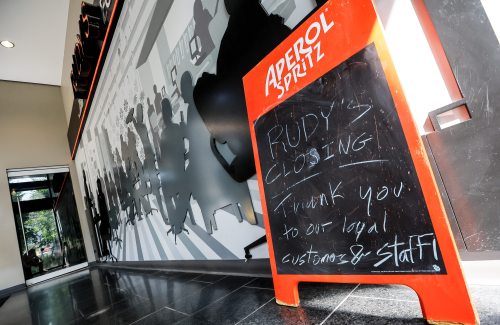
Rudy’s Eat & Drink announced on social media it was closing after 15 years in Manitoba Hydro Place but did not cite a reason.

“Cheers to the years of local beer, burger weeks, jets games, weddings, catering, stone soup week, DJ nights, charitable events and everything in between — we will hold these memories forever,” the post said. “The end of an era — but there’s always another chapter.”

General manager Mackenzie Robb declined to comment on the eatery’s closure. Rudy’s last day of service was on Friday.

Read
Yesterday at 6:23 PM CDT

Bombers late-game defensive errors boil down to technique

Taylor Allen 4 minute read Preview

Bombers late-game defensive errors boil down to technique

Taylor Allen 4 minute read Yesterday at 7:09 PM CDT

It feels silly to criticize the Winnipeg Blue Bombers’ defence on their latest showing.

To go on the road, force three turnovers, and hold the No. 1-ranked team in the West Division to 22 points is an impressive feat that should be heaped with praise.

But in the final minute of the game, the unit needed to tackle better.

With the score tied 19-19, the Edmonton Elks faced a second and three from their own 46-yard line when running back Justin Rankin squeezed through three defenders for a 16-yard gain.

Read
Yesterday at 7:09 PM CDT

Driver, 21, killed in Interlake crash

1 minute read Yesterday at 11:44 AM CDT

A 21-year-old Thompson man was killed in a crash in the Interlake on Sunday.

RCMP said a southbound truck went into a ditch on Highway 6, just north of Moosehorn, and rolled multiple times at about 5 a.m.

The 21-year-old man, who died at the scene, was driving the truck, police said.

Six passengers suffered non-life-threatening injuries. A STARS air ambulance was called to the scene.

Senior’s family frustrated by Manitoba Housing’s response to apartment’s bedbug infestation

Malak Abas 5 minute read Preview

Senior’s family frustrated by Manitoba Housing’s response to apartment’s bedbug infestation

Malak Abas 5 minute read Yesterday at 6:00 AM CDT

The family of a senior who left his Manitoba Housing apartment after two years of bedbug infestations is accusing the provincial body of being ineffectual and irresponsible in its treatment of the persistent pests.

The senior had lived at the Columbus Courts building at 253 Edgeland Blvd., since 2011, but when he began getting severe skin rashes all over his body about two years ago, his son began to worry.

They found out the 14-storey building was being sprayed for bedbugs after an infestation had impacted several units. After multiple rounds of pesticide treatments, the problem has not subsided, the son told the Free Press.

“They come in, they spray pesticides and then they leave. And it’s been completely ineffectual,” he said. “My dad keeps seeing the bedbugs even the day after the treatments and continuously, they’ve just gotten worse and worse.”

Read
Yesterday at 6:00 AM CDT

City inundated with thousands of complaints after launch of new transit system

Morgan Modjeski 11 minute read Preview

City inundated with thousands of complaints after launch of new transit system

Morgan Modjeski 11 minute read Friday, Aug. 21, 2026

Despite complaints from thousands of dissatisfied users, Winnipeg hasn't hit the brakes on the rollout of its new primary transit network. And it appears that ignoring the public response cost Winnipeg Transit millions of dollars in lost revenue and ridership.

Read
Friday, Aug. 21, 2026

Winnipeg team behind national LGBT monument spent six years bringing it to fruition

Nicole Buffie 5 minute read Preview

Winnipeg team behind national LGBT monument spent six years bringing it to fruition

Nicole Buffie 5 minute read Sunday, Aug. 23, 2026

The Winnipeg team behind a national monument recognizing the LGBT Purge were in Ottawa to celebrate its official unveiling Friday.

Thunderhead is the work of local artists Shawna Dempsey and Lorri Millan, Liz Wreford and Peter Sampson of Public City Architecture, and knowledge keeper Albert McLeod, who served as cultural adviser for the project.

The team beat out 31 international submissions for the project, which is permanently located at 201 Wellington St. in Ottawa along the Ottawa River, in view of Parliament.

“We are a beacon internationally around the world of what democracies can do about inclusion, about human rights,” McLeod said.

Read
Sunday, Aug. 23, 2026