Global poll indicates support for stronger Arctic conservation: Greenpeace
Advertisement
Read this article for free:
or
Already have an account? Log in here »
To continue reading, please subscribe:
Digital Subscription
One year of digital access for only $1.44 a week*
- Enjoy unlimited reading on winnipegfreepress.com
- Read the E-Edition, our digital replica newspaper
- Access News Break, our award-winning app
- Play interactive puzzles
*Billed as $5.77 plus GST every four weeks. After 52 weeks, price increases to the regular rate of $19.95 plus GST every four weeks. Offer available to new and qualified returning subscribers only. Cancel any time.
To continue reading, please subscribe:
Add Free Press access to your Brandon Sun subscription for only an additional
$1 for the first 4 weeks*
- Enjoy unlimited reading on winnipegfreepress.com
- Read the E-Edition, our digital replica newspaper
- Access News Break, our award-winning app
- Play interactive puzzles
*Your next Brandon Sun subscription payment will increase by $1.00 and you will be charged $17.95 plus GST for four weeks. After four weeks, your payment will increase to $24.95 plus GST every four weeks.
Read unlimited articles for free today:
or
Already have an account? Log in here »
Hey there, time traveller!
This article was published 03/09/2014 (4436 days ago), so information in it may no longer be current.
A poll commissioned by Greenpeace suggests that a clear majority of people in 30 countries want to see stronger efforts made to preserve the Arctic environment from industrial development.
The four-question poll of more than 30,000 people found some of the strongest support for conservation comes from Canada.
“(Canadians) definitely have higher numbers in each category when compared to the global average,” Farrah Khan, Greenpeace’s Arctic campaigner, said Wednesday. “Canada’s pretty high on the list.”
The international environmental organization hired a Toronto-based polling firm, which conducted the online survey between Aug. 8 and Aug. 28. The firm, RIWI Corp., used technology that intercepts Internet users who make mistakes entering an online address to generate random samples, which were then adjusted to account for each country’s demographic character.
RIWI Corp. did not supply a margin of error with the poll. Industry associations limit statements about margins of sampling error for most online surveys.
Pollsters asked four questions.
They found that 71 per cent of respondents agreed that the Arctic Ocean should be free from oil drilling and other heavy industries. Canada’s result was 75 per cent.
A total of 74 per cent either agreed or strongly agreed that a wildlife sanctuary should be created around the North Pole. Seventy-eight per cent of Canadians fell into those categories.
A global average of 64 per cent wanted oil drilling and transport as well as industrial-scale fishing kept out of international waters around the North Pole, with 70 per cent of Canadians agreeing.
Energy companies found some support — 51 per cent of respondents said industry is capable of cleaning up a major spill in the Arctic, although that figure dropped to 47 per cent in Canada.
Khan acknowledges that Greenpeace’s pitch for a protected area around the North Pole is fighting headwinds. All circumpolar countries except Finland have rejected the idea and three of them — including Canada — plan to file a claim with the United Nations for economic control of the seafloor at the top of the planet.
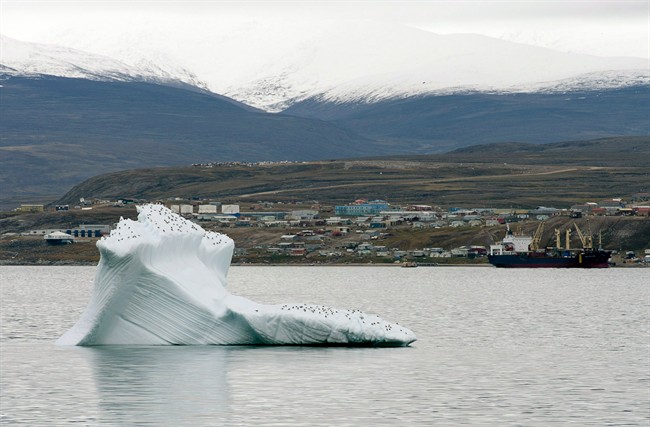
Governments around the North are encouraging industrial development and are at least considering offshore oil drilling. This week in Iqaluit, Canada was host to the inaugural meeting of a business panel to discuss ways of increasing economic activity in the Arctic.
Russia has included representatives from its national oil company among its nominees for the Arctic Economic Council. Rosneft is one of the North’s worst environmental actors, said Khan.
“You can’t really talk about sustainability and Rosneft in the same sentence,” she said.
Still, she said, the poll results suggest governments pushing Arctic industrial development are out of step.
“The will of the people in Canada and in many parts of the world is that we shouldn’t be drilling,” said Khan. “There’s definitely a disconnect between what’s happening in Canada’s Arctic and what people here really want to happen.”
Greenpeace, which has recently made some Inuit friends in the North for its opposition to seismic testing in Davis Strait, isn’t opposed to all Arctic development.
“We don’t think that extractive industries are the only solution for developing the North,” Khan said. “Instead of investing in projects that are going to be destructive of the environment and of many traditional practices in the North, we want to know why our government isn’t exploring alternatives.”
Note to readers: This is a corrected story. A previous version said all circumpolar countries opposed an Arctic refuge.