Environment charities may benefit from new Alberta premier’s vow to fight them

Advertisement

Advertise with us

EDMONTON - Alberta's incoming premier plans to take on environmental charities that he says are blocking exports of the province's oil, but those groups may be saying "bring it on."

Read this article for free:


or

Already have an account? Log in here »

To continue reading, please subscribe:

Subscribe and receive a limited-edition Free Press branded hat or tote.

Digital Subscription

One year of digital access for only $205*

  • Enjoy unlimited reading on winnipegfreepress.com
  • Read the E-Edition, our digital replica newspaper
  • Access News Break, our award-winning app
  • Play interactive puzzles

*First annual payment billed as $205.00 + GST for one year. This annual subscription will automatically renew at $233.00 + GST every 52 weeks (10% off the regular annual price of $259.35). Offer available to new and qualified returning subscribers only. Cancel any time.

To continue reading, please subscribe:

Add Free Press access to your Brandon Sun subscription for only an additional

$1 for the first 4 weeks*

  • Enjoy unlimited reading on winnipegfreepress.com
  • Read the E-Edition, our digital replica newspaper
  • Access News Break, our award-winning app
  • Play interactive puzzles
Start now

*Your next Brandon Sun subscription payment will increase by $1.00 and you will be charged $17.95 plus GST for four weeks. After four weeks, your payment will increase to $24.95 plus GST every four weeks.

Hey there, time traveller!
This article was published 17/04/2019 (2726 days ago), so information in it may no longer be current.

EDMONTON – Alberta’s incoming premier plans to take on environmental charities that he says are blocking exports of the province’s oil, but those groups may be saying “bring it on.”

In his victory speech Tuesday, Jason Kenney repeated his promise to fight back against Canadian environmental groups that take money from American foundations with what he says is the covert aim of economic sabotage by preventing Alberta from exporting oil in any direction but south.

“We have been targeted by a foreign-funded campaign of special interests seeking to landlock Canadian energy,” Kenney said.
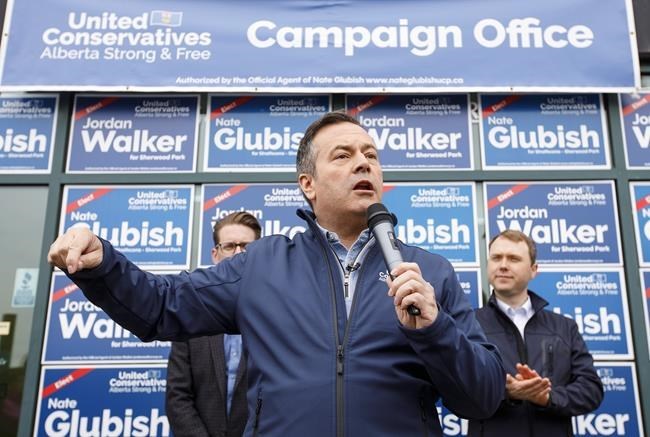
United Conservative Party leader Jason Kenney speaks at a rally before the election, in Sherwood Park Alta, on Monday April 15, 2019. THE CANADIAN PRESS/Jason Franson

The federal Conservative government under Stephen Harper tried the same thing in 2012 by spending $12 million to audit environmental charities the Tories suspected of breaking the rules. Donations to those charities skyrocketed.

Donations to the Tides Canada Foundation, audited (and cleared) in 2012, nearly quadrupled. Figures compiled from federal statistics show the group collected $3.7 million in 2012 and nearly $13 million the next year.

“If Mr. Kenney wants to drive tens of millions of dollars to a few environmental groups, to the detriment of 1,200 other environmental charities in Canada, just do what the previous federal Conservatives did,” said Mark Blumberg, a Toronto lawyer who specializes in charities.

“It would be a major fundraising coup for these few groups and terrible for the charity sector.”

The Rockefeller Brothers Foundation is one of the groups Kenney has accused of conspiring against Canadian oil. But figures on the group’s website show the foundation spends almost six times as much fighting climate change in the U.S. than it does in all other countries combined.

The David Suzuki Foundation, another target, said 90 per cent of its donations come from Canadians — and two-thirds of those are from individuals.

Lead Now was investigated by Elections Canada and cleared last October of violating the rules, despite accusations Kenney made Tuesday.

Joshua Hart, who teaches social psychology at New York’s Union College, said Kenney’s speech fits the technical definition of a conspiracy theory: a small group working in secret to enrich themselves at the expense of others.

Most people believe in at least one, he said. Some may be true. But Hart said some circumstances are more conducive to their spread than others.

“When people are out of political power or when they feel they aren’t in control of circumstances, that’s when they’ll gravitate toward conspiracy theories.”

Mark Busser, who lectures on conspiracy theories at McMaster University, said it works the other way as well. Successful politicians can use such theories to attack enemies.

“This can be a way of pushing back against trends or social movements that can be out of step with their own policy preferences. It’s a way of undermining the legitimacy of critical voices.”

The theory first surfaced in the early 2010s but has resurfaced, appearing recently in opinion columns in mainstream media outlets.

Concerns about Russian meddling in the U.S. presidential election and the Brexit vote may have helped bring it back, said David Tindall, a sociologist at the University of British Columbia. But the two issues shouldn’t be confused, he said.

Any Russian interference would have been to help a specific political party, Tindall said. Environmental groups work with whichever party advances their interests and sometimes switch allegiances.

“It’s not partisan in the same way.”

Besides, he said, climate change crosses borders. Canadians and Canadian groups are involved in other countries as well.

“Climate change is an international issue and Canadians are involved in international issues elsewhere. What does that matter?”

Blumberg said provincial governments have ways of making life difficult for charities. But it may not be worth it.

“The Conservative overreaction to what was, in the end, a very small number of groups doing things they didn’t like was in the end very detrimental to Alberta. (The UCP) need to come up with an approach that will actually result in there being progress on the things that the people of Alberta think are important as opposed to just taking potshots.”

— Follow Bob Weber on Twitter at @row1960

Report Error Submit a Tip

More Stories

Clock ticks down on destruction of records documenting residential school abuses

Marsha McLeod 13 minute read Preview

Clock ticks down on destruction of records documenting residential school abuses

Marsha McLeod 13 minute read Yesterday at 12:49 PM CDT

In less than a year, a private company is set to destroy the largest cache of records detailing the widespread abuse of Indigenous children at residential schools in Canada.

The destruction, which was ordered by an Ontario court in 2014 and later upheld by the Supreme Court, is set to take place on Sept. 19, 2027.

This countdown is igniting emotional conversations that seek to balance the immense historical value of the records alongside the confidentiality survivors were promised as part of the process of providing detailed testimony about abuses they’d suffered.

The records were created as part of the Indian Residential Schools Settlement Agreement, a class-action settlement stemming from survivors who began suing the federal government in the late 1990s over the harm they’d been subjected to at residential schools.

Read
Yesterday at 12:49 PM CDT

Kent Monkman debuts beaver sculpture in Toronto’s ambitious new waterfront park

Alex Nino Gheciu, The Canadian Press 2 minute read Preview

Kent Monkman debuts beaver sculpture in Toronto’s ambitious new waterfront park

Alex Nino Gheciu, The Canadian Press 2 minute read Updated: Yesterday at 3:33 PM CDT

TORONTO - Kent Monkman’s first-ever public art installation is dam good.

The celebrated Cree artist’s new permanent sculpture, dubbed “The Colony,” debuts Wednesday in Toronto’s east end.

The 15-foot-high bronze structure features beavers dancing, feasting and celebrating, evoking Indigenous ceremonies.

It highlights the vital role of beavers in the natural, Indigenous and colonial histories of Turtle Island, says a release.

Read
Updated: Yesterday at 3:33 PM CDT

Six high school hockey programs ceased operations following new Hockey Manitoba policy

Joshua Frey-Sam 7 minute read Preview

Six high school hockey programs ceased operations following new Hockey Manitoba policy

Joshua Frey-Sam 7 minute read Updated: Yesterday at 8:19 PM CDT

She lived the best of both worlds.

For the last three years, the 17-year-old wore a sweater for two different hockey programs — her high school team and AAA club in the Manitoba Female Hockey League — and was preparing to flourish in both colours again this winter.

Recently, however, the blue-liner was disappointed to learn she is no longer eligible to play her Grade 12 season with her school owing to a new policy imposed by Hockey Manitoba that bans players from participating in the Manitoba Women’s High School Hockey League if they are rostered on a U18 AAA team.

The rule applies to all athletes who play for both Winnipeg-based and rural AAA teams.

Read
Updated: Yesterday at 8:19 PM CDT

Volunteer pop-up library axed from Manitoba Youth Centre

Matthew Frank 4 minute read Preview

Volunteer pop-up library axed from Manitoba Youth Centre

Matthew Frank 4 minute read 2:01 AM CDT

Manitoba Corrections has cancelled a pop-up library program at the Manitoba Youth Centre, leaving inmates without librarian services and fewer options to borrow certain books.

The Prison Libraries Committee, part of the non-profit Manitoba Library Association, operated and funded the volunteer program since 2024 before it was shut down by the province last month. The group previously partnered with the province to offer the service because the facility has no dedicated library of its own.

“It is concerning that community members who are incarcerated, especially youth, are losing out on meaningful programming, access to information and rehabilitation efforts, which are offered at no cost to (Manitoba) Corrections. We urge Manitoba Justice to promote more library services and programming, not less,” said a Sept. 24 letter from the non-profit addressed to the justice minister.

Ashley Huot, chair of the Prison Libraries Committee, said she was puzzled when she received an email last month from Manitoba Corrections stating that the pop-up library was no longer needed.

Read
2:01 AM CDT

J’accuse!: Kinew uses French to fry interim Tory leader over alleged caucus subterfuge

Chris Kitching and Maggie Macintosh 4 minute read Preview

J’accuse!: Kinew uses French to fry interim Tory leader over alleged caucus subterfuge

Chris Kitching and Maggie Macintosh 4 minute read Thursday, Oct. 1, 2026

NDP Premier Wab Kinew took a dig at the Progressive Conservatives’ leadership change while facing off with Obby Khan’s short-term replacement for the first time in question period Thursday.

Read
Thursday, Oct. 1, 2026

Mayoral candidate Vogiatzakis criticized for living outside Winnipeg

Malak Abas 4 minute read Preview

Mayoral candidate Vogiatzakis criticized for living outside Winnipeg

Malak Abas 4 minute read Updated: Yesterday at 6:03 PM CDT

A mayoral hopeful took heat from other candidates Friday for living outside Winnipeg while running in the civic election.

Mike Vogiatzakis’s primary residence is in the Rural Municipality of St. Andrews, about 25 kilometres north of Winnipeg — a community with its own mayor and councillors.

But the funeral director said he owns a home in Winnipeg where he divides his time, and he would move to the city full-time if elected mayor.

“It doesn’t matter where a person lives. Why are we dividing St. Andrews and Manitoba and Winnipeg? I’ve met the criteria to run for mayor,” Vogiatzakis said Friday morning.

Read
Updated: Yesterday at 6:03 PM CDT