Here’s where to find every wind turbine in Canada

Advertisement

Advertise with us

Want to know the exact location and specifications of every wind turbine in Canada? The federal government has you covered.

Read this article for free:


or

Already have an account? Log in here »

To continue reading, please subscribe:

Subscribe and receive a limited-edition Free Press branded hat or tote.

Digital Subscription

One year of digital access for only $205*

  • Enjoy unlimited reading on winnipegfreepress.com
  • Read the E-Edition, our digital replica newspaper
  • Access News Break, our award-winning app
  • Play interactive puzzles

*First annual payment billed as $205.00 + GST for one year. This annual subscription will automatically renew at $233.00 + GST every 52 weeks (10% off the regular annual price of $259.35). Offer available to new and qualified returning subscribers only. Cancel any time.

To continue reading, please subscribe:

Add Free Press access to your Brandon Sun subscription for only an additional

$1 for the first 4 weeks*

  • Enjoy unlimited reading on winnipegfreepress.com
  • Read the E-Edition, our digital replica newspaper
  • Access News Break, our award-winning app
  • Play interactive puzzles
Start now

*Your next Brandon Sun subscription payment will increase by $1.00 and you will be charged $17.95 plus GST for four weeks. After four weeks, your payment will increase to $24.95 plus GST every four weeks.

Hey there, time traveller!
This article was published 23/10/2020 (2170 days ago), so information in it may no longer be current.

Want to know the exact location and specifications of every wind turbine in Canada? The federal government has you covered.

Natural Resources Canada has published the Canadian Wind Turbine Database, which contains the precise latitude and longitude of every turbine, along with details like its dimensions, its power output, its manufacturer and the date it was commissioned. There is also an interactive map.

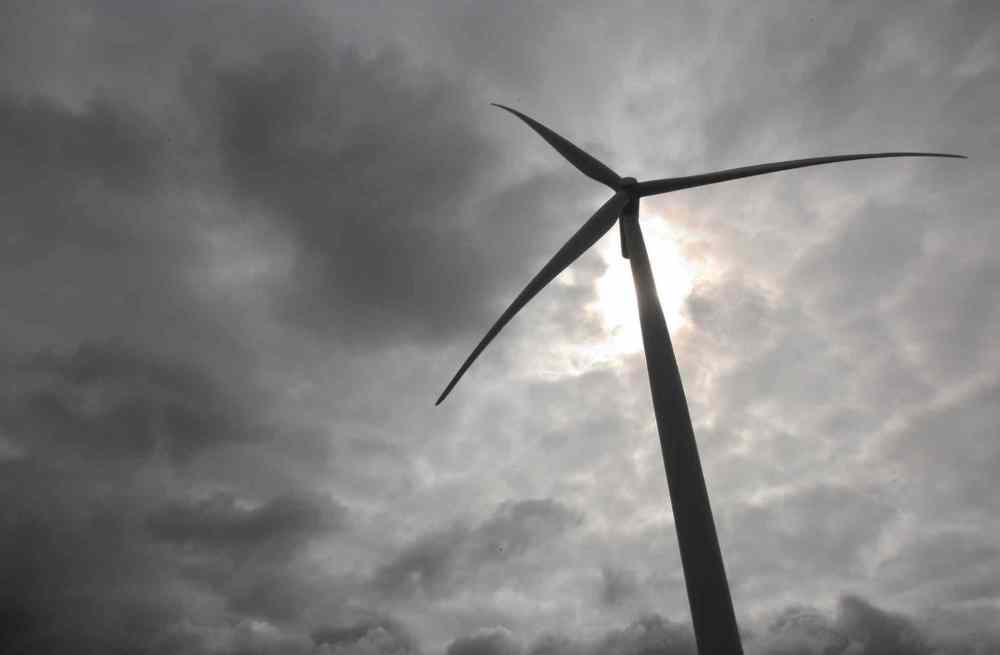
For example, users can see that the largest rotor diameter of any wind turbine in Canada belongs to the Moose Lake Wind Project, northwest of Tumbler Ridge, B.C., which came online last year and is expected by Aeolis Wind Power to “produce energy at a level comparable to large BC Hydro projects, such as the Site C dam.”
JOE BRYKSA / WINNIPEG FREE PRESS

The massive rotors on Moose Lake’s four turbines are 141 metres in diameter, far beyond the average diameter of the 6,698 wind turbines that are tracked in the database, which is 88 metres.

“For the first time, Canadians have access to centralized geographic and technical information on individual wind turbines that make up individual wind farms, (which) were all collected prior to now very much on an aggregated basis,” said Tom Levy, senior wind engineer at the federal Natural Resources Department.

The department’s CanmetENERGY-Ottawa research centre collaborated with the Centre for Applied Business Research in Energy and the Environment at the University of Alberta and the Canadian Wind Energy Association, now part of the Canadian Renewable Energy Association, to put together the project.

The database shows how wind turbines themselves have grown over time, along with the size of the industry.

“They’re getting bigger. They’re getting taller. Their capacity is growing. And their sophistication is growing,” said Levy.

Roughly 60 per cent of Canada’s wind turbines have been commissioned since 2010, with the average age being about nine years old.

British Columbia has the fifth-most turbines by province or territory, at 292. In addition to Moose Lake in the northeast, there are seven other wind farms in B.C. — four more in the northeast, two in the southern Interior and one on Vancouver Island. There is also one turbine on Grouse Mountain in the Vancouver area, a tourist attraction with a panoramic viewing area.

With 2,663 turbines, or about 40 per cent of the country’s total, Ontario has the most overall. About 30 per cent more of Canada’s turbines are in Quebec, with 1,991, and Alberta comes in third, with 900 turbines.

Meanwhile, Nova Scotia has 310 turbines, Saskatchewan has 153, Manitoba has 133, New Brunswick has 119, Prince Edward Island has 104, Newfoundland and Labrador has 27, Northwest Territories has four and Yukon has two.

By showing where wind power exists, it also shows where it isn’t. For one, there are no offshore wind farms across all of Canada. Clean Energy BC says the province has “vast offshore wind potential,” particularly along the north coast.
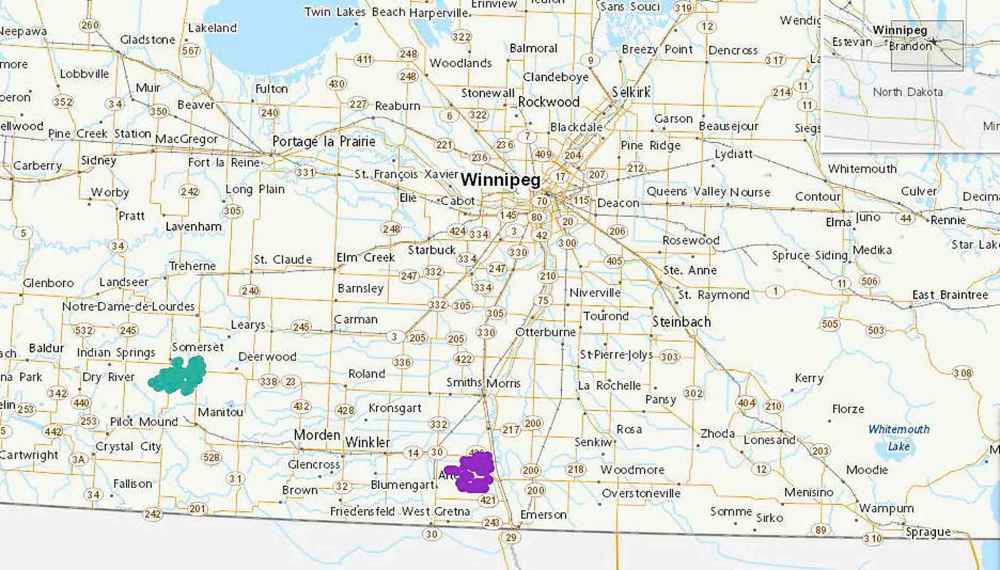
The locations of Manitoba's wind turbines are marked on the Canadian Wind Turbine Database map.

“In each province, there are untapped locations,” said Levy.

“I think it points to the opportunity for more renewable energy, more wind energy, under the right conditions with the right level of community engagement and support, and all the other infrastructure that goes with it, from electric lines to access.”

The database reveals that Danish manufacturer Vestas can put its name to most turbines now installed in Canada, with 1,834.

Vestas narrowly beat out GE, the second-largest manufacturer of installed turbines in Canada, with 1,725. German multinational Siemens can claim the third-largest manufacturing total, at 1,248.

Levy said the government is aiming to update the database about once a year.

Carl Meyer / Local Journalism Initiative / Canada’s National Observer
Report Error Submit a Tip

More Stories

Retired guidance counsellor defends explicit 2025 sex-ed presentation to high school football team in disciplinary hearing

Maggie Macintosh 7 minute read Preview

Retired guidance counsellor defends explicit 2025 sex-ed presentation to high school football team in disciplinary hearing

Maggie Macintosh 7 minute read 7:12 PM CDT

Gus Watanabe, a former employee of Oak Park High School in Winnipeg, was the subject of a public disciplinary hearing on Thursday.

Read
7:12 PM CDT

Here’s where to find every wind turbine in Canada

Carl Meyer, Local Journalism Initiative Reporter, National Observer 4 minute read Preview

Here’s where to find every wind turbine in Canada

Carl Meyer, Local Journalism Initiative Reporter, National Observer 4 minute read Friday, Oct. 23, 2020

Want to know the exact location and specifications of every wind turbine in Canada? The federal government has you covered.

Natural Resources Canada has published the Canadian Wind Turbine Database, which contains the precise latitude and longitude of every turbine, along with details like its dimensions, its power output, its manufacturer and the date it was commissioned. There is also an interactive map.

For example, users can see that the largest rotor diameter of any wind turbine in Canada belongs to the Moose Lake Wind Project, northwest of Tumbler Ridge, B.C., which came online last year and is expected by Aeolis Wind Power to "produce energy at a level comparable to large BC Hydro projects, such as the Site C dam."

The massive rotors on Moose Lake’s four turbines are 141 metres in diameter, far beyond the average diameter of the 6,698 wind turbines that are tracked in the database, which is 88 metres.

Read
Friday, Oct. 23, 2020

Sisters relieved hospital takes accountability after mother’s death

Scott Billeck 6 minute read Preview

Sisters relieved hospital takes accountability after mother’s death

Scott Billeck 6 minute read 6:39 PM CDT

Eight months after losing their mother, two Winnipeg sisters say an internal hospital review has finally given them something they had been seeking since her death: accountability.

Chelsea Mann and Samantha Burns said St. Boniface Hospital officials acknowledged mistakes were made in the care of their mother, Judy Burns, during a recent meeting to discuss the findings of a critical incident review into her death.

The acknowledgement marked a significant departure from an earlier meeting with hospital officials, when they felt their concerns were largely dismissed.

Burns, 68, died on Jan. 21, three days after being admitted, after experiencing rectal bleeding.

Read
6:39 PM CDT

What’s open, what’s closed, what’s up in Winnipeg on National Day for Truth and Reconciliation Sept. 30, 2026

Free Press staff 4 minute read Preview

What’s open, what’s closed, what’s up in Winnipeg on National Day for Truth and Reconciliation Sept. 30, 2026

Free Press staff 4 minute read Sunday, Sep. 27, 2026

The National Day of Truth and Reconciliation, or Orange Shirt Day, as it's known in Manitoba, happens Sept. 30 with many commemorative community events scheduled.

Read
Sunday, Sep. 27, 2026

Storylines aplenty as Jets’ regular season set to begin

Ken Wiebe and Mike McIntyre 9 minute read Preview

Storylines aplenty as Jets’ regular season set to begin

Ken Wiebe and Mike McIntyre 9 minute read 6:25 PM CDT

If the Winnipeg Jets get their way over the course of the coming months, this 84-game redemption tour will extend beyond the regular season.

For the time being, the focus of this group is to leave the disappointment of a 26th-place finish in the rearview mirror and to get back to playing the style that allowed them to be in the Stanley Cup playoffs three consecutive springs before falling eight points short last April.

“We’re just ready for a fresh start where we’re looking ahead, and we’re excited to get the season underway,” captain Adam Lowry said Thursday. “Obviously, a short training camp but I feel like we got up to speed.”

The Boston Bruins will be Friday’s opponent (7 p.m.) in this 16th season opener for the Jets since the franchise relocated back in 2011, and the storylines surrounding the club are plentiful.

Read
6:25 PM CDT

Port of Churchill signs agreement with Dutch port

Aaron Epp 2 minute read Preview

Port of Churchill signs agreement with Dutch port

Aaron Epp 2 minute read Tuesday, Sep. 29, 2026

Arctic Gateway Group, operator of the Port of Churchill, has signed an agreement with the Port of Rotterdam in the Netherlands to attract business and strengthen supply chains linking Western Canada and Europe.

The agreement enables the two ports to work together to develop new trade in critical minerals and energy products, connect Canadian producers with European buyers, and identify opportunities to improve the supply chain from Western Canadian resource projects through Churchill and into European markets.

The Port of Rotterdam is Europe’s largest port and home to more than 3,000 businesses across its industrial complex, serving as a major gateway for critical raw materials and energy.

Meanwhile, the Port of Churchill has been identified as a transformative national strategy for Canada and is emerging as a northern trade corridor connecting Western Canada’s resources to global markets.

Read
Tuesday, Sep. 29, 2026