Canada not on track to hit its first electric car target in 2025
Advertisement
Read this article for free:
or
Already have an account? Log in here »
To continue reading, please subscribe:

Digital Subscription
One year of digital access for only $205*
- Enjoy unlimited reading on winnipegfreepress.com
- Read the E-Edition, our digital replica newspaper
- Access News Break, our award-winning app
- Play interactive puzzles
*First annual payment billed as $205.00 + GST for one year. This annual subscription will automatically renew at $233.00 + GST every 52 weeks (10% off the regular annual price of $259.35). Offer available to new and qualified returning subscribers only. Cancel any time.
To continue reading, please subscribe:
Add Free Press access to your Brandon Sun subscription for only an additional
$1 for the first 4 weeks*
- Enjoy unlimited reading on winnipegfreepress.com
- Read the E-Edition, our digital replica newspaper
- Access News Break, our award-winning app
- Play interactive puzzles
*Your next Brandon Sun subscription payment will increase by $1.00 and you will be charged $17.95 plus GST for four weeks. After four weeks, your payment will increase to $24.95 plus GST every four weeks.
Read unlimited articles for free today:
or
Already have an account? Log in here »
Hey there, time traveller!
This article was published 07/11/2020 (2155 days ago), so information in it may no longer be current.
OTTAWA – National cash rebates convinced more Canadians to buy an electric car in the last 18 months, but Transport Canada says it won’t be enough to hit the first zero-emission vehicle sales targets in 2025.
Transport Canada set targets to have 10 per cent of all light-duty cars be electric by 2025, 30 per cent by 2030 and 100 per cent by 2040. The most recent analysis suggests Canada will only reach between four and six per cent by 2025 and 10 per cent by 2030.
To get there, the federal government introduced the cash rebates for purchases, as well as millions of dollars to build more charging stations, tax credits for businesses that buy electric cars for their fleets and an effort to have automakers set voluntary sales quotas.
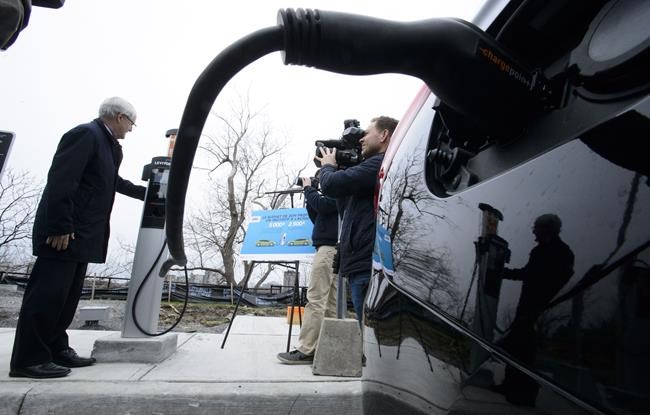
Megan Nichols, the director general of environment policy at Transport Canada, told the House of Commons environment committee in late October that sales have been rising but there are efforts underway to see what else needs to be done.
“We know that additional measures are needed to achieve our sales targets,” said she said in her written brief to the committee Oct. 26.
Nichols and officials from multiple other departments told the committee an array of options are being studied, including sales quotas, offering money to scrap gas cars for electric ones, and making used electric vehicles eligible for federal rebates.
She also said it’s expected the cost of an electric car won’t be on par with a comparable gas model for another five years, noting that likely means purchase rebates will be needed at least until then.
The rebates currently offer up to $5,000 for buying a fully electric car and up to $2,500 for plug-in hybrid models. The maximum purchase price of the lowest-end model can’t be over $45,000.
The $300-million program started in May 2019 and was supposed to last until 2022. But more than $255 million had already been claimed by the end of September.
Transport Minister Marc Garneau has been looking at expanding the program for more than a year now and said this week it is still something he wants to do.
“It’s been an incredibly popular program,” he told The Canadian Press in an interview. “It’s something that I would hopefully like to see continued, but it is something that we’re looking at.”
Joanna Kyriazis, senior policy adviser at Clean Energy Canada, said it’s clear more needs to be done to hit the existing targets. She said on top of extending the existing rebate, used cars should also be eligible, and more should be done to target rebates to Canadians who wouldn’t be able to afford an electric car without them.
“We want to see a few tweaks to that program to make sure that the money is getting to Canadians who need it most done, not those who would have gone out and bought one anyway,” she said.
An electric car mandate that legislates the sales targets is also something that should be considered, she said. Quebec and British Columbia, the only two provinces with both provincial rebates and sales quotas, also accounted for almost eight in 10 electric car purchases.
According to Statistics Canada, electric and plug-in hybrid sales grew from less than one per cent of all light-duty sales in 2015 and 2016, to one per cent in 2017, two per cent in 2018, and 2.7 per cent in 2019.
Data from the lobby group Electric Mobility Canada further shows sales grew to 3.3 per cent in the first half of 2020, a period of time when all car sales were down because of the COVID-19 pandemic.
The group said there are 168,000 electric vehicles on Canadian roads now, less than one per cent of the 23 million light-duty vehicles registered in total.

Transport Canada’s sales targets aim to increase that to 825,000 electric cars registered in 2025, and 2.7 million in 2030.
Currently, light-duty vehicles produce more than one-tenth of Canada’s greenhouse gas emissions, and total emissions from them have grown 10 per cent in the last decade, despite tougher emissions standards for vehicles.
That’s mostly because more cars are on the road and SUVs and pickup trucks, which produce more emissions per kilometre, now account for almost eight in 10 passenger vehicles sold in Canada.
This report by The Canadian Press was first published Nov. 7, 2020.
— With files from Christopher Reynolds.