Future depends on sustainable buildings now
'The technological challenges are no longer an obstacle'

Advertisement
Read this article for free:
or
Already have an account? Log in here »
To continue reading, please subscribe:

Digital Subscription
One year of digital access for only $205*
- Enjoy unlimited reading on winnipegfreepress.com
- Read the E-Edition, our digital replica newspaper
- Access News Break, our award-winning app
- Play interactive puzzles
*First annual payment billed as $205.00 + GST for one year. This annual subscription will automatically renew at $233.00 + GST every 52 weeks (10% off the regular annual price of $259.35). Offer available to new and qualified returning subscribers only. Cancel any time.
To continue reading, please subscribe:
Add Free Press access to your Brandon Sun subscription for only an additional
$1 for the first 4 weeks*
- Enjoy unlimited reading on winnipegfreepress.com
- Read the E-Edition, our digital replica newspaper
- Access News Break, our award-winning app
- Play interactive puzzles
*Your next Brandon Sun subscription payment will increase by $1.00 and you will be charged $17.95 plus GST for four weeks. After four weeks, your payment will increase to $24.95 plus GST every four weeks.
Read unlimited articles for free today:
or
Already have an account? Log in here »
Hey there, time traveller!
This article was published 07/12/2020 (2112 days ago), so information in it may no longer be current.
How do we heat our buildings affordably without fossil fuels?
That was the question at a Sustainable Building Manitoba lunch and learn last week, and it’s an urgent one, experts said. Despite evidence of its detrimental environmental impact, reliance on natural gas is growing in Manitoba, a recipe for climate calamity and economic instability, they said.
While the world is focused on flattening the COVID-19 curve, it’s also imperative for the building industry to decrease its reliance on natural gas, replacing it with cleaner methods, including geothermal heating and passive home design, which reduces energy requirements to keep houses and buildings warm.

“If we continue to do what we’re doing (with regard to heating),” said moderator Curt Hull, the project director of Climate Change Connection, the emissions consequences will lead to “a climate that won’t be able to sustain civilization.”
The good news is, there are options to make energy-efficient buildings with a net-positive impact on the global carbon balance, which scientists warn must decrease substantially — and fast — in order to reach global climate control targets.
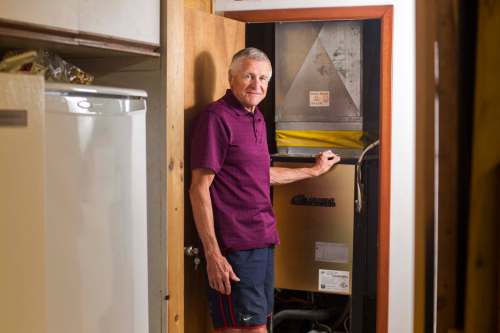
Local expert Donald Proven of Sun Certified Co-op says a good way to start is through the construction of high-performance buildings and the retrofitting of existing ones to reduce energy demand and create potential for energy renewal and heat recovery. Through plant-based materials, high-quality cellulose insulation, and a decreased dependence on natural gas, Proven said it’s clear there’s a pathway to a reduction of energy consumption and natural gas dependency.
Ed Lohrenz of local firm GEOptimize said geothermal energy sources like ground-source, air-source, and lake-source heat pump technology are available, and reduce peak electrical demand by about 40 per cent over dams.
“In our view, the technological challenges are no longer an obstacle,” Proven said.
So what are the obstacles? There’s still a lack of education and awareness of those technological solutions, for one, but mostly, people see the initial price tag and balk, said Proven. But a closer look reveals savings down the road, Hull and Proven both said: savings for both the consumer and the carbon balance.
“When you decide to go down the high performance path, you end up with an economic return almost immediately,” Proven said.
During his presentation, Proven gave the following example: if 5,000 homes are built each year for 10 years, the ownership cost burden — the total cost of owning and maintaining a residence — decreases substantially over time. If those homes are built to standard code, the burden over 60 years is a combined $48 billion. Built to high performance standards over that period, it’s $31 billion, or $283 million per year in savings through superior energy retention.
“And that’s only for single family homes,” he said. If that capital is redirected to retrofit natural or electrically heated homes to use geothermal and subsidize training for trades, “there’s enough capital available to follow this path.”
“This is achievable on a mass scale if we decide to do it,” he said.
Also on the call was Michael Stocki, the vice-president of efficiency programs at Efficiency Manitoba, the province’s newest crown corporation, begun this year, devoted to energy conservation.
Stocki said the crown’s three-year plan to increase energy savings and boost conservation has just begun, but it’s imperative to get on board now.

Between 2011 and 2020, the province actually increased its reliance on natural gas delivery by an average of 1.2 per cent per year each year, Stocki said. That’s “essentially going in the wrong direction.”
Stocki said it ultimately comes down to the economics from both a supply and cost perspective. Builders’ first question when it comes to energy-efficient modelling is frequently centred on up-front costs, and an overall move to fuel-switching would also require a boost to supply.
Those are challenges in terms of adoption of methods such as electrical, geothermal and net-positive technologies, but Stocki said it’s clear that in the long term “energy efficiency is the most cost-effective method.”
Plus, returns on investments are “usually extremely high,” he said, ranging from 20 to over 100 per cent within a few years. Paired with lower utility bills and lower maintenance costs, the savings at a consumer level are hard to deny, he said.
A number of incentivized programs to upgrade to energy efficient systems, including ground source heat pumps, are offered through Efficiency Manitoba, Stocki said.
As Lohrenz said, “kicking the fossil fuel habit” might seem expensive at first, but the value is there. The cost to convert 130,000 single-family homes to geothermal would reduce peak energy demand by 900 megawatts, a reduction in demand greater than the output of the $10.5-billion Keeyask dam project. That conversion would cost $3.9 billion, and would lead to a considerable drop in the cost per kilowatt.
There are hurdles to climb, but the switch from fossil fuels, said Proven, is attainable.“This is achievable on a mass scale if we decide to do it.”
As Hull said, that decision has tremendous implications for the climate. The question of affordability is about more than dollars and cents.
ben.waldman@freepress.mb.ca
Ben Waldman is a National Newspaper Award-nominated reporter on the Arts & Life desk at the Free Press. Born and raised in Winnipeg, Ben completed three internships with the Free Press while earning his degree at Ryerson University’s (now Toronto Metropolitan University’s) School of Journalism before joining the newsroom full-time in 2019. Read more about Ben.
Every piece of reporting Ben produces is reviewed by an editing team before it is posted online or published in print — part of the Free Press‘s tradition, since 1872, of producing reliable independent journalism. Read more about Free Press’s history and mandate, and learn how our newsroom operates.
Our newsroom depends on a growing audience of readers to power our journalism. If you are not a paid reader, please consider becoming a subscriber.
Our newsroom depends on its audience of readers to power our journalism. Thank you for your support.
Heat Pump Costs for Homes
According to furnaceprices.ca, the unit price for a heat pump is similar to that of a new furnace, ranging from $2,500 to $5,000, however, installation can cost as much as $30,000. That up-front cost is offset over time by the savings of a geothermal system, which reduces energy bills by 40 to 60 per cent on average each year. Over time, those savings can reduce the per household ownership burden significantly, saving customers more than the initial investment if enough time is given.
Ben Waldman is a National Newspaper Award-nominated reporter on the Arts & Life desk at the Free Press. Born and raised in Winnipeg, Ben completed three internships with the Free Press while earning his degree at Ryerson University’s (now Toronto Metropolitan University’s) School of Journalism before joining the newsroom full-time in 2019. Read more about Ben.
Every piece of reporting Ben produces is reviewed by an editing team before it is posted online or published in print — part of the Free Press‘s tradition, since 1872, of producing reliable independent journalism. Read more about Free Press’s history and mandate, and learn how our newsroom operates.
Our newsroom depends on a growing audience of readers to power our journalism. If you are not a paid reader, please consider becoming a subscriber.
Our newsroom depends on its audience of readers to power our journalism. Thank you for your support.
Advertisement Advertise With Us
Advertisement Advertise With Us