Alberta considering its options after Supreme Court ruling on carbon tax: Kenney
Advertisement
Read this article for free:
or
Already have an account? Log in here »
To continue reading, please subscribe:

Digital Subscription
One year of digital access for only $205*
- Enjoy unlimited reading on winnipegfreepress.com
- Read the E-Edition, our digital replica newspaper
- Access News Break, our award-winning app
- Play interactive puzzles
*First annual payment billed as $205.00 + GST for one year. This annual subscription will automatically renew at $233.00 + GST every 52 weeks (10% off the regular annual price of $259.35). Offer available to new and qualified returning subscribers only. Cancel any time.
To continue reading, please subscribe:
Add Free Press access to your Brandon Sun subscription for only an additional
$1 for the first 4 weeks*
- Enjoy unlimited reading on winnipegfreepress.com
- Read the E-Edition, our digital replica newspaper
- Access News Break, our award-winning app
- Play interactive puzzles
*Your next Brandon Sun subscription payment will increase by $1.00 and you will be charged $17.95 plus GST for four weeks. After four weeks, your payment will increase to $24.95 plus GST every four weeks.
Read unlimited articles for free today:
or
Already have an account? Log in here »
Hey there, time traveller!
This article was published 25/03/2021 (2018 days ago), so information in it may no longer be current.
EDMONTON – Alberta Premier Jason Kenney says he hopes the Supreme Court decision upholding Ottawa’s right to levy a carbon tax on provinces doesn’t open the door to federal overreach in other areas.
“While we are disappointed with this decision, we have to respect that it’s a majority decision of the Supreme Court of Canada,” Kenney told a news conference Thursday.
“The best we can hope for is that the Supreme Court has invented a one-time-only carbon pricing exception to the Constitutional order.
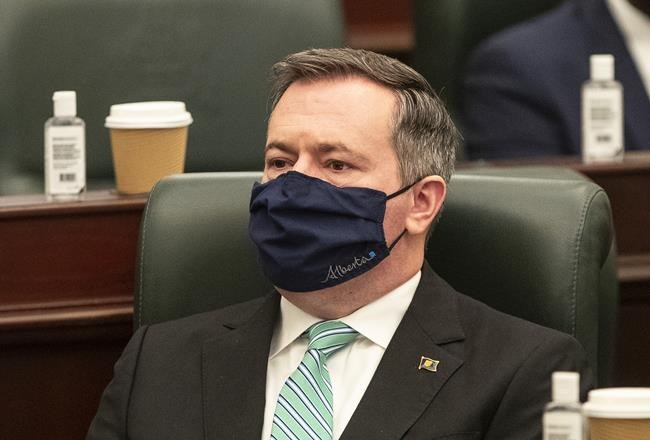
“We’ll continue to fight to defend our exclusive provincial power to regulate our resource industries.”
Kenney said his government will now consider its options, but the guiding principle will be to impose the least cost and hardship on consumers and Alberta industries.
Asked if Alberta will resurrect a provincial carbon tax, Kenney said, “We are going to consult with Albertans and also talk to our allied provinces to determine the best way forward to protect jobs and the economy in Alberta, (and) to minimize the costs of any future policies on this province.”
The high court, in a 6-3 decision, ruled that climate change is a critical threat to the globe and that Canada cannot effectively combat it if each province can go its own way on greenhouse gas emissions.
It was responding to lower court challenges of the tax by Alberta, Saskatchewan, and Ontario.
The dispute revolved around the right of the federal government to legislate on matters of national interest versus provincial rights to develop and manage their natural resources.
Kenney’s United Conservative government campaigned and won the 2019 election around a centrepiece promise to scrap the Alberta NDP consumer carbon tax, which brought in $2 billion a year, most of it returned in rebates with the rest used for green initiatives.
Kenney labelled the NDP tax expensive, ineffective, and unfairly imposed on Albertans without prior notification.
His first bill as premier was to scrap the NDP tax, prompting Ottawa to impose its own fee at the start of 2020.
The federal levy is at $30 a tonne, heading up to $40 a tonne this year and then $50 a tonne by 2022, delivering at that time a projected $2.2 billion from Albertans. About 90 per cent of that levy goes back to Albertans in rebates.
Instead, the Alberta government has focused on taxing heavy emitters to produce revenue to further develop green technologies, calling that a fairer system than charging consumers who need to heat their homes or gas up their cars.
University of Calgary economist Trevor Tombe said the court decision can work for both Alberta and the nation.
A cross-Canada consumer tax, he said, would allow Canada to meet its climate targets while ensuring heavy emitters, such as Alberta’s fossil fuel industries, are not saddled with the lion’s share of the fees.
Tombe said a more level playing field would ease trade friction among provinces by reducing incentives for businesses to leave one jurisdiction to shop for a better green deal in another.
“That matters economically because differences in policy can distort economic activity, shift where businesses are located and that can potentially lower Canada’s productivity.”
Political scientist Duane Bratt said the court decision is another setback on the energy file for a premier who won in 2019 on a promise to “fight back” against those who would impede Alberta’s foundational oil and gas business.
Kenney has since put $1.3 billion into the Keystone XL oil pipeline expansion, only to see it cancelled by the U.S. government.
He created a “war room” called the Canadian Energy Centre to challenge false reports on the industry only to see it get caught up in controversies such as a Tweet-fight with the New York Times and more recently a petition campaign against a children’s Bigfoot cartoon.
Kenney also launched a public inquiry into foreign funding of those seeking to discredit oil and gas.
That inquiry, led by forensic accountant Steve Allan, has gone over time and over budget while being criticized for soliciting reports said to rely on junk climate science and conspiracy theories.
“Since (the 2019 Alberta election) I can’t identify a moment where they (the UCP) have won,” said Bratt, with Mount Royal University in Calgary.
Opposition NDP Leader Rachel Notley, who brought in the original Alberta carbon tax as premier, said Kenney’s “fight back” strategy has been a smoke-and-mirrors show to find scapegoats and divert attention from the fact he can’t adapt to the new energy economy.
“There’s been a lot of hot air from this premier before he was elected and since he was elected,” said Notley. “More and more the hot air is clearing and there is little of substance to see behind it.”
This report by The Canadian Press was first published March 25, 2021.
Related Articles
Premiers vow not to give up on carbon-tax fight
Advertisement Advertise With Us
Advertisement Advertise With Us