Truth Test: Debate claims on climate change, RCMP reform, Afghanistan under scrutiny
Advertisement
Read this article for free:
or
Already have an account? Log in here »
To continue reading, please subscribe:

Digital Subscription
One year of digital access for only $205*
- Enjoy unlimited reading on winnipegfreepress.com
- Read the E-Edition, our digital replica newspaper
- Access News Break, our award-winning app
- Play interactive puzzles
*First annual payment billed as $205.00 + GST for one year. This annual subscription will automatically renew at $233.00 + GST every 52 weeks (10% off the regular annual price of $259.35). Offer available to new and qualified returning subscribers only. Cancel any time.
To continue reading, please subscribe:
Add Free Press access to your Brandon Sun subscription for only an additional
$1 for the first 4 weeks*
- Enjoy unlimited reading on winnipegfreepress.com
- Read the E-Edition, our digital replica newspaper
- Access News Break, our award-winning app
- Play interactive puzzles
*Your next Brandon Sun subscription payment will increase by $1.00 and you will be charged $17.95 plus GST for four weeks. After four weeks, your payment will increase to $24.95 plus GST every four weeks.
Read unlimited articles for free today:
or
Already have an account? Log in here »
Hey there, time traveller!
This article was published 10/09/2021 (1838 days ago), so information in it may no longer be current.
OTTAWA – The Truth Test is a project of The Canadian Press that examines the accuracy of statements made by politicians. Each claim is researched and analyzed to provide Canadians with facts instead of spin.
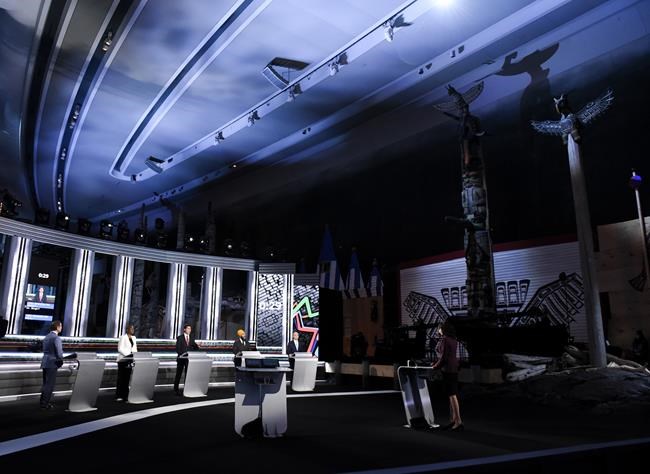
The leaders of five federal political parties shared a stage at the Canadian Museum of History in Gatineau, Que., on Thursday night for the second of the two official televised leaders’ debates.
The Canadian Press examined statements by the party leaders who took part in the English-language debate to put them into context and add the details Canadians need to better understand the claims.
Erin O’Toole, Conservative Party of Canada
“Mr. Trudeau always forgets one fact: he has never made a target for climate change. He never meets his targets.”
Greenhouse gases trap heat in the Earth’s atmosphere, increasing the temperature of the planet — the phenomenon known as global warming that poses a grave threat.
After winning the 2015 general election, Justin Trudeau’s Liberals signed on to the Paris Agreement to the United Nations Framework Convention on Climate Change, pledging to reduce greenhouse gas emissions by 30 per cent below 2005 levels by 2030.
Canada plans to achieve net-zero emissions by 2050.
As a result, it is too early to say that Trudeau has missed an emissions-reduction target.
Justin Trudeau, Liberal Party of Canada
“We are right now on track to exceeding those 2030 targets set (in) Paris down to 36 per cent and we’ve gone even further with that with a concrete plan that the experts have said is the only one that can achieve a 40 per cent reduction. That is what we’re dealing with.”
The initial Liberal plan — reducing greenhouse gas emissions by 30 per cent below 2005 levels by 2030 — was assessed as credible last December by Kathryn Harrison, a political-science professor at the University of British Columbia.
“For the first time, a Canadian government is being honest about what it will take to meet our 2030 target and begin the transition to net-zero emissions,” wrote Harrison, who has studied climate policy for three decades. “Yes, there are costs, but they’re less than the costs of inaction.”
Earlier this year, Trudeau said Canada would step up its fight against global warming, promising to cut greenhouse gas emissions by 40 to 45 per cent over the next nine years. He did not lay out a “concrete plan” to get there.
He said policies including a national carbon price, set to rise steeply to $170 per tonne by 2030, would allow Canada to “blow past” its previous 30 per cent reduction commitment under the Paris Agreement.
How realistic is the revised target?
Critics have pointed out that Canada’s greenhouse gas emissions have actually risen during the Liberal government’s tenure. A June report by veteran earth scientist David Hughes said the oil and gas sector alone would cause Canada to miss its new 40 per cent reduction target.
Before the election, the Liberals promised to soon publish an emissions reduction plan for the 2030 target that would include an interim greenhouse gas objective for 2026. It would be followed by three progress reports before the end of 2027.
The Liberals have outlined several measures to meet their new target. Among them: requiring all passenger vehicles to be zero emission by 2035 and reaching a net-zero electricity grid by the same year.
The party also promises in its election platform to make sure the oil and gas sector reduces emissions from current levels at a pace and scale needed to achieve net-zero by 2050, with five-year targets starting in 2025. However, there are no details on precisely what that would involve.
Even so, these steps could get the Liberals to their goal, said Marc Jaccard, a climate policy modeller and director of the School of Resource and Environmental Management at Simon Fraser University in British Columbia.
“While I haven’t had time to precisely model these latest policies, my triangulation between our many simulations suggests they’ll likely achieve the 40 target, albeit with a larger GDP impact of about 2.5 per cent,” Jaccard wrote in a Sept. 3 article. “These are effective and economically efficient policies.”
Jagmeet Singh, New Democratic Party of Canada
“We’ve got to change the RCMP’s mandate. And that’s something we can do at the federal level. That’s something that Mr. Trudeau said he would do and yet has yet to do.”
Singh stressed the importance of transforming the national police force when asked about interactions between the authorities and Indigenous Peoples.
In the 2020 throne speech, the Liberals promised to move forward on enhanced civilian oversight of law enforcement agencies such as the RCMP, along with other reforms, including a shift toward community-led policing by the Mounties.
Public Safety Minister Bill Blair noted in the latest annual plan for RCMP that a critical focus of the force’s coming work was to become an even more reliable and trusted policing service in the eyes of all Canadians.
The RCMP reported some progress on those goals but, as Singh indicates, there were no bold initiatives from the Liberals following the throne speech.
The Liberal election platform promises several measures, such as giving the force’s current management advisory board full oversight powers and bringing forward clear timelines for compliance with Civilian Review and Complaints Commission recommendations.
Annamie Paul, Green Party of Canada
“Guaranteed livable income is a policy whose time has come. We saw at the beginning of the pandemic, how many people were thrown immediately into financial crisis because our patchwork system simply isn’t working. There is a growing consensus.”
The Greens say a guaranteed livable income, or GLI, would replace separate federal and provincial programs with a single, universal, unconditional cash payment delivered through the tax system.
Every Canadian would receive a regular minimum payment, with incentives for recipients to keep working and earn more. Those earning above a certain total income would pay money back through taxes.
An April 2018 report by the parliamentary budget officer pegged the annual net cost of a federally implemented guaranteed basic income at $44 billion. It said more than 7.5 million people would benefit, with an annual per capita cost between $9,421 and $10,169 for the period 2018-2023.
Support payments devised by the federal government to shepherd workers and families through the COVID-19 pandemic revived interest in a guaranteed income.
However, the idea has detractors concerned about cost and efficiency.
Earlier this year, an expert panel in B.C. recommended against a basic income, instead making dozens of recommendations to help achieve the same goals.
“We have concluded that moving to a system around a basic income for all as its main pillar is not the most just policy option. The needs of people in this society are too diverse to be effectively answered simply with a cheque from the government.”
Yves-François Blanchet, Bloc Québécois
“(T)he problem is that Canada has failed many times to create some strong partnerships with other countries in order to be stronger facing a situation like Afghanistan.”
The Bloc leader suggested Canada’s chaotic scramble to help people flee Afghanistan following the Taliban takeover of Kabul was a result of Canada’s weak ties with allies.
Canada faced criticism for overly bureaucratic procedures and not doing enough to get more people safely on to flights.
But there was sustained teamwork with allies.

Canada toiled with a dozen other countries on a U.S.-led air bridge to help many people, including Canadians and Afghans who had worked with Canadian Forces over the years, to flee the strife-ridden country.
A G7 leaders statement, issued Aug. 24, affirmed commitment to a renewed humanitarian effort by the international community.
“As part of this, our immediate priority is to ensure the safe evacuation of our citizens and those Afghans who have partnered with us and assisted our efforts over the past 20 years, and to ensure continuing safe passage out of Afghanistan,” the statement said.
“We will co-operate together, and with neighbouring and other countries in the region hosting refugees, on a co-ordinated approach to safe and legal routes for resettlement.”
This report by The Canadian Press was first published Sept. 10, 2021.
Related Articles
Liberals win 4th mandate as NDP vote collapses and Singh announces he will resign











Advertisement Advertise With Us
Advertisement Advertise With Us