Australian opposition promises deeper emission reductions

Advertisement

Advertise with us

CANBERRA, Australia (AP) — Australia would set a more ambitious target of reducing its greenhouse gas emissions by 43% by the end of the decade if the government changes hands in elections early next year, the opposition leader said on Friday.

Read this article for free:


or

Already have an account? Log in here »

To continue reading, please subscribe:

Subscribe and receive a limited-edition Free Press branded hat or tote.

Digital Subscription

One year of digital access for only $205*

  • Enjoy unlimited reading on winnipegfreepress.com
  • Read the E-Edition, our digital replica newspaper
  • Access News Break, our award-winning app
  • Play interactive puzzles

*First annual payment billed as $205.00 + GST for one year. This annual subscription will automatically renew at $233.00 + GST every 52 weeks (10% off the regular annual price of $259.35). Offer available to new and qualified returning subscribers only. Cancel any time.

To continue reading, please subscribe:

Add Free Press access to your Brandon Sun subscription for only an additional

$1 for the first 4 weeks*

  • Enjoy unlimited reading on winnipegfreepress.com
  • Read the E-Edition, our digital replica newspaper
  • Access News Break, our award-winning app
  • Play interactive puzzles
Start now

*Your next Brandon Sun subscription payment will increase by $1.00 and you will be charged $17.95 plus GST for four weeks. After four weeks, your payment will increase to $24.95 plus GST every four weeks.

Hey there, time traveller!
This article was published 02/12/2021 (1750 days ago), so information in it may no longer be current.

CANBERRA, Australia (AP) — Australia would set a more ambitious target of reducing its greenhouse gas emissions by 43% by the end of the decade if the government changes hands in elections early next year, the opposition leader said on Friday.

Center-left Labor Party leader Anthony Albanese set climate policy as a battle line at elections expected to be held between March and May.

Prime Minister Scott Morrison was widely criticized at a U.N. climate summit in Scotland last month over his conservative government’s target of reducing Australia’s emissions by only 26% to 28% below 2005 levels by 2030.
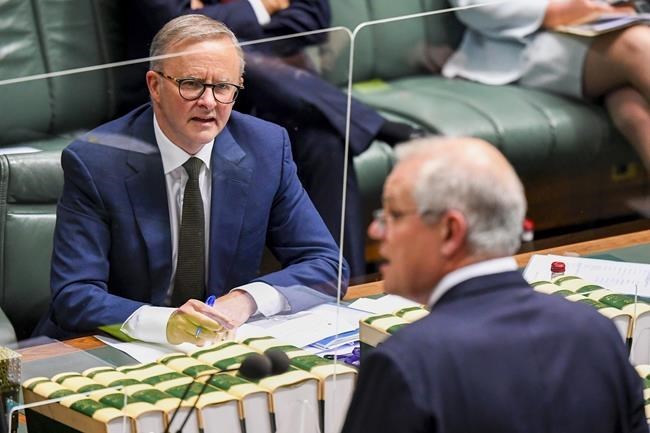
Australian Opposition Leader Anthony Albanese, left, watches as Prime Minister, Scott Morrison speaks during House of Representatives Question Time at Parliament House in Canberra, Thursday, Dec. 2, 2021. Australia's opposition leader says the nation would set a more ambitious target of reducing its greenhouse gas emissions by 43% by the end of the decade if the government changes at elections early next year. (Lukas Coch/AAP Image via AP)

It was the same target Australia adopted at the Paris summit in 2015, while other wealthy countries have pledged far deeper cuts in a bid to contain global warming to less than 1.5 degrees Celsius.

Albanese said a change of government would mean Australia would be able to attend the next international climate and “not be in the naughty corner.”

Australia’s economy was similar to Canada’s and Labor’s goal was similar to the Canadian target of reducing emissions by 40% to 45% by the end of the decade.

“We think that we’ve got absolutely the balance right because one of the things that I wanted to make sure is that we have a policy that doesn’t leave people behind, that supports industry, that supports jobs,” Albanese said.

But Morrison said Labor’s target would increase electricity prices and cost jobs.

“We’re on our way to net zero by 2050,” Morrison said. “We’re not on our way to drive people out of their jobs and force up their electricity price.”

Morrison’s coalition was narrowly re-elected in 2019 when Labor promised to cut emissions by 45% by 2030 and achieve net zero by 2050.

The government has also recently adopted the net zero target.

Morrison was a Cabinet minister in 2014 when a newly elected government repealed Australia’s 2-year-old carbon tax. Government climate policies since have rejected any measures that would make polluters pay for their emissions.

Report Error Submit a Tip

More Stories

Jets mailbag: storylines to watch as countdown to 16th season begins

Mike McIntyre and Ken Wiebe 19 minute read Preview

Jets mailbag: storylines to watch as countdown to 16th season begins

Mike McIntyre and Ken Wiebe 19 minute read Yesterday at 12:00 PM CDT

There’s a chill in the air, which must mean hockey is right around the corner.

Sure enough, the Winnipeg Jets open training camp this week, full of excitement and hope for the upcoming campaign.

However, there are a few other emotions surrounding the club right now, which were evident when we opened up the monthly Free Press mailbag. Specifically when it comes to a certain goaltender who isn’t expected to show his face  while waiting news on a trade he’s demanded.

Among them: Angst. Apathy. Anger.

Read
Yesterday at 12:00 PM CDT

CT-scanner to operate in Dauphin next week

Rylee Gerrard 3 minute read 2:00 AM CDT

BRANDON — A CT-scanner is expected to be operational in Dauphin next week after the city’s hospital closed in early July.

The unit, which is being set up on the grounds of the Dauphin Regional Health Centre, will be in use as of Sept. 23, Health Minister Uzoma Asagwara said Wednesday.

“We were originally told it was going to take many months to have CT up and running … We said that timeline was unacceptable,” Asagwara said.

Dauphin’s emergency department reopened on Sept. 7. The facility was forced to close on July 1 due to significant flooding in its basement that damaged mechanical and electrical systems throughout the building.

Gas turbine peaker plants are a mistake

Don Scott 7 minute read 2:00 AM CDT

Technology respecting electricity generation, storage and grid management is rapidly advancing and displacing gas-fired peaker plants. New battery storage systems are more efficient and less costly, smooth grid flow and are non-polluting. Texas, California and Australia are replacing gas turbine peaker plants with more effective storage batteries.

Solar and wind energy generation combined with battery storage at both the grid and home/business level is the most efficient way to meet peak demand. Building expensive, outdated, polluting American gas turbines, as Manitoba Hydro is proposing, is not in Manitoba’s interest.

Premier Wab Kinew noted that a final decision to build a new turbine power plant in Brandon has not been made. I hope he’s correct, for if Manitoba Hydro already made the decision and entered binding financial obligations with GE Vernova, the PUB’s role was superfluous.

In 2025/26 Nova Scotia Power installed 3 x 50 MW Lithium-ion grid batteries with the storage capacity of over 600 MWh. Installed by Kitchener/Waterloo based Canadian Solar’s subsidiary e-Storage who have operations around the world, they accomplished this in less than two years from the approval date in June 2024. Two were operational within 18 months, the third in 24. The cost was $237 million. At Nova Scotia’s cost per MW, a 750 MW battery peaker facility would cost Hydro $1.185 billion, just 40 per cent of the proposed $3 billion gas peaker plant.

Teenage e-scooter driver in critical condition after crash

Chris Kitching 6 minute read Preview

Teenage e-scooter driver in critical condition after crash

Chris Kitching 6 minute read Updated: Yesterday at 5:50 PM CDT

A teenager riding an e-scooter suffered life-threatening injuries when he was struck by an SUV in southwest Winnipeg on Monday night.

Witnesses provided first aid to the injured rider, who police said is under 18, after the collision happened at Waverley Street and Arbour Meadow Gate/Lake Crest Road at about 9:30 p.m.

“It feels like it happened in slow motion,” said driver Audrey Vanderspek, who was waiting at a red light when she witnessed the incident. “Maybe it’s because you’re helpless, that it just feels like everything slows down in the moment.”

Police said the electric scooter rider was crossing Waverley and was hit by a southbound 2010 Honda CR-V. The posted speed limit on that stretch of Waverley is 70 kilometres per hour.

Read
Updated: Yesterday at 5:50 PM CDT

Letters, Sept. 17

7 minute read 2:00 AM CDT

It’s done here, too

The GLITTER program in Portland was held up last week as a glowing example of progressive, community-minded litter removal that Winnipeg and its downtown agencies should aspire to replicate.

Well, the grass may seem greener, and the encampments a little cleaner, but ask around and you may learn that Winnipeg already has community-led programs doing this work and doing it well.

I can’t fault anyone for raising the merits of a made-in-Portland program for the sake of discussion. After all, it is a timeless Winnipeg pastime to ask why our city lags behind others on any number of trends, programs, or amenities. But the suggestion that “some version” of GLITTER should be considered here falls short when it fails to acknowledge the parallel efforts already delivering results here.

Food literacy curriculum on the menu

Maggie Macintosh 5 minute read Preview

Food literacy curriculum on the menu

Maggie Macintosh 5 minute read Yesterday at 2:01 AM CDT

Manitoba has a new recipe for health class and “food literacy” is a key ingredient.

The in-class portion of phys-ed has historically involved lessons about puberty, the risks of consuming drugs and dissecting Canada’s food guide.

A new pilot program asks teachers to expand their nutrition units and include in-depth discussions about how everything from diet culture to food insecurity affects eating habits.

“This is really moving beyond a conception of food as only fuel, where you just boil down food to its calories, its vitamins,” said Sarah Elvins, a food historian at the University of Manitoba who researches popular culture and marketing.

Read
Yesterday at 2:01 AM CDT