Indigenous leaders say safe drinking water settlement with federal gov’t is unfair

Advertisement

Advertise with us

OTTAWA - The federal government has set aside about $1.5 billion to compensate Indigenous people who have been without clean drinking water, the result of a class-action lawsuit initiated by First Nations communities.

Read this article for free:


or

Already have an account? Log in here »

To continue reading, please subscribe:

Subscribe and receive a limited-edition Free Press branded hat or tote.

Digital Subscription

One year of digital access for only $205*

  • Enjoy unlimited reading on winnipegfreepress.com
  • Read the E-Edition, our digital replica newspaper
  • Access News Break, our award-winning app
  • Play interactive puzzles

*First annual payment billed as $205.00 + GST for one year. This annual subscription will automatically renew at $233.00 + GST every 52 weeks (10% off the regular annual price of $259.35). Offer available to new and qualified returning subscribers only. Cancel any time.

To continue reading, please subscribe:

Add Free Press access to your Brandon Sun subscription for only an additional

$1 for the first 4 weeks*

  • Enjoy unlimited reading on winnipegfreepress.com
  • Read the E-Edition, our digital replica newspaper
  • Access News Break, our award-winning app
  • Play interactive puzzles
Start now

*Your next Brandon Sun subscription payment will increase by $1.00 and you will be charged $17.95 plus GST for four weeks. After four weeks, your payment will increase to $24.95 plus GST every four weeks.

Hey there, time traveller!
This article was published 28/04/2022 (1622 days ago), so information in it may no longer be current.

OTTAWA – The federal government has set aside about $1.5 billion to compensate Indigenous people who have been without clean drinking water, the result of a class-action lawsuit initiated by First Nations communities.

But while the government called the settlement “historic,” people living under the country’s longest boil-water advisory called it unfair and frustrating at a news conference Thursday.

Chief Wayne Moonias of Neskantaga First Nation in Ontario said the 27-year-long advisory is “heartbreaking,” particularly for children who’ve never known clean water.
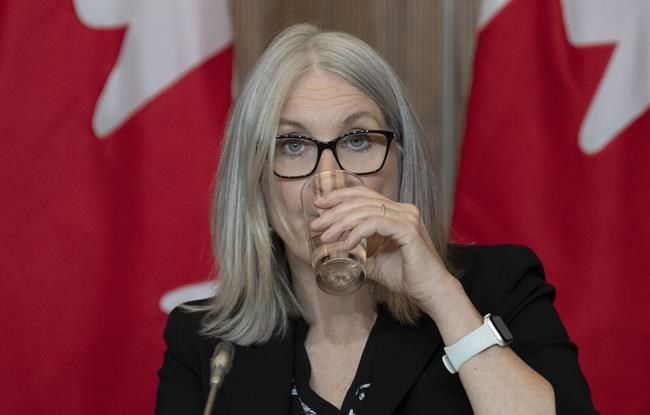
Indigenous Services Minister Patty Hajdu drinks water from a glass as she listens to speakers appearing virtually during a news conference, Thursday, April 28, 2022 in Ottawa. The federal government has set aside about $1.5 billion to compensate Indigenous people who have been without clean drinking water, the result of a class-action lawsuit initiated by First Nations communities. THE CANADIAN PRESS/Adrian Wyld

Community member Roy Moonias said he’s only entitled to claim six years of compensation even though he’s lived under the advisory since 1995.

“That is B.S.,” Moonias said. “Who made that call?”

He said the water treatment plant in Neskantaga is still incomplete, “and our people have lost hope in this project.”

“The government of Canada should be accountable for the wrongdoing of this community,” he said.

The settlement will compensate people living in communities that were subject to a drinking water advisory of at least one year between November 1995 and June 20, 2021.

Tataskweyak Chief Doreen Spence said the class-action lawsuit was intended to make the federal government aware of the injustice faced by Indigenous people.

The lawsuit was initiated by Neskantaga First Nation, Curve Lake First Nation and Tataskweyak Cree Nation in 2019. The court approved a settlement agreement on Dec. 22, 2021.

But representatives from those communities who were invited to speak at Thursday’s news conference said people are still suffering.

Sharon Sakanee, health director for Neskantaga, said people have come to the nursing station with skin rashes caused by the water.

“We are asked to use bottled water to bathe, to cook, to clean, and that’s not acceptable,” she said.

Sakanee’s son was born a month after the water advisory came into effect in 1995. She said he died by suicide in 2012 — shortly before the community declared a state of emergency over suicides — and “he never got to drink clean drinking water since the day he was born, and that’s what all our children today are facing.”

“It’s just another form of genocide,” she said.

Indigenous Services Minister Patty Hajdu said individual compensation will never make up for the harm to people’s lives, but added the government’s commitment of at least $6 billion through the settlement is meant to end all boil-water advisories “once and for all.”

“I agree, nobody should have to fight so hard for basic human rights,” she said.

Spence invited Hajdu to visit her community in Manitoba, which has been under an advisory for five years, to get a better understanding of the living conditions.

In a news release, the government said it “acknowledges the past harms caused to First Nations by a lack of safe drinking water and is firmly committed to supporting these communities by addressing systemic barriers and developing sustainable solutions.”

The settlement also includes a $400 million First Nation Economic and Cultural Restoration Fund, and a promise of “making all reasonable efforts” to repeal the Safe Drinking Water for First Nations Act and introduce a replacement law by the end of the year.

“If we want to build reconciliation, a path to healing, we have to address these basic fundamental rights of individuals,” Chief Moonias said.

The Trudeau government promised to end all long-term boil water advisories when it was first elected in 2015. So far 132 advisories have ended but there are still 33 active in 28 communities.

Tataskweyak elder Eunice Beardy said the prime minister “makes promises but doesn’t keep them.”

“I’m hoping that someday before it’s my time to leave this earth I see that clean water for our young people,” she said.

The settlement claims period is open and people can apply for compensation until next March.

This report by The Canadian Press was first published April 28, 2022.
Report Error Submit a Tip

More Stories

Mayoral candidates Klein, Vogiatzakis continue to snipe over inducement allegations

Chris Kitching and Joyanne Pursaga 6 minute read Preview

Mayoral candidates Klein, Vogiatzakis continue to snipe over inducement allegations

Chris Kitching and Joyanne Pursaga 6 minute read Updated: Yesterday at 5:50 PM CDT

Winnipeg mayoral candidate Mike Vogiatzakis told reporters Monday he will contact the city clerk to report his allegation that rival Kevin Klein offered him a job to drop out of the race.

Vogiatzakis and Klein both doubled down a day after accusing each other of offering the other a position at city hall, if they were victorious in the Oct. 28 election, in exchange for a withdrawal.

“Do I want to get him charged? Not really. I don’t want to destroy anybody’s life,” Vogiatzakis told reporters.

“Kevin’s a good guy. I thought he was a friend of mine, but he’s not. Kevin uses leverage to get ahead, and he tried to use me as leverage.”

Read
Updated: Yesterday at 5:50 PM CDT

Hydro Québec faces issue we should avoid

Editorial 4 minute read Preview

Hydro Québec faces issue we should avoid

Editorial 4 minute read Yesterday at 2:01 AM CDT

You might be tempted to call it a canary in an electric power generation coal mine.

Read
Yesterday at 2:01 AM CDT

Connor powers Jets past Red Wings for first win of season

Ken Wiebe 8 minute read Preview

Connor powers Jets past Red Wings for first win of season

Ken Wiebe 8 minute read Updated: Yesterday at 6:11 AM CDT

DETROIT — Kyle Connor is on a mission.

Whether it’s the baby bump from the birth of his second child or his constant mission to elevate his game and find new ways to score, the Winnipeg Jets left-winger is flying out of the gate and seemingly notching goals at will.

After scoring in the season opener for an NHL record ninth consecutive time, Connor delivered a pair of goals and added an assist in his home state to lead the Jets to a 3-2 victory over the Detroit Red Wings on Sunday afternoon at Little Caesars Arena.

“The sheer amount of volume that he gets and how he gets himself in a good spot, he’s able to get that release off from anywhere,” said Jets forward Cole Perfetti. “His first one was just all skill. What a finish that was and then his second one, just reading the play so well. (Coming) off the pads like that, kind of in front of him and he put it in a small little window top shelf that no goalie could ever save. He doesn’t panic when he gets into those spots, obviously.

Read
Updated: Yesterday at 6:11 AM CDT

Essential workers ruling raises questions

Editorial 4 minute read Preview

Essential workers ruling raises questions

Editorial 4 minute read 2:00 AM CDT

Ever been to a Dynacare clinic? Most of us have been. It’s an amazing demographic and ethnic slice of the city we’ve become. Old patients. Young patients. New arrivals. Long-time Canadians. People who know the ropes — others who are startled by the crowds and the noise and the lockstep forward motion of professionals doing what they have been trained to do. It seems, all at the same time, both chaotic and diagnostic, as names of patients are steadily called out and thousands of tests are performed.

But Dynacare is at the centre of a new kind of test and this time, we’re all in the test tube together.

It’s the first real test for new labour law put in place by the government of Premier Wab Kinew in 2024 — a law that redefined what essential services are for provincially-regulated workplaces. Under this law, companies and their employee and unions must have an agreement of which employees are essential — which ones must stay on the job during a legal strike for the protection of the health and safety of the public.

Dynacare had that kind of essential employee agreement with its staff and union — the company and the union had agreed the employees were not essential.

Read
2:00 AM CDT

MPI lowers speed limit on tech upgrade with ‘IT roadmap’ following Project Nova debacle

Carol Sanders 5 minute read Preview

MPI lowers speed limit on tech upgrade with ‘IT roadmap’ following Project Nova debacle

Carol Sanders 5 minute read Updated: Yesterday at 9:44 PM CDT

Manitoba Public Insurance is now using an “IT road map” and phasing in new technology and systems after pulling the plug last year on its failed $164-million overhaul known as Project Nova, its annual report says.

Read
Updated: Yesterday at 9:44 PM CDT

Clocks stay in daylight saving, but analysis backs permanent standard time

Ashley Joannou, The Canadian Press 5 minute read Preview

Clocks stay in daylight saving, but analysis backs permanent standard time

Ashley Joannou, The Canadian Press 5 minute read Updated: Yesterday at 6:15 AM CDT

VANCOUVER - Ralph Mistlberger's light is adjustable, allowing him to have the full spectrum of options depending on what his internal clock needs.

"You want cool in the morning. You want warm in the evening or warm in the afternoon," he said.

"And so, it goes from being more bluish in the morning to more reddish in the evenings. Both of those are important because artificial light affects your clock."

Mistlberger knows real sunlight is better than a lamp, but after more than 40 years as a neuroscientist studying sleep and the body's circadian rhythms, he's preparing for what's to come Nov. 1.

Read
Updated: Yesterday at 6:15 AM CDT