Alberta premier visits U.S. capital to talk North American energy security

Advertisement

Advertise with us

WASHINGTON - The Alberta government's all-out effort to become America's preferred provider of oil and gas will face a critical moment Tuesday as Premier Jason Kenney delivers his province's sales pitch to some of the most prominent members of the U.S. Congress.

Read this article for free:


or

Already have an account? Log in here »

To continue reading, please subscribe:

Subscribe and receive a limited-edition Free Press branded hat or tote.

Digital Subscription

One year of digital access for only $205*

  • Enjoy unlimited reading on winnipegfreepress.com
  • Read the E-Edition, our digital replica newspaper
  • Access News Break, our award-winning app
  • Play interactive puzzles

*First annual payment billed as $205.00 + GST for one year. This annual subscription will automatically renew at $233.00 + GST every 52 weeks (10% off the regular annual price of $259.35). Offer available to new and qualified returning subscribers only. Cancel any time.

To continue reading, please subscribe:

Add Free Press access to your Brandon Sun subscription for only an additional

$1 for the first 4 weeks*

  • Enjoy unlimited reading on winnipegfreepress.com
  • Read the E-Edition, our digital replica newspaper
  • Access News Break, our award-winning app
  • Play interactive puzzles
Start now

*Your next Brandon Sun subscription payment will increase by $1.00 and you will be charged $17.95 plus GST for four weeks. After four weeks, your payment will increase to $24.95 plus GST every four weeks.

Hey there, time traveller!
This article was published 16/05/2022 (1602 days ago), so information in it may no longer be current.

WASHINGTON – The Alberta government’s all-out effort to become America’s preferred provider of oil and gas will face a critical moment Tuesday as Premier Jason Kenney delivers his province’s sales pitch to some of the most prominent members of the U.S. Congress.

He’ll see some friendly faces, including Sen. Joe Manchin, the swing-vote West Virginia Democrat who has bonded with Kenney over the issue of North American energy security. Others might be less hospitable, like Vermont’s progressive standard-bearer Sen. Bernie Sanders.

Kenney is convinced he has common sense on his side.
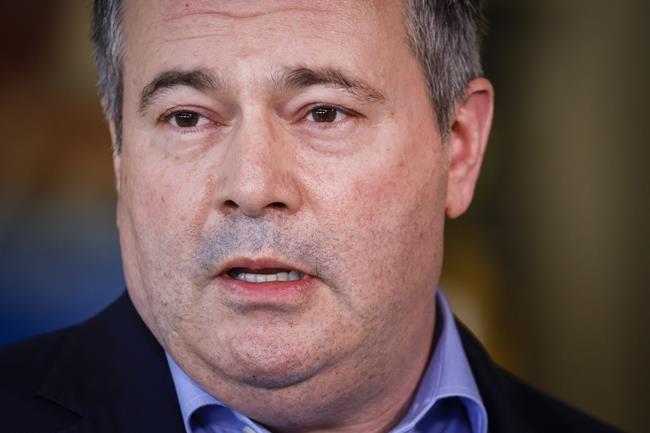
Alberta Premier Jason Kenney provides details on sustainable helicopter air ambulance funding in Calgary, Alta., Friday, March 25, 2022. Alberta Premier Jason Kenney is in the U.S. capital in an effort to convince Capitol Hill lawmakers that his province is their best bet for North American energy security. THE CANADIAN PRESS/Jeff McIntosh

“Alberta is by far the largest source of U.S. energy imports — 10 times more than Saudi Arabia, and five times more than all of OPEC combined. I doubt there’s 100 people in the United States who know that,” the premier said Tuesday in a meeting with Canadian journalists in D.C.

“It is deeply frustrating to us. We don’t even seem to show up on the radar screen when it comes to these discussions.”

That’s why the government has installed former Conservative MP James Rajotte at the Canadian Embassy as Alberta’s U.S. emissary. It is also opening new offices this summer in Denver, Chicago and Seattle and has a slick new US$6-million ad campaign based on the tag line “Look North.”

It’s also why the likes of Energy Minister Sonya Savage and Environment Minister Jason Nixon will be racking up frequent-flyer miles to convince a gridlocked Capitol Hill and seemingly indifferent White House of the energy security solution Kenney believes is staring them in the face.

“I think you can expect to see an Alberta delegation of ministers down here in Washington at least every other month,” he said.

“I was here two months ago, they’re going to be here one month from now — we’re going to be really picking up the tempo of our presence here.”

The hearing, to explore the “energy and minerals” partnership between Canada and the U.S., will also feature virtual testimony from Natural Resources Minister Jonathan Wilkinson, as well as Nathalie Camden, Quebec’s deputy minister of mines, and Electricity Canada president Francis Bradley.

Wilkinson said Monday he expects senators will hear a unified message about the vital role Canada can and should play in securing a reliable and sustainable supply of North American energy.

And it will be in that spirit he will remind the committee of the importance of Line 5, a key energy artery between Alberta and Michigan that Gov. Gretchen Whitmer is actively trying to shut down out of fear of an ecological disaster in the Great Lakes.

“Part of what I will be saying to the committee on Line 5 is, ‘Let’s not actually take steps backwards,'” Wilkinson said in an interview.

“This is an important part of North American energy security. Yes, it’s important for Canada, but there are American states that also get products off this line. So let’s declare that we need to be moving forward.”

The rare spectacle of a premier at a Senate committee comes at the invitation of chairman Manchin, a household name in Washington these days as a critical — and notoriously unreliable — swing vote for Democrats and President Joe Biden in the evenly divided Senate.

Manchin, who has made no secret of his concerns about rampant inflation in the U.S. as well as soaring energy prices, paid a high-profile visit to Alberta last month, where his message seemed torn directly from Kenney’s United Conservative songbook.

Biden, Manchin said, made a grievous error when he cancelled the presidential permits for the Keystone XL pipeline expansion. It would have ultimately added 800,000 barrels a day of capacity to Alberta’s ability to export oilsands bitumen to refineries on the U.S. Gulf Coast.

“The Keystone XL pipeline is something we should have never abandoned. Now we wish we hadn’t,” Manchin said during his visit.

Republicans, mindful of midterm elections this November that are widely expected to deliver a sharp comeuppance to Democrats in Congress and in several key statehouses, have also taken to blaming that decision for a dramatic spike in gas prices.

The truth is more complicated: inflationary pressure from a pandemic spending spree, lingering supply chain issues, a shortage of domestic oil and gas production, soaring demand and Russia’s invasion of Ukraine have all played an outsized role.

Nor would Keystone XL have been completed and operational in time to make a difference, experts say. Even if it was, it would not likely have resulted in enough of a production increase to make much of a dent. Even the project’s original architect, Calgary-based TC Energy Corp., has written it off.

So why keep talking about it?

“Where there’s a will, there’s a way,” said Kenney, acknowledging in the same breath that the original expansion project is well and truly “dead.” The private sector, he said, will never put billions in capital on the line considering the political and regulatory climate surrounding pipelines.

But the Trans Mountain pipeline expansion between Edmonton and the B.C. coast faced the same uncertainty until the federal government “de-risked it” by buying it outright, Kenney said, predicting it would be fully operational in another 15 months, creating capacity for an additional 600,000 barrels a day.

“If the U.S. is serious about this energy problem, all I’m saying is, we’ve got the supply. We just need more infrastructure,” he said.

What’s more, Keystone XL taught the industry in general and TC Energy in particular some valuable lessons, Kenney added. That included the importance of using U.S. steel, engaging more closely with Indigenous stakeholders and taking more seriously the concerns of climate activists and protesters about the potential impact of greater oilsands production.

“All of those issues became irritants. I think we could learn from the mistakes of the last 10 years and figure out how to do this in a more intelligent way,” he said.

“But ultimately, if you want the energy, somebody’s got to build the infrastructure.”

This report by The Canadian Press was first published May 16, 2022.

Report Error Submit a Tip

More Stories

Moving drama at MTYP gives voice to boy who changed law

Holly Harris 5 minute read Preview

Moving drama at MTYP gives voice to boy who changed law

Holly Harris 5 minute read 2:37 PM CDT

The heroic true tale of Norway House Cree Nation-born Jordan River Anderson came home Friday night, as Manitoba Theatre for Young People presented Yvette Nolan’s Jordan.

The touring production, a collaboration with Geordie Theatre, runs weekends through Oct. 11, with additional stops in Toronto, Vancouver and Ottawa’s National Arts Centre.

Having several of Anderson’s family members witness the local première underscored the evening with poignancy. Elder and Pine Creek First Nation member Barbara Nepinak added her own dignified presence and prayers following MTYP artistic director Pablo Felices-Luna’s welcoming remarks.

The season-opener also marks the Winnipeg-raised playwright’s homecoming; the Algonquin playwright, director, dramaturg, actor and educator was a fixture in our local theatre community for many years before going on to serve as artistic director for Native Earth Performing Arts from 2003 to ‘11, among other contributions.

Read
2:37 PM CDT

A day on the campaign trail: Winnipeg's mayor, seeking a second term, does double duty

Malak Abas 12 minute read Preview

A day on the campaign trail: Winnipeg's mayor, seeking a second term, does double duty

Malak Abas 12 minute read Updated: Yesterday at 5:56 PM CDT

In the weeks leading up to the civic election, Scott Gillingham has been performing a juggling act: he’s running to be Winnipeg’s 45th mayor, while still serving as its 44th.

“If someone asks me about the campaign, I’m going to answer them. But I think for most people, I’m the mayor of Winnipeg, even if I’m showing up as a candidate,” Gillingham, 58, says. “I try to do all I can to maintain that distinction.”

The Free Press joined Gillingham on a recent rainy September Saturday on the campaign trail, where he served in both roles during an event-laden day. City council’s final meeting before the Oct. 28 election was days earlier.

In Winnipeg, it’s rare for an incumbent to be defeated. But Gillingham knows his win in 2022 wasn’t exactly a landslide — he won with 27.5 per cent of the vote — and he’s been thinking about his second term ever since.

Read
Updated: Yesterday at 5:56 PM CDT

Mayoral candidate Vogiatzakis criticized for living outside Winnipeg

Malak Abas 4 minute read Preview

Mayoral candidate Vogiatzakis criticized for living outside Winnipeg

Malak Abas 4 minute read Updated: Yesterday at 6:03 PM CDT

A mayoral hopeful took heat from other candidates Friday for living outside Winnipeg while running in the civic election.

Mike Vogiatzakis’s primary residence is in the Rural Municipality of St. Andrews, about 25 kilometres north of Winnipeg — a community with its own mayor and councillors.

But the funeral director said he owns a home in Winnipeg where he divides his time, and he would move to the city full-time if elected mayor.

“It doesn’t matter where a person lives. Why are we dividing St. Andrews and Manitoba and Winnipeg? I’ve met the criteria to run for mayor,” Vogiatzakis said Friday morning.

Read
Updated: Yesterday at 6:03 PM CDT

Volunteer pop-up library axed from Manitoba Youth Centre

Matthew Frank 4 minute read Preview

Volunteer pop-up library axed from Manitoba Youth Centre

Matthew Frank 4 minute read Updated: 11:25 AM CDT

Manitoba Corrections has cancelled a pop-up library program at the Manitoba Youth Centre, leaving inmates without librarian services and fewer options to borrow certain books.

The Prison Libraries Committee, part of the non-profit Manitoba Library Association, operated and funded the volunteer program since 2024 before it was shut down by the province last month. The group previously partnered with the province to offer the service because the facility has no dedicated library of its own.

“It is concerning that community members who are incarcerated, especially youth, are losing out on meaningful programming, access to information and rehabilitation efforts, which are offered at no cost to (Manitoba) Corrections. We urge Manitoba Justice to promote more library services and programming, not less,” said a Sept. 24 letter from the non-profit addressed to the justice minister.

Ashley Huot, chair of the Prison Libraries Committee, said she was puzzled when she received an email last month from Manitoba Corrections stating that the pop-up library was no longer needed.

Read
Updated: 11:25 AM CDT

Kenney in D.C. to make case for Alberta oil & gas

James McCarten, The Canadian Press 6 minute read Preview

Kenney in D.C. to make case for Alberta oil & gas

James McCarten, The Canadian Press 6 minute read Monday, May. 16, 2022

WASHINGTON - The Alberta government's all-out effort to become America's preferred provider of oil and gas will face a critical moment Tuesday as Premier Jason Kenney delivers his province's sales pitch to some of the most prominent members of the U.S. Congress.

He'll see some friendly faces, including Sen. Joe Manchin, the swing-vote West Virginia Democrat who has bonded with Kenney over the issue of North American energy security. Others might be less hospitable, like Vermont's progressive standard-bearer Sen. Bernie Sanders.

Kenney is convinced he has common sense on his side.

"Alberta is by far the largest source of U.S. energy imports — 10 times more than Saudi Arabia, and five times more than all of OPEC combined. I doubt there's 100 people in the United States who know that," the premier said Tuesday in a meeting with Canadian journalists in D.C.

Read
Monday, May. 16, 2022

Letters, Oct. 3

7 minute read 2:01 AM CDT

A morning in the life …

My very first lesson does not start when I walk into that lecture hall, oh no — it starts long before. It begins when I walk to my car, check the estimated arrival time to the University of Manitoba and hope that Winnipeg traffic agrees with it.

A drive that appears completely manageable changes almost immediately when I’m greeted by a tsunami of orange pylons and a line of cars that appears to go on forever. Traffic moves by the inch, lanes magically disappear and the detour I took yesterday now has a detour of its own. These factors make me do a calculation that I have become all too familiar with. How late can I arrive and still find parking, run to my class across campus and get to class with enough time left to make it worth it?

I have grown used to people saying, “Why not just leave earlier?” I do. But when I’m already leaving for my 8:30 a.m. class at 7 a.m., there’s only so much I can do. This drive that some would think is relaxing is one that feels like an assignment that I didn’t know I had to complete and is due at 8:30 a.m.