California outlines plan for scaled back giant water tunnel

Advertisement

Advertise with us

SACRAMENTO, Calif. (AP) — A new plan to reroute how water moves from wetter Northern California to drier Southern California would ferry it through a single, 45-mile (72-kilometer) underground tunnel, wrapping around the state’s existing water delivery system and dumping the water straight into the main aqueduct that sends it south to vast swaths of farmland and millions of people.

Read this article for free:


or

Already have an account? Log in here »

To continue reading, please subscribe:

Subscribe and receive a limited-edition Free Press branded hat or tote.

Digital Subscription

One year of digital access for only $205*

  • Enjoy unlimited reading on winnipegfreepress.com
  • Read the E-Edition, our digital replica newspaper
  • Access News Break, our award-winning app
  • Play interactive puzzles

*First annual payment billed as $205.00 + GST for one year. This annual subscription will automatically renew at $233.00 + GST every 52 weeks (10% off the regular annual price of $259.35). Offer available to new and qualified returning subscribers only. Cancel any time.

To continue reading, please subscribe:

Add Free Press access to your Brandon Sun subscription for only an additional

$1 for the first 4 weeks*

  • Enjoy unlimited reading on winnipegfreepress.com
  • Read the E-Edition, our digital replica newspaper
  • Access News Break, our award-winning app
  • Play interactive puzzles
Start now

*Your next Brandon Sun subscription payment will increase by $1.00 and you will be charged $17.95 plus GST for four weeks. After four weeks, your payment will increase to $24.95 plus GST every four weeks.

Hey there, time traveller!
This article was published 27/07/2022 (1529 days ago), so information in it may no longer be current.

SACRAMENTO, Calif. (AP) — A new plan to reroute how water moves from wetter Northern California to drier Southern California would ferry it through a single, 45-mile (72-kilometer) underground tunnel, wrapping around the state’s existing water delivery system and dumping the water straight into the main aqueduct that sends it south to vast swaths of farmland and millions of people.

The scaled back proposal released Wednesday would build one tunnel to take water from the Sacramento River, the state’s largest, to the California Aqueduct for delivery to millions of people and farmland further south.

It’s a change from the two-tunnel plan championed by former Gov. Jerry Brown and the latest iteration of a project that has been talked about and planned in some form since the 1980s, but never been under construction.
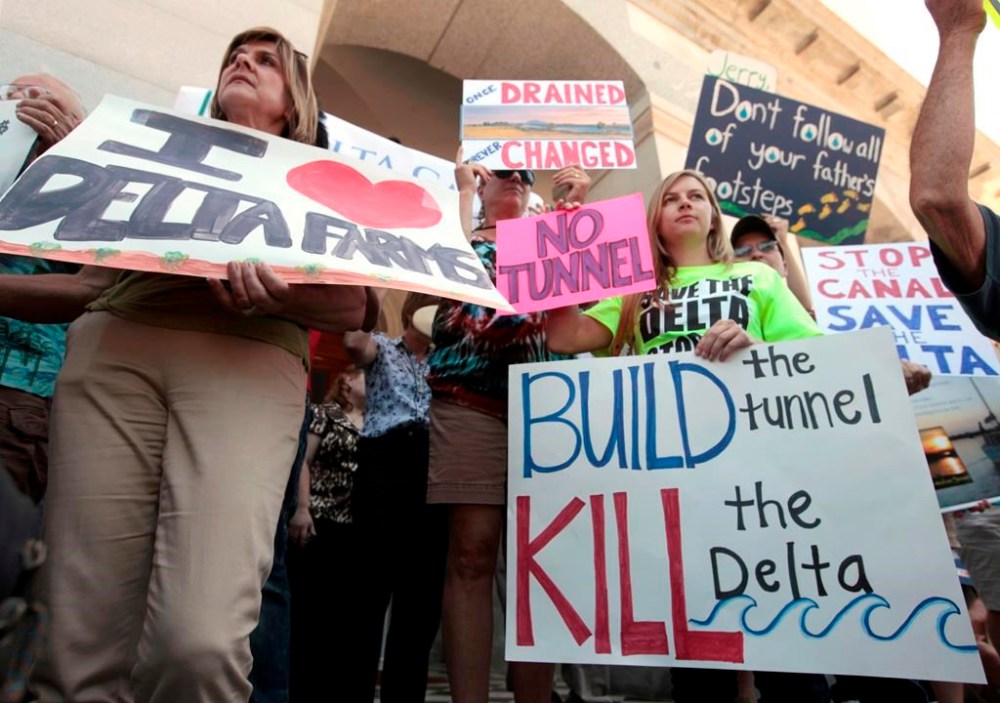
FILE -- Demonstrators rallied at the Capitol to protest a plan announced by Gov. Jerry Brown to build a giant twin tunnel system to move water from the Sacramento-San Joaquin River Delta to Southern California, Wednesday July 25, 2012. Gov. Gain Newsom's administration has scaled the project back to a single tunnel, but the project still has many critics. The state Department of Water Resources released a report on July 27, 2022, outlining their preferred route for the giant water system, which will reroute water from the north to the south. (AP Photo/Rich Pedroncelli, File)

State water officials say the project is badly needed to modernize the state’s water infrastructure in the face of climate change, which scientists say is likely to cause both prolonged droughts and major deluges of rain and snow.

Though California is in the third year of a punishing drought, it also saw record rain falls last October and another major dump of rain and snow in December, some of which the state was unable to capture and store for later use.

“Our water infrastructure was not built for that,” said Wade Crowfoot, secretary of California’s Natural Resources Agency.

The Department of Water Resources plan analyzes the effects of the project on the environment, residents, fish and farmland. Critics say it will harm communities in the fragile Sacramento-San Joaquin River Delta, which rely on water that could instead be diverted to the tunnel.

Officials did not release a price tag for the latest iteration of the project. A prior estimate for a different route put it at about $16 billion, which would ultimately be paid by water agencies that contract with the state to use it, said Carrie Buckman, environmental program manager for the project. If it moves ahead, construction likely wouldn’t break ground until at least 2028 and would take more than a decade.

That preferred route would build two new intake stations that pull water from the Sacramento River just south of the capital city near the small communities of Hood and Courtland.

It would then carry that water underground south alongside Interstate 5 before breaking off toward Bethany Reservoir at the top of the California Aqueduct, the state’s main channel for moving water south, built in the 1960s.

California conveys water through a system known as the State Water Project, which supplies about 27 million people and 750,000 acres (303,400 hectares) of farmland with fresh water. That water comes from the Delta, a vital estuary where the two rivers mingle with tidal flows from the Pacific Ocean.

In the southern end of the Delta, two major state and federally run pumping plants suck up the water and send it south. The proposed tunnel project would instead take the water from the Sacramento River before it reaches the Delta and route it around the system, delivering it below the pumps and into the aqueduct.

The Delta region is home to millions of people, more than 400,000 acres (161,870 hectares) of farmland and critical species like salmon and the Delta smelt. It relies on adequate flows from the two rivers to stay in balance, and advocates in the region worry the tunnel will divert that fresh water before it reaches them.

The state already lacks enough water to keep the Delta flourishing and fulfill its existing contracts to deliver water.

“We believe, once we get into the details, that the proposed project will take out more water,” said Barbara Barrigan-Parrilla, executive director of Restore the Delta.

State officials downplay those doubts, saying the tunnel would only be used at times of year when there is a lot of water pouring through the river, like after a major rainstorm. Had the tunnel existed during a major rain storm last December, the state would have been able to pump 236,000 acre feet of water south, enough to supply about 2.5 million households for a year, Crowfoot said.

Water officials say the chosen path would have the least negative consequences of the various options. Still, the 10-year construction could affect local air quality and would increase greenhouse gas emissions.

Construction would require removing 71 buildings, including 15 homes, as well as overtaking 2,340 acres of farmland and running through cultural resources and sites significant to tribal communities, the report said.

As for fish, the project could hurt both the Delta smelt and the endangered winter-run Chinook salmon, though the state said it has plans to mitigate those impacts. The project could harm water quality by increasing the amount of bromide and chloride as well as the salt content.

Crowfoot, the natural resources secretary, acknowledged managing the Delta is challenging but said the newly approach strikes a better balance than previous attempts.

“It is a conundrum to be able to manage the Delta in a way that protects the environment, respects the communities that live there and provide for the water supplies for a large portion of the state,” he said.

The Metropolitan Water District of Southern California is the state’s largest water contractor, using water from the Delta to help supply 19 million people. The district is working to expand its water supply with non-Delta sources, but the project is critical to provide flexibility and ensure the state is capturing all of the water that it can, said Adel Hagekhalil, the district’s general manager.

Report Error Submit a Tip

More Stories

May be whiff of truth to ex’s odour ardour

Maureen Scurfield 5 minute read 2:01 AM CDT

DEAR MISS LONELYHEARTS: I ran into an old boyfriend I used to curl on a team with, and we went for drinks. We’ve been almost eight years apart, and I couldn’t remember why we broke up, as we always had such a great time together.

It wasn’t until the second date — this time on a weekend — that it came back to me, with a jolt. Pee-yew! I remembered he doesn’t use deodorant on weekends. Why? He enjoys his own body odour. I recalled that a bit too late, and it was just as awful as ever! I went home early.

Tonight, he called and I refused him another date. I said, “Think back. You remember why we broke up?” Then he said, “Oh yeah, you hated my no-deodorant weekend policy. Well, guess what? Some women don’t mind!” I said I really doubted that, and that ended the conversation. Miss L., wouldn’t any women find stinky underarms offensive?

— Sensitive Nose, Fort Richmond

A day on the campaign trail: Winnipeg's mayor, seeking a second term, does double duty

Malak Abas 12 minute read Preview

A day on the campaign trail: Winnipeg's mayor, seeking a second term, does double duty

Malak Abas 12 minute read Updated: Yesterday at 5:56 PM CDT

In the weeks leading up to the civic election, Scott Gillingham has been performing a juggling act: he’s running to be Winnipeg’s 45th mayor, while still serving as its 44th.

“If someone asks me about the campaign, I’m going to answer them. But I think for most people, I’m the mayor of Winnipeg, even if I’m showing up as a candidate,” Gillingham, 58, says. “I try to do all I can to maintain that distinction.”

The Free Press joined Gillingham on a recent rainy September Saturday on the campaign trail, where he served in both roles during an event-laden day. City council’s final meeting before the Oct. 28 election was days earlier.

In Winnipeg, it’s rare for an incumbent to be defeated. But Gillingham knows his win in 2022 wasn’t exactly a landslide — he won with 27.5 per cent of the vote — and he’s been thinking about his second term ever since.

Read
Updated: Yesterday at 5:56 PM CDT

California outlines plan for scaled back giant water tunnel

Kathleen Ronayne, The Associated Press 6 minute read Preview

California outlines plan for scaled back giant water tunnel

Kathleen Ronayne, The Associated Press 6 minute read Wednesday, Jul. 27, 2022

SACRAMENTO, Calif. (AP) — A new plan to reroute how water moves from wetter Northern California to drier Southern California would ferry it through a single, 45-mile (72-kilometer) underground tunnel, wrapping around the state’s existing water delivery system and dumping the water straight into the main aqueduct that sends it south to vast swaths of farmland and millions of people.

The scaled back proposal released Wednesday would build one tunnel to take water from the Sacramento River, the state's largest, to the California Aqueduct for delivery to millions of people and farmland further south.

It's a change from the two-tunnel plan championed by former Gov. Jerry Brown and the latest iteration of a project that has been talked about and planned in some form since the 1980s, but never been under construction.

State water officials say the project is badly needed to modernize the state's water infrastructure in the face of climate change, which scientists say is likely to cause both prolonged droughts and major deluges of rain and snow.

Read
Wednesday, Jul. 27, 2022

Volunteer pop-up library axed from Manitoba Youth Centre

Matthew Frank 4 minute read Preview

Volunteer pop-up library axed from Manitoba Youth Centre

Matthew Frank 4 minute read 2:01 AM CDT

Manitoba Corrections has cancelled a pop-up library program at the Manitoba Youth Centre, leaving inmates without librarian services and fewer options to borrow certain books.

The Prison Libraries Committee, part of the non-profit Manitoba Library Association, operated and funded the volunteer program since 2024 before it was shut down by the province last month. The group previously partnered with the province to offer the service because the facility has no dedicated library of its own.

“It is concerning that community members who are incarcerated, especially youth, are losing out on meaningful programming, access to information and rehabilitation efforts, which are offered at no cost to (Manitoba) Corrections. We urge Manitoba Justice to promote more library services and programming, not less,” said a Sept. 24 letter from the non-profit addressed to the justice minister.

Ashley Huot, chair of the Prison Libraries Committee, said she was puzzled when she received an email last month from Manitoba Corrections stating that the pop-up library was no longer needed.

Read
2:01 AM CDT

Khan should’ve taken high road: Goertzen

Carol Sanders 5 minute read Preview

Khan should’ve taken high road: Goertzen

Carol Sanders 5 minute read Yesterday at 6:39 PM CDT

The veteran Progressive Conservative who championed Obby Khan’s leadership bid says the former Blue Bomber dropped the ball by dissing his Tory teammates before he stepped down.

“I wouldn’t recommend it, and I didn’t recommend it,” Kelvin Goertzen (Steinbach) said in an interview Friday.

Khan resigned as PC leader and quit the caucus Monday saying some members were secretly plotting his ouster, even after he won a confidence vote on Sept. 25.

On Tuesday, Khan lashed out in a CJOB interview, naming the alleged plotters, saying constituents deserved to know which of their elected representatives “lacked moral integrity.” Khan told the Free Press he was “deeply emotionally hurt,” and felt stabbed in the back.

Read
Yesterday at 6:39 PM CDT

Brandonmeat packer thriving on its own

Abiola Odutola 3 minute read Preview

Brandonmeat packer thriving on its own

Abiola Odutola 3 minute read 2:01 AM CDT

BRANDON — Canada Packers has strengthened its business and laid the foundation for future growth during its first year as an independent company, its president says.

The Brandon-based pork producer, separated from Maple Leaf Foods in October 2025, established its own leadership, strategy, systems, culture and identity while continuing operations across its hog production farms and regional hog barns in southern and eastern Manitoba.

The company’s first year was focused on building a successful standalone business while continuing to serve customers, communities and shareholders, president Dennis Organ said.

“Market conditions over the past year have been more challenging than we anticipated when we became a separate entity,” he said in an email. “Despite that, we continued to execute against our priorities, including increasing processing volumes, maintaining disciplined operations and strengthening the business.”

Read
2:01 AM CDT