Life gradually returns a year after fire chars Sierra Nevada
Advertisement
Read this article for free:
or
Already have an account? Log in here »
To continue reading, please subscribe:

Digital Subscription
One year of digital access for only $205*
- Enjoy unlimited reading on winnipegfreepress.com
- Read the E-Edition, our digital replica newspaper
- Access News Break, our award-winning app
- Play interactive puzzles
*First annual payment billed as $205.00 + GST for one year. This annual subscription will automatically renew at $233.00 + GST every 52 weeks (10% off the regular annual price of $259.35). Offer available to new and qualified returning subscribers only. Cancel any time.
To continue reading, please subscribe:
Add Free Press access to your Brandon Sun subscription for only an additional
$1 for the first 4 weeks*
- Enjoy unlimited reading on winnipegfreepress.com
- Read the E-Edition, our digital replica newspaper
- Access News Break, our award-winning app
- Play interactive puzzles
*Your next Brandon Sun subscription payment will increase by $1.00 and you will be charged $17.95 plus GST for four weeks. After four weeks, your payment will increase to $24.95 plus GST every four weeks.
Read unlimited articles for free today:
or
Already have an account? Log in here »
Hey there, time traveller!
This article was published 10/08/2022 (1527 days ago), so information in it may no longer be current.
LONE PINE, Calif. (AP) — The flames fade away. Firefighters extinguish the last embers. A final curl of smoke uncoils in the wind.
A wildfire in the California wilderness has come to an end, and what’s left behind is a blackened landscape of skeletal pines and leafless oaks, scorched meadows and ashen stumps where saplings once stood.
Then, slowly, life returns.
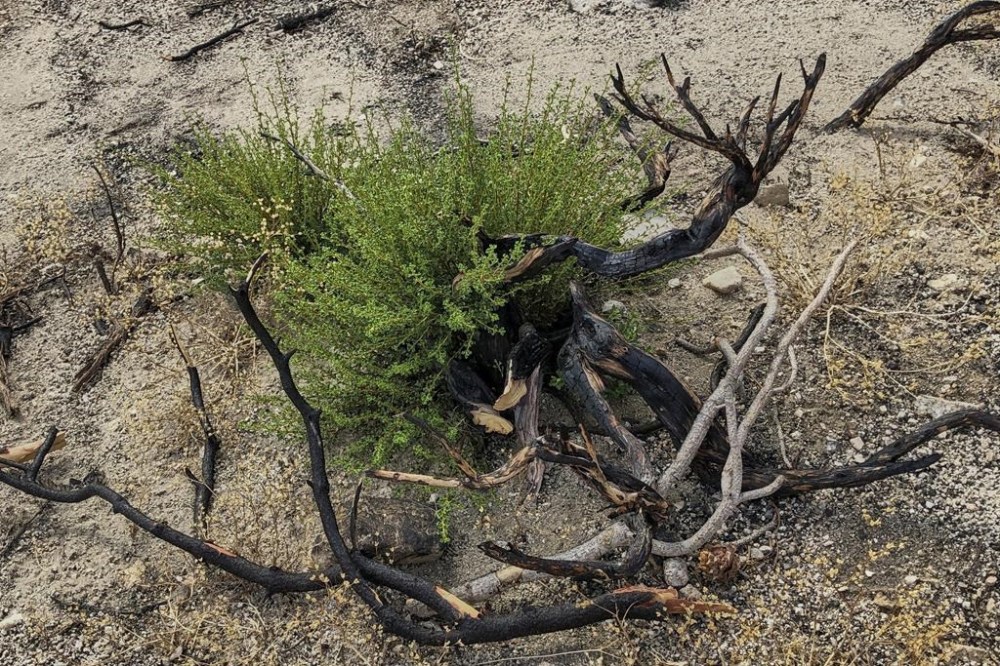
One year after a wind-whipped wildfire charged across a craggy mountainside above Lone Pine, California, flashes of new growth are emerging in this still-charred corner of the Inyo National Forest, a hiking, camping and fishing playground about 350 miles (563 km) southeast of San Francisco.
Tiny clusters of white and purple wildflowers stand out against denuded pines, many stripped of bark in the fire. Green shoots of horsetail as thin as yarn strands break from the ground below a tree’s barren branches. A fistful of new leaves emerges like a fresh bouquet from within an incinerated stump.
It’s the start of a long recovery, and a cycle that’s being repeated more often across the West as climate change brings drier, hotter seasons and more wildland fires.
As it roars across the landscape, a fire burns at different intensities. Some of the towering trees on the hillside are dead, others only singed and can recover. The first plants to reappear after a burn typically have grown more resistant over time to the flames.
“Some of the shrub species and other grass species are more fire-adapted, and they can come back quicker,” said Todd Ellsworth, a post-fire restoration program manager with the U.S. Forest Service.
But it can be five years before the ground cover returns to what it was before the blaze. One stand of pinyon pines was heavily damaged – needles burned off the branches, their trunks torched black – and will not come back.
“The conifer trees don’t come back very quickly,” Ellsworth said, referring to certain pines and other trees that bear cones. Sometimes, it’s up to foresters to go in and replant them.
The tiny, fragile flowers and patches of fresh growth against a stark mountainside and slabs of gray rock were a reminder that wildfire is part of the ecosystem in California, including the eastern Sierra Nevada where the fire took place.
Firefighters said they used minimum-impact techniques to fight the blaze because “natural fire plays an important role in maintaining the landscape within these areas.”
Some species only flower after a wildfire.
The area of the blaze — not far from the trailhead to Mt. Whitney, at 14,505 feet (4,421 meters) the highest mountain the contiguous United States — is home to Sierra Nevada bighorn sheep, an endangered species, and to the whitebark pine, an endangered species candidate.
News reports and press releases from June and July 2021 attributed the wildfire to a lightning strike and said the nearly 600-acre (243-hectare) blaze fanned by winds forced evacuations and cut off access to nearby roads, hiking trails and campgrounds. Firefighters used helicopters to dump water on the fire, which burned across rugged terrain.
The effects of climate change can be significant on forest regeneration.
One 2018 study in the journal Ecology Letters that looked at nearly 1,500 wildfire sites found that because of hotter and drier climates, fewer forests are returning to their pre-burn tree mix, and in some cases trees did not return at all.
Camille Stevens-Rumann, an assistant professor at Colorado State University and co-author of the study, said wildfires have become larger and more intense, killing more trees, while also happening more frequently.
“We have a lot of places that are probably climatically different than when those (conifer) species were established,” she said, which means they can struggle when trying to recover after a burn.
If a hotter, drier climate is unsuitable for those trees to come back, “they won’t recover,” she added.