US changes names of places with racist term for Native women

Advertisement

Advertise with us

CHEYENNE, Wyo. (AP) — The U.S. government has joined a ski resort and others that have quit using a racist term for a Native American woman by renaming hundreds of peaks, lakes, streams and other geographical features on federal lands in the West and elsewhere.

Read this article for free:


or

Already have an account? Log in here »

To continue reading, please subscribe:

Subscribe and receive a limited-edition Free Press branded hat or tote.

Digital Subscription

One year of digital access for only $205*

  • Enjoy unlimited reading on winnipegfreepress.com
  • Read the E-Edition, our digital replica newspaper
  • Access News Break, our award-winning app
  • Play interactive puzzles

*First annual payment billed as $205.00 + GST for one year. This annual subscription will automatically renew at $233.00 + GST every 52 weeks (10% off the regular annual price of $259.35). Offer available to new and qualified returning subscribers only. Cancel any time.

To continue reading, please subscribe:

Add Free Press access to your Brandon Sun subscription for only an additional

$1 for the first 4 weeks*

  • Enjoy unlimited reading on winnipegfreepress.com
  • Read the E-Edition, our digital replica newspaper
  • Access News Break, our award-winning app
  • Play interactive puzzles
Start now

*Your next Brandon Sun subscription payment will increase by $1.00 and you will be charged $17.95 plus GST for four weeks. After four weeks, your payment will increase to $24.95 plus GST every four weeks.

Hey there, time traveller!
This article was published 08/09/2022 (1481 days ago), so information in it may no longer be current.

CHEYENNE, Wyo. (AP) — The U.S. government has joined a ski resort and others that have quit using a racist term for a Native American woman by renaming hundreds of peaks, lakes, streams and other geographical features on federal lands in the West and elsewhere.

New names for nearly 650 places bearing the offensive word “squaw” include the mundane (Echo Peak, Texas), peculiar (No Name Island, Maine) and Indigenous terms (Nammi’I Naokwaide, Idaho) whose meaning at a glance will elude those unfamiliar with Native languages.

Nammi’I Naokwaide, located in traditional lands of the Shoshone and Bannock tribes in southern Idaho, means “Young Sister Creek.” The tribes proposed the new name.
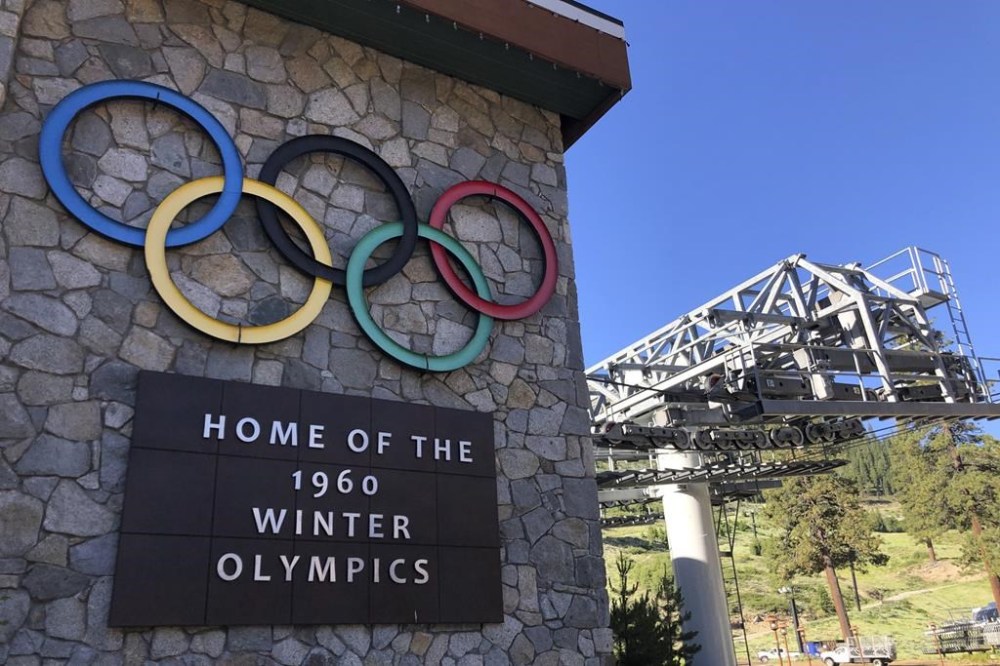
FILE - A sign marking the 1960 Winter Olympics is seen by a chairlift at what was then called Squaw Valley Ski Resort, July 9, 2020, in Olympic Valley, Calif. The U.S. government has joined a ski resort and others that have quit using a racist term for a Native American woman by renaming hundreds of peaks, lakes, streams and other geographical features on federal lands in the West and elsewhere. (AP Photo/Haven Daley, File)

“I feel a deep obligation to use my platform to ensure that our public lands and waters are accessible and welcoming. That starts with removing racist and derogatory names that have graced federal locations for far too long,” Interior Secretary Deb Haaland said in a statement.

The changes announced Thursday capped an almost yearlong process that began after Haaland, the first Native American to lead a Cabinet agency, took office in 2021. Haaland is from Laguna Pueblo in New Mexico.

The Native American Rights Fund, a nonprofit legal organization, welcomed the changes.

“Federal lands should be welcoming spaces for all citizens,” deputy director Matthew Campbell said in a statement. “It is well past time for derogatory names to be removed and tribes to be included in the conversation.”

Haaland in November declared the term derogatory and ordered members of the Board on Geographic Names, the Interior Department panel that oversees uniform naming of places in the U.S., and others to come up with alternatives.

Haaland meanwhile created a panel that will take suggestions from the public on changing other places named with derogatory terms.

Other places renamed include Colorado’s Mestaa’ėhehe (pronounced “mess-taw-HAY”) Pass near Mestaa’ėhehe Mountain about 30 miles (48 kilometers) west of Denver. The new name honors an influential translator, Owl Woman, who mediated between Native Americans and white traders and soldiers in what is now southern Colorado.

The Board on Geographic Names approved changing the mountain’s name in December.

While the offensive term in question, identified as “sq___” by the Interior Department on Thursday, has met wide scorn in the U.S. only somewhat recently, changing place names in response to broadening opposition to racism has long precedent.

The department ordered the renaming of places carrying a derogatory term for Black people in 1962 and those with a derogatory term for Japanese people in 1974.

The private sector in some cases has taken the lead in changing the offensive term for Native women. Last year, a California ski resort changed its name to Palisades Tahoe.
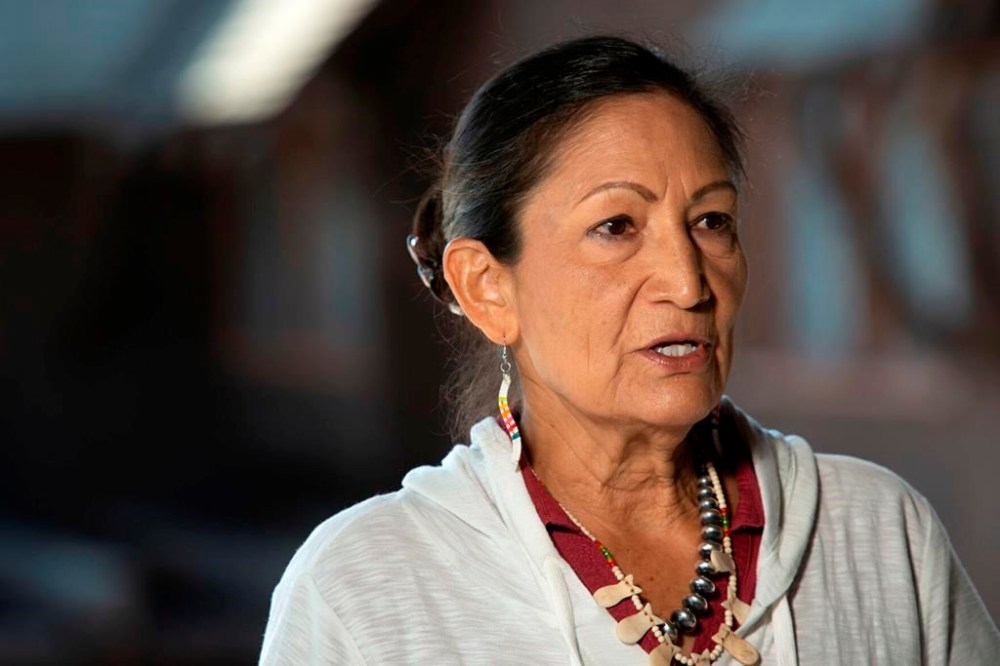
FILE - Secretary of the Interior Deb Haaland speaks at a news conference in Yellowstone National Park on Friday, July 8, 2022. The U.S. government has joined a ski resort and others that have quit using a racist term for a Native American woman by renaming hundreds of peaks, lakes, streams and other geographical features on federal lands in the West and elsewhere. Haaland in November declared the term derogatory and ordered members of the Board on Geographic Names, the Interior Department panel that oversees uniform naming of places in the U.S., and others to come up with alternatives. (Rachel Leathe/Bozeman Daily Chronicle via AP, File)

A Maine ski area also committed in 2021 to changing its name, two decades after that state removed the slur from names of communities and landmarks, though it has yet to do so.

The term originated in the Algonquin language and may have once simply meant “woman.” But over time, the word morphed into a misogynist and racist term to disparage Indigenous women, experts say.

California, meanwhile, has taken its own steps to remove the word from place names. The state Legislature in August passed a bill that would remove the word from more than 100 places beginning in 2025.

Democratic Gov. Gavin Newsom has until the end of September to decide whether to sign the bill into law.

___

Adam Beam in Sacramento, California, contributed to this report.

___

Follow Mead Gruver at https://twitter.com/meadgruver
Report Error Submit a Tip

More Stories

US changes names of places with racist term for Native women

Mead Gruver, The Associated Press 5 minute read Preview

US changes names of places with racist term for Native women

Mead Gruver, The Associated Press 5 minute read Thursday, Sep. 8, 2022

CHEYENNE, Wyo. (AP) — The U.S. government has joined a ski resort and others that have quit using a racist term for a Native American woman by renaming hundreds of peaks, lakes, streams and other geographical features on federal lands in the West and elsewhere.

New names for nearly 650 places bearing the offensive word “squaw” include the mundane (Echo Peak, Texas), peculiar (No Name Island, Maine) and Indigenous terms (Nammi’I Naokwaide, Idaho) whose meaning at a glance will elude those unfamiliar with Native languages.

Nammi’I Naokwaide, located in traditional lands of the Shoshone and Bannock tribes in southern Idaho, means "Young Sister Creek." The tribes proposed the new name.

“I feel a deep obligation to use my platform to ensure that our public lands and waters are accessible and welcoming. That starts with removing racist and derogatory names that have graced federal locations for far too long,” Interior Secretary Deb Haaland said in a statement.

Read
Thursday, Sep. 8, 2022

Students from France visit Winnipeg to learn about soldiers who helped liberate their country

Aaron Epp 4 minute read Preview

Students from France visit Winnipeg to learn about soldiers who helped liberate their country

Aaron Epp 4 minute read Saturday, Sep. 26, 2026

Travelling nearly 7,000 km from his home in France to Winnipeg gave Gabriel Zaranski a new perspective on warfare.

“It’s very different to speak about war in school (than) to speak with real people who (have fought) in a war,” he said. “We can feel the emotion when they speak … The testimony has more impact when it’s real soldiers.”

Zaranski is one of 14 Grade 12 students from Bayeux, a town in France’s Normandy region, in Winnipeg this week for a learning tour.

The students, who attend Lycée Arcisse de Caumont high school, met on Saturday with veterans from the Queen’s Own Cameron Highlanders of Canada, a local military regiment, to discuss their studies and the regiment’s role in the Second World War.

Read
Saturday, Sep. 26, 2026

Museum warehouse holds the history of electrical power in Manitoba

Sheldon Birnie 8 minute read Preview

Museum warehouse holds the history of electrical power in Manitoba

Sheldon Birnie 8 minute read 6:00 AM CDT

The work it takes to bring any endeavour to light is rarely, if ever, seen by those who look upon the final result — be that a creative work such as a feature film or a museum display.

Since 2001, the Manitoba Electrical Museum and Education Centre, located at 680 Harrow St., has provided thousands of visitors with a century’s worth of history on electrical power in Manitoba.

“Everyone who comes in here is amazed at how much we can pack into such a small space,” says executive director Beryth Strong, who took on the role last November.

The museum is open to the public Tuesday to Saturday from 1 to 4 p.m. and hosts large groups of students throughout the school year. While the museum itself boasts numerous displays featuring approximately 220 electrical artifacts, including household appliances, computers, telephones, technical gear and much more, along with a collection of nearly 20,000 photos documenting major electrical construction projects, its warehouse just south of McGillivray Boulevard houses thousands more unique items.

Read
6:00 AM CDT

Restaurants ‘under pressure’

Gabrielle Piché 5 minute read Preview

Restaurants ‘under pressure’

Gabrielle Piché 5 minute read Friday, Sep. 25, 2026

Happy hour outings are on Jackie Piggott’s calendar — but even those are fewer.

She and her husband might visit a restaurant once a month. It’s a change over the past year: earlier, they might go twice, thrice or weekly.

“It’s something that we’ve talked about, my husband and myself, just because the pricing is so expensive,” Piggott said, stopping during a grocery run in St. Vital. “It’s also better for our health.”

She’s in the majority: a new Restaurants Canada report found 80 per cent of Canadians are eating out less frequently because of higher living costs, up from 75 per cent in 2025.

Read
Friday, Sep. 25, 2026

Bombers let another one slip away and face pivotal issue

Taylor Allen 7 minute read Preview

Bombers let another one slip away and face pivotal issue

Taylor Allen 7 minute read Saturday, Sep. 26, 2026

Mike O’Shea summed it up best.

“That one doesn’t feel very good.”

Nor should it.

The Winnipeg Blue Bombers started out hot Friday night, only to run out of gas down the stretch and allow the visiting Toronto Argonauts to steal a 30-28 victory.

Read
Saturday, Sep. 26, 2026

Wab Kinew as ‘communicator in chief’

Paul G. Thomas 6 minute read Preview

Wab Kinew as ‘communicator in chief’

Paul G. Thomas 6 minute read 2:00 AM CDT

Premier Wab Kinew and his party have been riding high in the polls longer than normal for a government one year or less away from its first re-election contest. One reason is his ubiquitous, dominating communications presence as NDP leader and premier.

The argument here is that Kinew has supplemented his prerogatives as premier and party leader (such as appointing cabinet ministers and approving party nominations) with the skilful use of communications to advance his policy agenda, boost his personal popularity and maintain the competitive advantage of his party over the opposition Progressive Conservatives.

Communications has always been a significant part of politics and policy making. However, in the contemporary political and media environments, communications considerations have moved from the background to the foreground of decision-making by political parties, including when they are performing in the role of government. Campaigning and governing now overlap in what has been described as a permanent election campaign.

Political parties use communications strategies for several purposes: to establish an image of the leader which makes a positive emotional connection with voters; to promote a coherent message and to keep party members on message; and to gain favourable media coverage for its policies and other actions on almost a daily basis.

Read
2:00 AM CDT