B.C. drought benefits some farmers, extending harvest and reducing rot

Advertisement

Advertise with us

VANCOUVER - British Columbia is enduring a record-breaking dry spell, but farmer Amir Mann says the drought is far preferable to other recent weather extremes.

Read this article for free:


or

Already have an account? Log in here »

To continue reading, please subscribe:

Subscribe and receive a limited-edition Free Press branded hat or tote.

Digital Subscription

One year of digital access for only $205*

  • Enjoy unlimited reading on winnipegfreepress.com
  • Read the E-Edition, our digital replica newspaper
  • Access News Break, our award-winning app
  • Play interactive puzzles

*First annual payment billed as $205.00 + GST for one year. This annual subscription will automatically renew at $233.00 + GST every 52 weeks (10% off the regular annual price of $259.35). Offer available to new and qualified returning subscribers only. Cancel any time.

To continue reading, please subscribe:

Add Free Press access to your Brandon Sun subscription for only an additional

$1 for the first 4 weeks*

  • Enjoy unlimited reading on winnipegfreepress.com
  • Read the E-Edition, our digital replica newspaper
  • Access News Break, our award-winning app
  • Play interactive puzzles
Start now

*Your next Brandon Sun subscription payment will increase by $1.00 and you will be charged $17.95 plus GST for four weeks. After four weeks, your payment will increase to $24.95 plus GST every four weeks.

Hey there, time traveller!
This article was published 14/10/2022 (1459 days ago), so information in it may no longer be current.

VANCOUVER – British Columbia is enduring a record-breaking dry spell, but farmer Amir Mann says the drought is far preferable to other recent weather extremes.

“You can always apply more water, but it’s hard to get rid of water,” he said, referring to B.C.’s historic floods last November.

Mann and others involved in agriculture say the downside of the drought, which has required some crops to be irrigated, is offset by benefits such as a longer harvesting period and little rot.
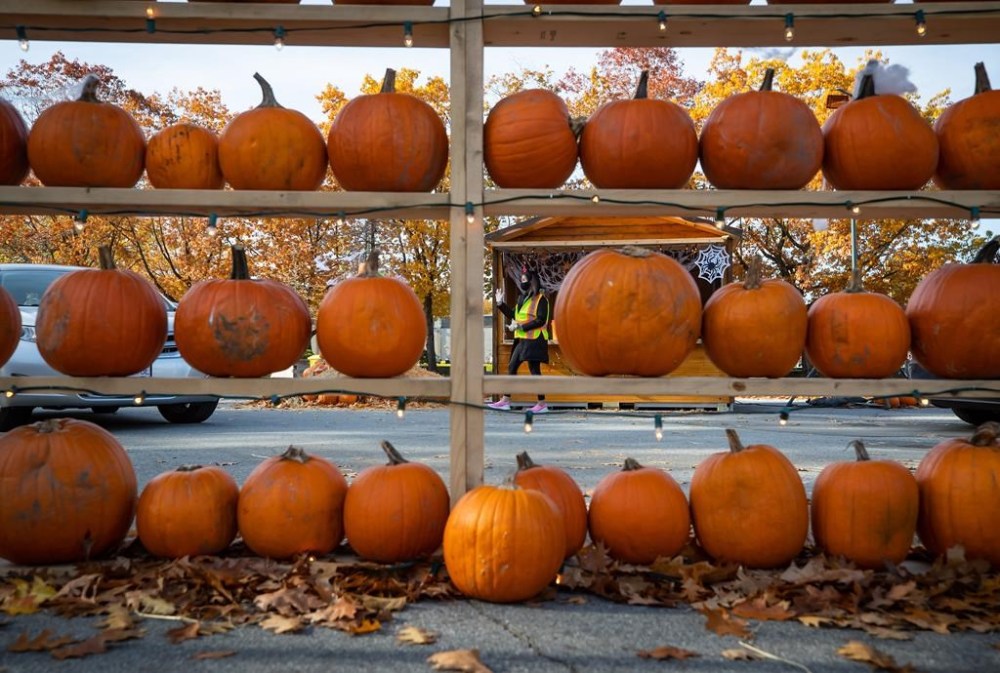
A worker is framed by a display of pumpkins while handing out candy to children during a drive-thru trick-or-treating Halloween event, at the Pacific National Exhibition grounds in Vancouver, on Saturday, Oct. 31, 2020. Agriculture experts in British Columbia say the record-setting drought has created favourable harvesting conditions for most crops this fall. THE CANADIAN PRESS/Darryl Dyck

BC Agriculture Council presidentStan Vander Waal said fall’s dry spell had been useful to many farmers, after a wet spring.

“There’s nothing better than having a dry fall for farmers to get crop out of the field and to manage crops,” he said in an interview.

“We had very adequate moisture, actually a little too much in the beginning. As long as they can get enough cover on the crop before the conditions start drying up, the moisture will retain enough to finish the crop off.”

Mann, who runs Mann Farms in Abbotsford, harvests a variety of crops including strawberries, raspberries, blueberries, pumpkins, corn, gourds, squash and grapes.

“Because it’s been so dry, we have very little rot and the quality is amazing,” he said, pointing to his pumpkin crop as an example.

“It’s beneficial in regard to having no fungus and we don’t have to spray pesticides. It’s the end of the season and what we’ve noticed is the pumpkin quality has been exceptional — nice, hard pumpkins (that are) bright orange, the stem is nice and strong, and there’s very little fungus.”

However, he said, irrigation is essential. Farms without sophisticated irrigation systems, that instead rely on rain to water their crops, have likely fared worse, he added.

Sean Smulker, an associate professor in the faculty of land and food systems at the University of British Columbia, said the impacts of a drought depend on its timing in the crop production cycle.

“What farmers are looking for is the total number of productive days over the summer period, and if it’s been impacted in the beginning or the end, that’s shaving away from that productivity and potentially impacting their yields and profitability,” he said.

“Ideally, you’d be dry on both ends (of the season) and you’d be able to compensate much easier with some irrigation.”

Vander Waal said he doesn’t foresee any major long-term impact on agriculture unless the drought extends through the winter, which is too early to predict.

“Our biggest concern would be what’s going to happen over the winter. The snowpack is critical in that it provides irrigation water for a lot of areas,” he said.

Vander Waal noted that government-imposed water restrictions could be a concern in some areas of the province, saying farmers should be prioritized.

“If we want to keep the food supply alive, we also need to make sure we have water for the food supply,” he said.

Mann said there are risk mitigation strategies farmers should adopt to prepare for extreme weather events. For instance, he said unfavourable strawberry yields led to the farm finding an alternative growing option: a strawberry greenhouse, which now allows the farm to harvest berries for 10 months of the year.

“Price fluctuations, market conditions and costs are all ever-changing, weather is always ever-changing, so as a farmer, you have to be able to provide either a consistent crop or high quality and you can’t do that based off the weather that we’re having. You have to be able to just do something a little bit above and beyond,” he said.

Smulker said farmers are working to “build farm resilience” to extreme weather events caused by climate change, including improved drainage and irrigation systems.

“Certainly there are a suite of technologies that can be deployed to make the farming system more efficient terms of labour, in terms of nutrients, and those all helped build resilience as well,” he said.

Vander Waal agreed, adding that the government should also adopt a more sustainable water storage system.

“In agriculture, the key to success is ultimately recognizing that these climate change events are real, and they continue to happen. So, if we recognize the fact that we have surplus water at certain times of the year, the importance is to make sure we’re storing that water so we can use it when we need it,” Vander Waal said.

“There’s this balancing act, and this is where government, from a policy point of view, can really, really can help.”

This report by The Canadian Press was first published Oct. 14, 2022.

Report Error Submit a Tip

More Stories

Today’s horoscope

Georgia Nicols 4 minute read Preview

Today’s horoscope

Georgia Nicols 4 minute read 2:00 AM CDT

MOON ALERT: There are no restrictions to shopping or important decisions. The moon is in Scorpio.

ARIES (March 21-April 19)

Tread carefully as it’s easy to get into an argument, especially with your kids or even a romantic partner. Very likely the dispute will be about mutual expenses, shared property or perhaps differing values. Do what you can to keep the peace.

TAURUS (April 20-May 20)

Read
2:00 AM CDT

A Life's Story: Writer built bridges with genuine curiosity, compassion for diversity of religious practices

Janine LeGal 6 minute read Preview

A Life's Story: Writer built bridges with genuine curiosity, compassion for diversity of religious practices

Janine LeGal 6 minute read Saturday, Oct. 10, 2026

Brenda Suderman knew how to make people feel comfortable. For a journalist, that character trait is a real strength, and it made people trust and appreciate her.

Whether covering musicals, worship spaces, the effects of pandemic shutdowns, death rituals and practices of different traditions, the discovery of the burial of 2,284 infants in unmarked graves, or any other of the countless topics she wrote about in her four- decade career, Suderman did it with genuine interest and care.

Born and raised in Winkler, Suderman grew up on a farm. Much of her childhood was spent in gardens and sugar beet fields.

Baptized at 16, she became a member of the Winkler Bergthaler Mennonite Church. The restrictions against women at the time contributed to planting the seeds of Suderman’s feminist perspective.

Read
Saturday, Oct. 10, 2026

Backstreet Boys extend Toronto residency to 11 nights

The Canadian Press 2 minute read Preview

Backstreet Boys extend Toronto residency to 11 nights

The Canadian Press 2 minute read Yesterday at 2:11 PM CDT

TORONTO - Hit '90s boyband The Backstreet Boys are adding more tour dates to their Toronto residency.

What was first announced as a four-night run at Rogers Centre has swelled to 11 shows, with the band's recent announcement they're adding concerts on March 5 and 6.

The band says on its website the new dates were added "due to overwhelming demand."

Dubbed “Into the Millennium – Homecoming: Live in Canada,” the residency will kick off on Feb. 12.

Read
Yesterday at 2:11 PM CDT

Towing company hands stolen car back, but not to owner

By Matthew Frank 4 minute read Preview

Towing company hands stolen car back, but not to owner

By Matthew Frank 4 minute read Friday, Oct. 9, 2026

A Manitoba man says he is dumbfounded after his car was stolen, impounded by a Winnipeg towing company and given back — to someone that wasn’t him.

Cody Lamb lives in the western Manitoba community of Douglas, about 18 kilometres east of Brandon, but spends weeks away from home working on oil rigs in Alberta.

The 24-year-old says on Sept. 11, while away for work, he heard from his girlfriend who told him his car wasn’t in their driveway. Lamb reported the car stolen to Brandon RCMP the same day.

After filing the report, he heard from Steinbach RCMP on Oct. 1 that his car was recovered that day in the community of Mitchell, roughly five km west of Steinbach.

Read
Friday, Oct. 9, 2026

Late philanthropist, family fill Harvest’s Empty Bowls with record-setting $5-M donation

Morgan Modjeski 3 minute read Preview

Late philanthropist, family fill Harvest’s Empty Bowls with record-setting $5-M donation

Morgan Modjeski 3 minute read Friday, Oct. 9, 2026

It was a record-breaking night for Harvest Manitoba made possible by a genuine Winnipeg hero and his family.

The organization’s annual Empty Bowls Celebrity Auction Dinner on Thursday raised $6.5 million to support Manitobans facing hunger and food insecurity.

And it was a $5-million legacy donation from late city philanthropist Doug Harvey and his family that will see the event go down in the history books as the largest gala fundraising total ever recorded in Manitoba.

“There was literally nothing that lit my dad up more than contributing himself, but even more so, inspiring others to give,” his daughter Lauren Harvey said Friday.

Read
Friday, Oct. 9, 2026

Manitoba e-scooter legislation changes set to impose speed limit, age restrictions, sidewalk ban

Matthew Frank 5 minute read Preview

Manitoba e-scooter legislation changes set to impose speed limit, age restrictions, sidewalk ban

Matthew Frank 5 minute read Updated: Yesterday at 5:14 PM CDT

People riding e-scooters and other personal electric vehicles in Manitoba will have to strap on a helmet, stay off sidewalks and follow new age limits once new provincial rules for the devices take effect next year.

The vehicles, which also include electric skateboards, hoverboards and unicycles, will fall under The Highway Traffic Act starting in 2027, according to the province’s website. E-bikes are excluded from the new rules, according to the province’s frequently-asked-questions page.

All riders must be at least 16 years old and wear properly fitting helmets — that goes for passengers, too, the province said.

The proposed new legislation sets a speed limit of 25 km/h and would prohibit personal electric vehicles from sidewalks unless signs specifically allow sidewalk use. Riders would be using shared paths or roads with speed limits of 50 km/hr or less. They won’t be allowed to operate the vehicles under the influence of alcohol or drugs and they must use hand signals and obey traffic signs.

Read
Updated: Yesterday at 5:14 PM CDT